Total Pageviews

Showing posts with label gemstone. Show all posts

Wednesday, June 27, 2012

Finding Gemstone Deposits:

Ruby crystal on calcite
photo by Rob Lavinsky

Gems have been prized for thousands of years, for their color, luster, durability, hardness and their high intrinsic value per volume.  They are found in all kinds of geologic environments of all ages from thousands of million years to recent times.  Gemstones are also found in all kinds of rocks ranging from igneous to metamorphic to sedimentary and are classified according to the environment where they were formed.  The deposits are rare because of the geological conditions needed to form them are exceptional.  For example, in order for the Emerald to form the beryllium from which it is made has to come in contact with chromium or vanadium.  These elements travel in entirely different geochemical circles that are the exception rather than the rule.

It is important to realize that like any other commodity, gems are subject to the laws of supply and demand.  Even though the demand for gems remains about the same the supplies are becoming depleted.  Many of the gems especially the colored variety are mined in Third World countries by artesianal methods, i.e. by hand.  In any of these countries the discovery of the new deposit often leads to a local prosperity, but many of these stones become involved in the illegal trade that is being used to finance terrorism.

Sapphire crystal
Photo by Rob Lavinsky


These deposits of gemstones are volcanic in origin and are formed deep within the Earth’s crust.  Gemstones from this origin have formed over 100 Km below the surface and are brought to the surface as the result of magma intrusions or lava flows.  Diamonds are one type of this deposit that has formed from 100 to 150 Km below the surface.  These gemstones are found in potassium rich stone called “kimberlite” that is brought to the surface in an explosive eruption that proceeds at near supersonic speeds.  There seems to be a rule known as Clifford's rule that these eruptions take place in Achaean terranes or come up through younger terranes overlying Achaean terrenes.  Kimberlite is quite rich in peridot and appears to be full of xenoliths that are torn off the walls of the magma channel.  A cross-sectional view of the kimberlite is like looking at a carrot.  The stone itself is quite soft and easily eroded away with the diamonds being carried away with the rest of the erosion products.

Diamonds are not the only product that is found in a magmatic deposit so are others stones such as sapphires and zircons.  Sapphires are also formed under some very specific geological conditions the most important one is a magmatic stone that is low in primary silicates such as basalt.  The sapphires form as crystals in the basalt and they're released as products of erosion.  Although they form in the basalt they are rarely mined directly.  Zircons are another example of a gemstone that is found in a magmatic deposit.  Once again these gemstones are not mined directly from the stone that are found as the products of erosion.  In geology zircons are thought to be forever and the oldest dated minerals in the world are some zircons that were found in Western Australia that were dated at 4.5 billion years old.  Zircons are used by geochemists worldwide for dating formations of different ages, and are highly effective in this use.

Some other gemstone minerals that are found in magmatic deposits include:
Peridot, gem quality olivine usually found in mantle xenoliths.
Labradorite, found as gem quality grains in some basalts.
Zircon, found as crystals in granite, basalt and the rarer carbonatites.
Apatite, found as crystals in carbonatites.
Garnets, found as crystals in basalts as xenocrysts and granite.
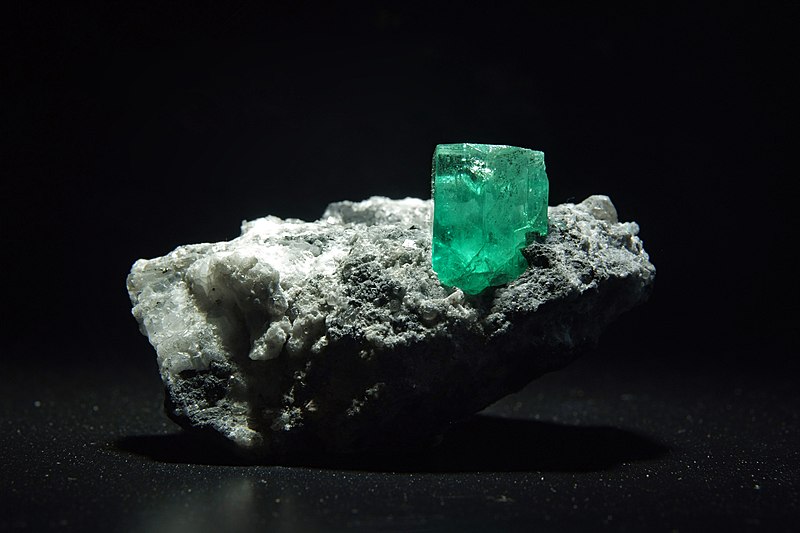
Emerald crystal on calcite
Photo by Eva Krocher


Pegmatites are hydrothermal deposits contain more different types of gemstones in any other rock.  These are formed from the volatile rich fluids that are found in pegmatites when they are formed.  In some geological circles pegmatites are called “Giant granite” because they have the same minerals as granite except the crystals of the individual minerals are much larger.  There are two different kinds of pegmatites simple and complex; most of the valuable minerals are found in complex pegmatites.  Although many of these minerals could be classified as gems other minerals found in pegmatites are the ores for rare metals such as niobium or rare earths. 

Depending on the fluids present when the pegmatite is solidifying different gemstones are deposited.  If the fluid is rich in fluorine topaz will be deposited.  A beryllium rich fluid will produce the mineral beryl in its many forms ranging from aquamarine, emerald, morganite, or heliodor.  Lithium rich fluid is another possibility depositing spodumene or other lithium rich minerals.  Pollucite is deposited from a cesium rich fluid.  In some cases the fluid is rich in several different elements producing “Tourmaline” a gemstone that is actually rarer them diamonds.  A manganese rich fluid will cause spessertine garnet to be deposited.

There are specific zones in a pegmatite where gemstones are found.  Many of them are found in cavities called “Vugs.”  The crystals formed in this environment are usually clear and well formed.  A deposit of this nature containing red and green tourmaline was discovered in the 1970s at Newry, Maine that was worth more then $8 million from a single vug as large as a bedroom.

There are other hydrothermal environments that are also capable of producing gemstones ranging from volcanic rocks to sedimentary rocks.  This is where one is likely to encounter agates, petrified wood, opal, amethyst as well as a whole plethora of gems.  Turquoise is another mineral deposited by hydrothermal waters.  It is copper phosphate and its beautiful sky blue botryoidal masses have been admired for over two thousand years.
Metamorphic deposits:


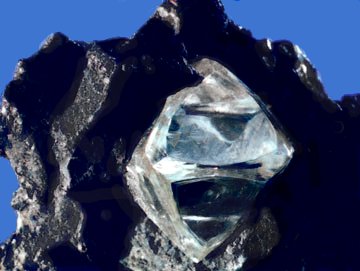
Diamond crystal in matrix - USGS


The only gem minerals normally found in metamorphic rocks are garnet, zoisite (variety tanzanite), rubies and emeralds.  Rubies are the red variety of the mineral corundum that is aluminum oxide.  These gems are found in cordierite rich gneiss as well as marble.  Sometimes rubies are carried up from the depths of the earth as xenocrysts in basalt.  Most of the world's emeralds are found in low grade carbonaceous schist in ColombiaOther gemstones that occur in metamorphic rocks are iolite (the gem-quality lilac-purple variety of cordierite), titanite and kyanite.
Jade is another mineral that is found in high-pressure; low-pressure blue schist metamorphic rocks.  There are two entirely different minerals that are recognized as jade in the trade one of these as jadeite a compact variety of the mineral pyroxene, and the other is nephrite a compact variety of the mineral that is derived from tremolite.  Although these minerals are composed of common minerals it takes a very special environment for them to form.


Sedimentary deposits:


By far the most valuable gemstone found in sedimentary rock is precious opal.  The largest deposits of this mineral in the world are found in central Australia.  Other deposits are found in the United States and Mexico.  Most opal is found as a replacement for fossils.  Opal also occurs as replacement beds or blebs in sedimentary rock.  A good piece of opal showing good colors can be as expensive as a diamond.


Placer deposits:


In some placer deposits gemstones are relatively abundant particularly in areas where the local rocks are known to produce gemstones.  This is especially true in areas underlying by cordierite gneiss or marble.  Another area is where gemstone bearing pegmatites are abundant.  Because of their toughness and hardness gemstones that are eroded from their country rock tend to remain intact preserving the best gemstones.  The same rough and tough treatment these stones go under as a result of natural processes particularly running water the weaker and softer stones are broken up leaving behind the highest quality gemstones.  Most of the gemstones in the world are recovered from placer deposits.  In some cases the work of recovery can be quite primitive; in others the most modern technology and machinery is used.


References:


Mineralogical Association of Canada, Editor Lee A. Groat, Geology Of Gem Deposits, Short Course Series, Volume 37, Yukon Geological Survey, © 2007, Yellowknife, Northwest Territories
Gem Deposits, http://amonline.net.au/geoscience/earth/gem.htm
Geology of Gem Deposits, Mineralogical Association of Canada, Editor Lee A. Groat, http://www.mineralogicalassociation.ca/doc/promo_SC37.pdf  Volume 37 © 2007

Saturday, March 10, 2012

Alabaster the Non-Gemstone


Church walls and gold leaf decorations made from calcitic alabaster in Poland
Photo by Beemwej


There are two distinct minerals that are called alabaster, one of them is calcium sulfate commonly called gypsum or anhydrite.  The other is a variety of calcium carbonate that is commonly known as limestone or marble.  Of these two the former is the alabaster of today, and the latter is the alabaster of the ancients.  Both of these materials are easy to work with, and have an attractive appearance making them favorites for small carvings and other works of art.

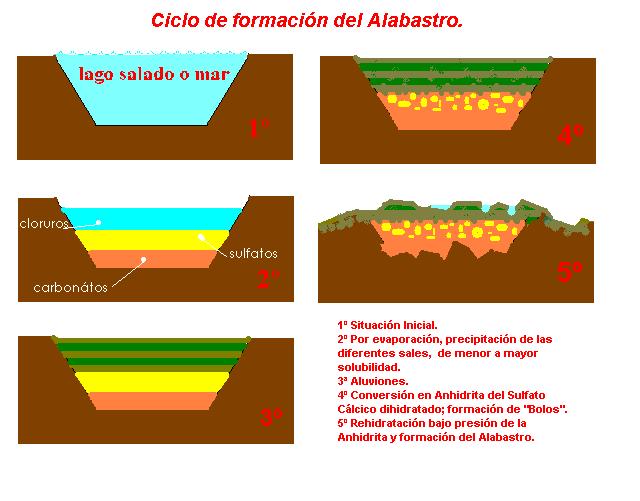
The formation of alabaster explained in Italian
by Miguel


Since we've already established that there are two different types of alabaster the best way to distinguish between them is by their relative hardness. The first type that is composed of gypsum is so soft you can scratch it would your fingernail because I have a Mohs hardness of 1.5 to 2. The calcite variety of alabaster is too hard to be scratched in this way having a Mohs hardness of 3 although you can scratch it with a knife blade. Because it is a carbonate it will effervesce when a drop of hydrochloric acid is placed on its surface. When the gypsum type of alabaster has a drop of mass placed on virtually nothing happens.

An alabaster lamp
Photo by David Dennis


Although alabaster can come in many different colors most people think of it as white, so much so that it has entered the language as a metonym for weight objects. In this sense it is often used to describe “alabaster skin” that means very light and quite transparent that is derived from the use of alabaster in building tombs.

Although alabaster is essentially too soft for use as a gemstone it often finds uses as a decorative stone for making different kinds of statuary and other objects de art. A very common use today is making the basis for electric lamps.

A piece of raw alabaster
Photo by Ra'ike


The word alabaster itself is derived from middle English as well as several other languages including Greek. The word was used to identify a type of vase made of alabaster. There is a certain amount of evidence that the word can be traced all the way back to ancient Egypt where it was named after the town Alabastron where it was commonly found. It was Alabastron where it was originally quarried, however the name of the mineral is still obscure.

The so-called “Oriental” alabaster was highly esteemed by sea ancients for making such items as small perfume bottles small point that basis that were called alabastra. This thing has also been suggested as a possible source of the mineral name. The craftsmen of this stone in ancient Egypt often used alabaster for use in candlestick chart and various other sacred and sepulchral objects. In the Sir John Soane’s Museum in London is a sarcophagus that was carved from a single block of translucent calcite alabaster that was mined Alabastron.

An alabaster carver at work.
Photo by Zyance


Both types of alabaster are essentially evaporative minerals in the case of the gypsum variety it is the mineral that evaporates from seawater before salt,  In the case of the calcitic variety is has its origin from the evaporation of lime water that has reached saturation.  Any further water loss causes the lime to come out of solution where it is deposited. A lot of this type of alabaster is found on the walls and floor of caves where it also forms the formations we call stalactites and stalagmites.

Ancient alabaster vases
Louvre Museum, Paris, France


Although most people think of alabaster as a white mineral it is also found in many other colors particularly when it is stained by mineral salts. Iron is the most common of these although copper and manganese also one of their own suite of colors to the stone. If you cut large blocks of this material into thin sheets they can be used as translucent windows such as those found in the Beineke Library of Rare Manuscripts and Books at Yale University. Throughout the ages how a master has been used to make many beautiful objects and will continue to do so into the future.

Thursday, March 8, 2012

Beryl the Genstone of Many Colors


Beryl crystals from Pakistan var. aquamarine
Photo by Gia Cassa


As a mineral beryl is beryllium aluminum cyclosilicate possessing the chemical formula Be3Al2(SiO3)6­.   As a gem it comes in many colors although pure beryl is colorless of the variety goshenite named after the town of Goshen in the central Berkshires of Massachusetts its type locality.  It is tinted by different colors causing it to be colored blue, green, red, yellow and white.  This is a mineral that is usually found in pegmatites although it is often found in biotite schists and in intruded limestone.  A rare occurrence is found in Utah called bixbite that has been colored red by manganese as an impurity.  Other gems in this family include aquamarine, emerald, green beryl, heliodor and morganite

An emerald crystal from Colombia
Photo by Gery Parent


Aquamarine is the color of sea water a bluish green with green beryl as a sub-order of aquamarine.  Emerald of course is bright green that is usually found in heavily intruded limestone although some occurrences are in biotite schist.  Heliodor is the yellow variety of beryl that is sometimes galled “golden beryl.”  Morganite is sometimes found associated with both aquamarine and golden beryl, bit is differentiated by its pink color.  Red beryl is also called bixbite or red emerald because of its red coloration.  Of all the beryl’s bixbite is the rarest, but only occurs in small crystals allowing gems cut from it to be lass then 5 carets in weight,

Golden beryl or heliodor
unknown


Beryl aside from its use as a gem is also the ore of beryllium where it occurs in granitic pegmatites.  One such crystal was a giant that occurred in the Bumpus Quarry in Albany, Maine that was about 5.5 meters long by 1.2 meters in diameter that weighed around 18 metric tons.  The largest crystal of any kind of mineral was found in Madagascar is a beryl crystal that was 18 meters long by 3.5 meters in diameter.  That is the size as the boiler on a steam locomotive.

A crystal of red beryl var. bixbite from Utah
Photo by Rob Lavinsky


Beryl is found on all the continents wherever crystalline igneous or metamorphic rocks are found.  The gems are found in the core of pegmatites where at times terminated crystals are found growing into cavities or vugs in the rock.  Some beryl like the emeralds found in Columbia are found in a peculiar black limestone that has been intruded with granite that contain in addition to the beryl an abundant amount of pyrite that certainly predates the formation of the emerald crystals.. Beryl is also found associated with biotite schist.   Many of the emeralds found in the Ural Mountains of Russia are this type of deposit.  The emeralds found at the Crabtree Corners deposit in North Carolina are also an example of this kind of deposit.

A crystal of morganite on albite and quartz.
Photo by Rob Lavinsky


One of the most important deposits of aquamarine in the United States is found in the Maryall district of New Milford, Connecticut where they occur in a large pegmatite that that was originally mined for feldspar and mica.  This mine has produced some fine specimens of both aquamarine and heliodor beryl including a 44 carat heart on display in the American Museum of Natural History in New York City.  It is also known to produce many other minerals especially large garnets and uranium minerals.  

Saturday, March 3, 2012

Benitoite the One of a Kind Gemstone


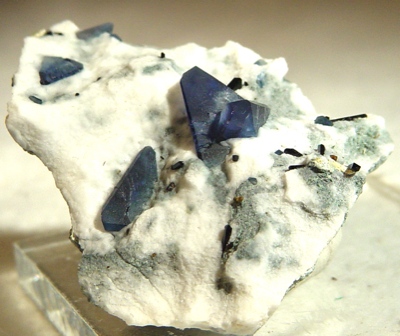
Benitoite in a matrix of neptunite from San Benito County, California.
Photo by Rob Lavinsky


Benitoite is a one-of-a-kind gem since it is only found in one place in California; it is also the state gemstone of California as of 1985.  The stone itself is a rare variety of barium-titanium silicate found in hydrothermally altered serpentine. Benitoite reacts under shortwave ultraviolet light fluorescing light blue in color.

As a mineral benitoite was described in 1907 by George D. Louderback who named it benitoite because it was found near the headwaters of the San Benito River of San Benito County, California. The stone was one of the first if not the first mineral to be studied under x-ray diffraction.

A single crystal of benitoite in matrix.
Photo by Lech Darski


This stone is usually found an unusual set of minerals including the minerals that make up its host rock. The associated minerals usually include naturolite, neptunite, joaquinite, serpentine and albite. Benitoite is very rare mineral that is only found that it few locations among them are places in San Benito County, California. It is also been found in Arkansas and Japan. It is usually found in glaucophane schist as inclusions in veins of naturolite.  Benitoite mining is allowed for a fee in the benitoite mine in the Clearwater management area in central California. Collecting is by appointment only!

This gemstone is typically colored various shades of blue although it can also appear as colorless or even have a yellowish caste.  Its crystals can vary from transparent to translucent with visible inclusions with a vitreous luster.

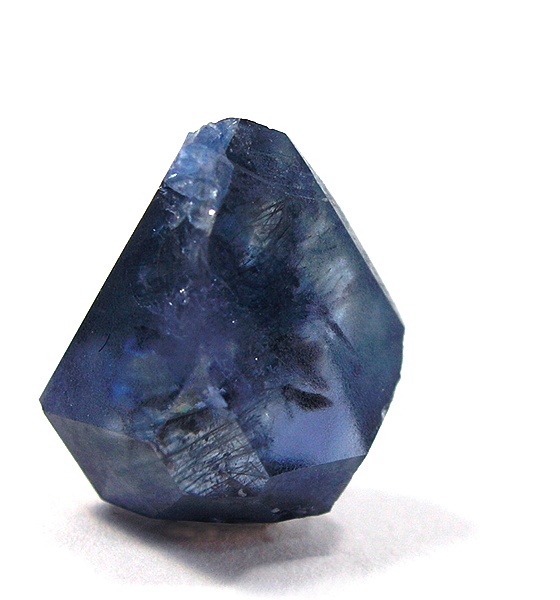
A single crystal of benitoite with no matrix.
Photo by Rob Lavinsky


When found its crystals are hexagonal; bar 6 m 2 that in crystal habits include six place dipyramid flattened shapes having a distinct triangle shape that is often modified by having minor faces.  At times it is also found as small grains.

Benitoite has no cleavage and its fracture is irregular.  Other distinguishing features are its hardness ranging from 6 to 6.5 on the Moh’s scale of hardness.  Its specific gravity is 3.6 making it denser then most other minerals making it capable of being separated by gravity methods such as panning.  The mineral also displays a white streak.

A faceted example of benitoite
Photo by Fastily


This mineral is counted among those that fluoresce under the influence of ultraviolet light displaying a blue light.  Minerals that are associated with benitoite include serpentine, neptunite, natrolite, joaquinite, sanbornite, taramellite, albite and fresonite. 

Benitoite gems are only found in three mines located in San Benito County, California where good to excellent crystals are found.  The only other occurrences are in Eocene aged sands in southwestern Texas along with another few localities in California.  These occurrences are only small grains found in sand.

Benitoite under ultraviolet light.
Photo by Parent Gery 


If you are searching for this mineral the best field indicators its crystal habit, the fact that it displays fluorescence in blue, its distinctive color, the minerals it is associated with and the locality.  The fact it is associated with bodies of serpentine suggests that it might be found in localities that have been identified as suture zones where geologists feel that serpentine is metamorphosed oceanic crust that has been caught up in earth movements associated with the collision of two continental plates,


Tuesday, February 28, 2012

Amber is Fossilized Tree Resin


Amber with a spider inclusion that came from the Baltic Sea area.
Photo by Elizabeth from Holland 


Although not a gemstone in the proper sense Amber in reality is fossilized tree resin that is several million years old. It is one of the oldest gems known to man where it is mentioned in the Bible and also by Pliny the Elder, who lived during the Roman Empire. Pliny was killed by the eruption of Vesuvius on August 24, 79 A.D.

Although amber is found in many parts of the world its earliest occurrence was when Amber was found around the Baltic Sea where it is still mined to this day.  Other places in the world where amber is found include the United States, the Dominican Republic, New Zealand and Indonesia.  In truth amber enjoys a worldwide occurrence.

Blue amber from the Dominican Republic
Photo by Vassil 


Mankind has admired amber for thousands of years where he appreciated its color and natural beauty since Neolithic times.  Amber is still used as an ingredient in perfumes; it has also been used as a healing agent in folk medicine.  Amber however finds its major use in Jewelry.

Amber pendents with inclusions
Photo by Adrian Pingstone


Geologically there are five recognized classes of amber that are defined according to their chemical composition.  Amber comes from a sticky tree resin that over time hardens by the loss of volatile chemicals it can contain various animal and plant remains as inclusions.  Some amber occurs in coal seams that are called resinite.  The term ambrite is specifically applied to amber that found in the coal seams of New Zealand.

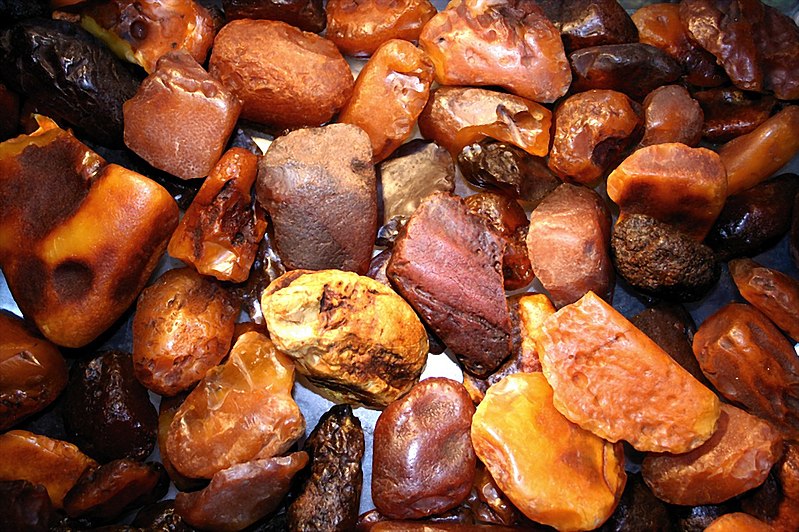
Amber rough from the Baltic Sea where it is washed up after heavy storms.
This amber is waiting to be processed.
Photo by Lanzi


One of the rarest members of the amber family is found in the Dominican Republic that is blue and flouresis under ultraviolet light.  Amber is found in several parts of the eastern United States most notably on Martha’s Vineyard where it is found on Gayhead.  The stone is also found in the marl deposits of New Jersey.  

Friday, February 24, 2012

Apatite as a gemstone


A crystal of gemmy apatite on a matrix of quartz.
Photo by Rob Lavinsky


Apatite is a whole family of minerals some of them are gems, but the place where you are most familiar with is your teeth and skeleton that are composed of hydroxalapatite.  Basically apatite is composed of calcium phosphate with extra ions added to its crystalline structure to cause it to be known as several related names: flourapatite, chlorapatite, bromapatite and in the case of your bones the OH ion. Apatite is used as the defining mineral for number five on the Moh’s hardness scale. Hydroxyapatite is a relatively rare form of the mineral are mostly groups are absent or contain many carbonate and acid phosphate substitutes that form a large part of bone material.

A twinned crystal of Apatite
Photo by Rob Lavinsky


Flourapatite is much more resistant to acid attack than hydroxyapatite it is for this reason that fluorine is added to your drinking water and can also be found in your toothpaste. In the case of the fluoridated water it allows the interchange of fluoride ions that substitute for hydroxyapatite ions. If you get too much fluoride into your system it can result in dental or skeletal flouresis.

Fission tracks are used by geochemists and geophysicists for determining the thermal history of orogenic belts and settlements in sedimentary basins. This is because as a trace element uranium and thorium are found in crystalline apatite. The same phenomenon is also used in paleontology to establish the dates of prehistoric wildfires.

A faceted gemstone of apatite.
Photo by Rob Lavinsky


Apatite in phosphorite is a phosphorus rich sedimentary rock containing between 18 and 40% of phosphorus pentoxide (P2O5). A great deal of the phosphorite is mined in central Florida in an area that is called “Bone Valley” for use as fertilizer. It contains so much uranium that during the Cold War if supplied several thousand tons of yellowcake uranium to the Atomic Energy Commission. The piles of mine slimes resulting from mining and refining this phosphorite presents a serious environmental hazard not only from the uranium, but also from the contained fluorides. The apatite contained in phosphorite is in crypto- crystalline masses that are called colophane. Apatite is also mined from igneous rocks in the Kola Peninsula of northeast Russia as a fertilizer as well..

Clear crystals of apatite can be faceted creating an extremely handsome gem. Because of the sensitivity to heat and shock gems that are cut from apatite are never heat-treated to improve their looks. Although apatite is found all over the world most of it is small crystals disseminated through the rocks; larger crystals are quite rare. Most of the faceting grade apatite crystals are shades of blue, although some are blue-green.

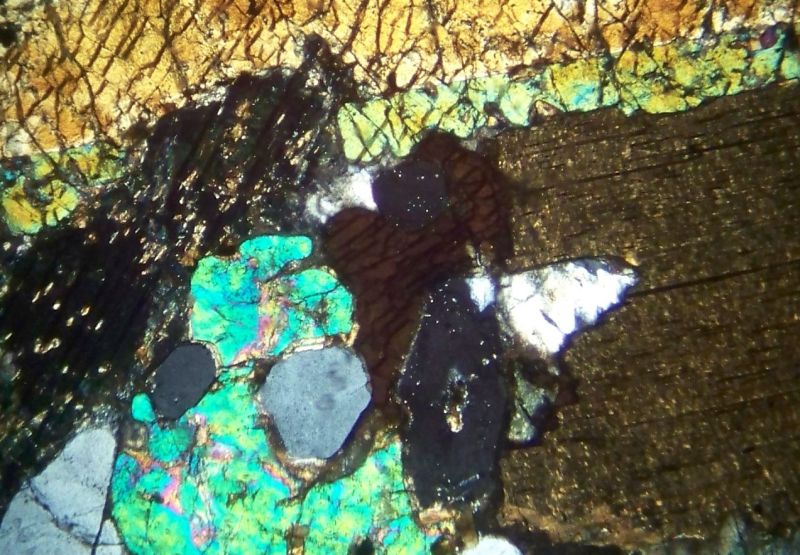
A thin section of hornblende and apatite
Photo by Pitor Sosnowski


Most of this faceting material is found in metamorphosed limestone that is commonly called marble. In general the more impurities that are found in limestone the more apt it is to produce apatite when it is metamorphosed. There is a bed of metamorphosed limestone that reaches all the way from Québec to Alabama just of the West of the Precambrian core of the Appalachians. In many places this is called the Great Valley of the Appalachians but the same marble belt extends all the way to Canada. There is apatite found throughout this entire region, and others like it all over the world.

Monday, February 20, 2012

Aquamarine as a Gemstone


Aquamarine is a member of the beryl family of gemstones that is usually colored various shades of blue/green or may appear as either light green or even as dark blue stones rivaling sapphire in color.  The mineral is a beryllium aluminum cyclosilicate with the formula Be3Al2(SiO3)6Terminated crystals of beryl are relatively rare, but are known to occur.  The stone has a value as a gemstone, and is a common ore of the metal beryllium.  In the case of aquamarine a small amount of iron that causes crystal defects in the crystal is the cause of its color.  The mineral beryl because of impurities in the crystal does occur in several different colors including green blue, yellow, red and white.

Aquamarine in a matrix of feldspar crystals.and other minerals including schorl the black crystal in the middle of the specimen.
Photo by Rob Lavinsky


The colors of aquamarine can range from light blue like that of the sky to a deep blue of the sea.  The darker the color the higher the price some aquamarines can sell for as much as $2,000 per caret although lighter stones only fetch a few dollars per carat.  The stone itself is fascinatingly beautiful with much appeal to women all over the world because it can complement or eye color.  For creative gemstone cutters it is an inspiration because of its ability to be cut in so many designs and still keep its beauty.

A water etched crystal of aquamarine from Brazil
Photo by Rob Lavinsky

Aquamarine is epitomized by its blue color, and the deeper blue the color the more expensive the stone making it one of the most popular stones rivaling at times its more expensive cousin emerald that also belongs to the beryl family.  The stone is hard enough at Mohs hardness of 7.5 to 8 so it can be used in most types of jewelry making it almost as popular as the classic stones emerald, ruby and sapphire.  In reality aquamarine is related to the emerald, but unlike its more famous cousin it usually free of flaws.  One flaw that is sometimes seen in aquamarine is long thin tubes that sometimes lend to its beauty in the form of chatoyancy forming tiger eyes or more rarely a star stone much like star sapphire.  Both forms of the stone command very high prices.

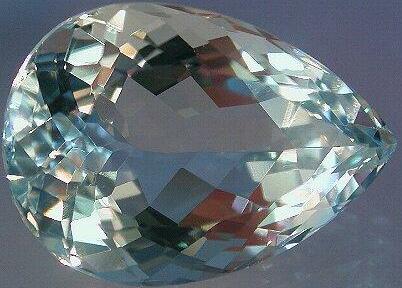
An example of a pear shaped aquamarine faceted gem.
Photographer Unknown


The color of aquamarine is caused by ions of iron causing crystal defects in the mineral beryl that is normally clear that is called goshenite my mineralogists because its type locality is in Goshen, Massachusetts were it is found in lithium bearing pegmatites.  Aquamarine can range from a pale blue to a strongly colored sea blue.  In some aquamarines you can see a light greenish simmer that is a typical feature of the stone.  Thee most prized color however is a pure clear blue transparent stone bringing out the transparency and shine of this magnificent stone.


Thursday, January 5, 2012

Gemstone Occurrences in New Jersey


A ruby crystal from Tanzania similar to those found in New Jersey.


Like many of the states of the Northeast New Jersey contains some of the best localities for finding gems in the Eastern United States.  Agate is found throughout the traprock quarries of the state as well as quartz gemstones including amethyst that occurs as cavities in the stone.  Many marine fossils are also found in the state including many fossils of shark teeth. Most of these fossils are found in the Kirkwood formation (Eocene and Miocene) in Monmouth County.

One of the most interesting stones found in the state are so-called Cape May Diamonds that in reality are waterworn quartz crystals that are found on the beaches of Cape May Point along the Delaware River in southern New Jersey.  These stones are the most abundant at Higbee and Sunset beaches in Cape May.  These stones can range in size from the finest sand to one whopper that weighed 3 pounds 14 ounces that is known as the Cape May Diamond that was found in New Castle, Delaware in 1866.

Rubies are rarely found in the white marble at the mining district in Franklin where they are found associated with the zinc mines in Franklin and Sparta.  Many of these stones are small, but are well formed.  The rubies fluoresces red, but the marble matrix doesn’t. Many minerals found on the mine dumps around the area are various minerals of zinc that also fluoresce in brilliant colors under a fluorescent light with some of them even considered gemstones.  Another mineral that is found associated with the zinc minerals is rhodonite a silicate of manganese that is often cut as cabochons.

Bloodstone or heliotrope is found in sparing amounts in the Eastern United States north from Florida with exposures in New Jersey.  This is a member of the quartz family of gemstones that is dark green in color with bright red spots of hematite.  This stone is often cut and used in inexpensive jewelry.
A polished slab of petrified wood.
Photo by Daniel Schwen

In addition to agate the traprock quarries in Passaic County also contain many zeolite minerals as well as datolite and prehnite in large quantities. In many places the traprock quarries have cavities lined with amethyst crystals.  In some areas in eastern New Jersey you can find jasper and petrified wood.

In recent years one of the most valuable gems in North America has been overlooked by collectors is the freshwater pearl found in many of the mollusks in the states many rivers.  The pearl was looked avidly for in the 19th Century, but for a period of inactivity caused by over fishing the mollusks  caused this industry to decline.   

Saturday, September 3, 2011

Gemstone Occurrences in New York:


Herkimer Diamonds from the Ace of Diamonds Mine.
Photo by Rob Lavinsky


You could almost write a book just about gemstone occurrences in Manhattan that has produced beryl, chrysoberyl and some huge garnets.  These are all gems that have been produced from excavations and the rock removed from them.  Most of this rock now resides along the bank of the Hudson River in uptown Manhattan where you can readily get at the excavation spoils from Inwood Park.  The entire southeast part of the mainland has the same kind of gemstones as Connecticut with whom it shares a common border.

Saratoga County has produced beryl and rose quartz from the pegmatites found in the Adirondacks.  Almandine garnets have been produced from a deposit on Gore Mountain in the town of North Creek..  These garnets are embedded in a matrix of gabbro with some of the crystals reaching more then a meter in diameter.  The Barton Mining Company produces the garnets for making abrasives, but sufficient amounts of cuttable material is produced to satisfy the needs of the Rock Hound trade.

In the middle of a city park in Syracuse is a kimberlite pipe that may be diamondiferous or not depending upon who is telling you about it.  This is a swarm of pipes that extend from a coal mine in Pennsylvania to the Monteregian Hills of Quebec. Many of these kimberlite dikes are clustered around Ithaca, but the narrow swarm of kimberlites can be found crossing the state from the Pennsylvania border to Ogdensburg on the St. Lawrence River. None of the NY kimberlites are known to contain diamonds.  Diamonds have been found in the glacial deposits that were brought down from the diamond deposits of Ontario.

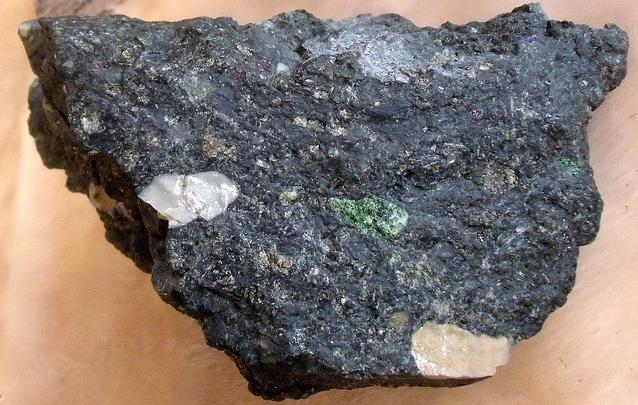
Kimberlite
Photo by Sub Arctic Mike


The original discovery of a kimberlite dike in New York occurred in Syracuse in 1837, but was mistaken for serpentine; it wasn’t until 1887 that rocks of this nature were properly identified at Kimberly South Africa that their true nature was discovered.  The kimberlite dikes in New York although they don’t contain diamonds because the magma came from too close to the surface of the earth do contain some other minerals that are considered gemstones providing they are large enough including olivine and spinel.

An interesting deposit of rubies and sapphires are found in the marble deposits of Orange County.  The quantity of stones that have been found in sparse, but the deposit extends into Sussex County New Jersey. These gems were found somewhere between Monroe and Southfield in Orange County. According to the report these gems were less then two carets in weight, and the deposit was sparse. This was a deposit that was worked secretly by two people for some years who took its locality to the grave with them.

When the zinc mine at Edwards was being actively mined they discovered a mass of lazulite weighing more then twenty pounds in the process of mining zinc ore.  This mass was cut up into cabochons and made into jewelry.  Lazulite is one of the components of the semi-precious stone lapis lazuli. 

A stone that is readily identified with New York State is quartz whether it is in the form of amethyst in the trap ridges along the Hudson River in the Haverstraw vicinity, at the old lead mine in Ellenville or in the Little Falls formation crossing the state from west to east where it ends at diamond cliff in Hague on Lake George.  This is the home of the world famous Herkimer Diamond that in reality is a doubly terminated quartz crystal found in cavities in the silicified dolomite of the Little Falls formation.  Various varieties of quartz (silica) gemstones are found throughout New York.  Albany County is noted for its flint and jasper that is found in sand and gravel deposits.  There was even a flint deposit overlooking the Hudson Valley that was worked by the Indians in prehistoric times for flint to make their weapons.

Saturday, July 30, 2011

Gemstone Occurrences in Connecticut

Almandine garnet, Connecticut's state stone.
Photo by Rob Lavinsky


Connecticut is amply endowed with gemstones ranging from andalusite to zircons.  The stones found in Connecticut are found in a variety of terranes although the primary one is pegmatites, but they are also found in the trap ridges of the Connecticut River Valley.  Even more are found as glacial float if you want to use that method of finding gems.

Just in the town where I live, Barkhamsted there are several different verities of gemstones including almandine garnets, beryl, corundum, kyanite, quartz, soapstone, zircon and the usual rock forming minerals.

Connecticut is blessed with many gem bearing pegmatites one series starts in Glastonbury and Crosses the Connecticut River at Middletown and extends almost to the coast of Long Island Sound.  The other belt of pegmatites extends diagonally across the western portion of the state from Hartland to Ridgefield.  Both of these belts contain many of the gemstones found in LCT type pegmatites.  Many of them are Dana localities and one of them, the Maryall Mine is considered to be one of the most important gemstone mines in the United States.  This mine is famous worldwide for its crystals of aquamarine and golden beryl.  It also contains some bright red garnets that can weigh up to several pounds.

Beryl crystals on Feldspar.
Photo by Rob Lavinsky


The trap ridges of the Connecticut River Valley and in Woodbury contain specimens of amethyst, datolite and prehnite that are found in vugs in the trap rock.  Some of these occurrences are also Dana localities. Many of them are also world famous.  Connecticut has over 600 recognized mines that are now abandoned scattered mainly across the western half of the state, but there is still plenty of gems to be found in eastern Connecticut.

Microlite-Elbalite and Lepidolite found in the pegmatites of Connecticut.
Photo by Rob Lavinsky
The beaches in eastern Connecticut are littered with moonstones that have eroded from the granite eastern Connecticut is known for.  Another stop you should make is the Connecticut Mining Museum that is part of the Sloan-Stanley Museum in Kent where many of the minerals found in Connecticut are displayed along with lots of information about the mining industry that used to be found in the state.  According to many authorities modern mining was developed in Connecticut then spread out all over the world.

Friday, July 29, 2011

Gemstone Occurrences in Rhode Island

This is an amethyst scepter like those found at Diamond Hill
Photo by Rob Lavinsky


There is a greenish mica schist found in Warwick that has embedded in it red almandine garnets. In East Warwick you can find purple almandine garnets embedded in a silvery mica schist. Jamestown has staurolite crystals embedded in phyllite. Garnet-staurolite bearing schist can also be found under the Jamestown Bridge,

A discovery of beryl was recently reported in the magazine Rock and Gem on the western side of Narragansett Bay in the vicinity of the Jamestown Bridge in the pegmatites found in the area. It was also found at the end of the Cliffwalk in Newport.  The largest crystal found in Newport was about 6 cm in length and 1 cm in diameter along with several other smaller specimens.

There have been moonstones reported on the beaches of Rhode Island that continue into eastern Connecticut.  One of the beaches in Rhode Island is actually called Moonstone Beach.

The state stone is bowenite a variety of serpentine of the sub variety antigorite that has often been classified as a semi-precious stone that is cut into polished slabs or cabochons.  The Maoris of New Zealand have also used bowenite to make axes.  This stone is associated with limestone and was originally found in Lincoln.

Amethyst has been from several localities in Rhode Island notably however from Diamond Hill in Ashaway, Hopkinton in Washington County.  This mineral is accompanied by several other varieties of quarts.  At times the amethyst from this locality is found as rare scepter specimens.

A variety of Jasper veined with chalcedony is found in several localities in Cumberland, Providence County.  Chalcedony has also been found at the Conklin Quarry in Lincoln and another locality is Diamond Hill in Ashaway.  

Sunday, June 26, 2011

Gemstone Occurrences in Massachusetts

This is rhodonite of the type found in the Betts Mine it is also the state gem of Massachusetts
Photo by Phillipe Giabbanelli


Massachusetts is another state that is sparsely supplied with gemstones although there are some exceptions one of which is the Betts Mine in West Cummington that produced some very fine rhodonite for years.  The rhodonite accompanied by rhodochrosite is respectively manganese silicate and carbonate both are cut as gems.  Rhodonite is also the state gem of Massachusetts. 

Rhodonite was first discovered as float from the glacier during the 19th century where the American Gem Company part of Tiffany & Co., became aware of the float.  They used the rhodonite for making knife and umbrella handles as well as dinnerware.  There is a place setting on display in the American Museum of Natural History in New York City made from rhodonite from Massachusetts.  The deposit that is at the contact between the Hawley and Savoy schists was developed by Anson Betts who mined the rhodonite for use as flux on welding rods and later mined it as a gemstone.  The mine was bulldozed shut after the death of Anson Betts and is now closed to collecting.  Rhodonite is still available from the site in the form of mine tailings where it is still collected.

Down the road from the rhodonite deposit to the east is the small village of Lithia in the town of Goshen where the mineral called spodumene was mined in the late 1800s.  This is an area of LCT pegmatites where the first colored tourmaline was discovered in a quarry in the town of Chesterfield in the early 1800s.  Goshen is the Dana type locality for the variety of beryl termed “Goshenite.” a colorless variety of beryl.  The same pegmatites also produce blue tourmaline, petalite and pollucite a cesium aluminum silicate mineral. Beryl has also been found in a pegmatite at Royalston in Worcester  County.

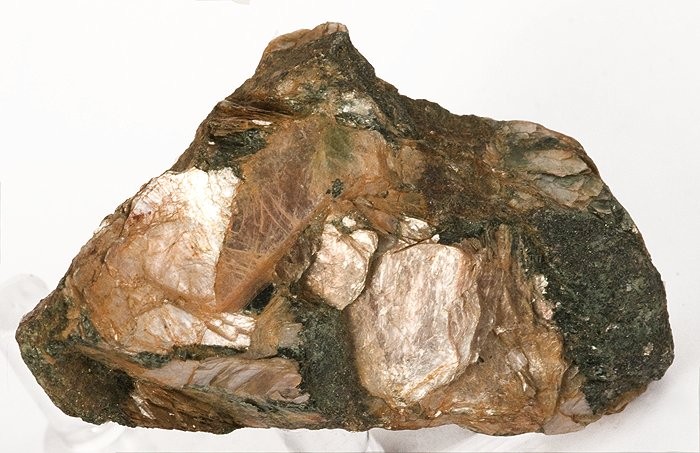
This is margarite a rare form of mica on emery from the mines at Chester, MA.  Emery is the black mineral that the margarite is hosted upon.  Margarite is a brittle form of aluminum rich mica associated with emery deposits.
Photo by Rob Lavinsky


The Chester Abrasives Co. in Chester used to produce emery from the mines west of Chester in about the area where the power lines cross US RT. 20 in a series of mines running north to south for a total of five mines.  In the historical society of Chester there are four apothecary jars containing several pounds of ruby and sapphire crystals that were actually mined in the Cowee Valley corundum mines in Franklin NC operated by the Chester Abrasive Co. in the late 1900s.  Although not mined in Chester they are at least worth a good look.  There is an exposure of gem grade serpentine on the Middlefield Rd. on the right just as you are climbing out of the Westfield River Valley.

The Connecticut Valley offers a completely different suite of gemstones.  The first place to look is in the gravels of the lower Deerfield River because it contains agates that have washed from the nearby trap ridges.  The trap ridges themselves offer good deposits of amethyst and zeolites.  Lanes Quarry in Westfield is the Dana Locality for datolite, however Lanes Quarry is closed to collectors as it is an active quarry.

Datolite from Lanes Quarry in Westfield
Photo by Rob Lavinsky


Garnets are found throughout the state wherever there are crystalline rocks although many of them are rotated making them useless as gemstones.  Most of them are almandine garnets although in the Betts Mine that contains the manganese minerals rhodonite and rhodochrosite there are a rare variety of orange colored garnets called spessartine that are gemmy and suitable for faceting.  Many of these garnets tend to be small, but there are some exceptions weighing several carets.

Spessartine garnets of the type found at the Betts Mine in Plainfield MA where they occur with quartz.
Photo by Rob Lavinsky


A good source about rocks and gems in the state can be found at the many gem and mineral stores dotting the landscape.  Most of these stores stock guidebooks that give specific localities for collection, and many of them are up-to-date,

Friday, June 17, 2011

Gemstone Occurrences in Maine

An example of carving grade tourmaline from the Dunton Quarry strike in Newry Maine.
Photo by Rob Lavinsky


There are many gemstones found in the pegmatites of Oxford County in western Maine including beryl, topaz and tourmaline, Maine’s state gemstone.  This is almost enough to make you cry, one writer describes the destruction of 225,000 carets of chrysoberyl in a blast in a pegmatite near Paris, Maine, the same writer also describes twinned crystals of this mineral weighing up to 120,000 carets that have come from the same locality.

The oldest gem mine in the United States is located on Mt. Mica an LCT Class of pegmatite in Paris the same quarry is also the second oldest known deposit of elbaite in the United States after its initial discovery at the Clarks Ledge Quarry in Chesterfield, Massachusetts. Elbaite is another name for colored tourmaline.  The Mt. Mica deposit has several other firsts including the discovery of the first rose quartz in the world.

Morganite beryl another gemstone found in Maine
Photo by Gery Parent


In the fall of 1972 a monstrous tourmaline pocket was found in the Dunton Quarry of Newry on a spur of Plumbago Mountain.  This pocket is legendary in the annals of gem mining as it yielded more then $8,000,000 worth of gem and specimen quality tourmaline.  The haul was so large the discoverers had to buy an abandoned bank building in Mexico where they stored the gem grade tourmaline in the bank vault and the specimen grade in the basement.

So important are the pegmatites of western Maine that there is a weeklong event held at the Poland Mining Camps called the Maine Pegmatite Workshop every year for the past ten years. In 2011 the workshop started on May 28. Further information about the Pegmatite Workshop can be found on their webpage.

A crystal of clear topaz
Photo by Rob Lavinsky


Tourmaline isn’t the only gemstone found in Maine there are many others.  One of these was the deposits of amethyst that came from Deer Hill in Stow that is now closed to the public.  Here the amethyst came from three quarries the Deer Hill Mine, the Nevel Mine and the Intergalactic (Eastman Ledge) Mine.  The Intergalactic Mining Company is presently mining for blue aquamarine crystals.  Aquamarine is another gemstone that is often found with tourmaline in pegmatites.

Topaz is another gemstone found in Maine with the deposits of Stoneham containing the only sizable crystals in the state.  This is a stone that is often confused with clear quartz, but glistens more when struck by sunlight.  Clear and smoky quartz crystals often accompany topaz in the states many pegmatites.  Transparent smoky quartz is often called smoky topaz or Spanish topaz if it has been heated assuming a yellowish tint.

A Maine amethyst point from Deer Hill in Stow
Photo by Rob Lavinsky


Along the banks of the St. Croix River in Perry one can find agates that have weathered from the basalt flows that are also along the river.  These basalt flows also contain native copper that was observed by the author on a collecting trip to Perry in the 1960s.  Agates are hard to see unless they have been wet by water that really makes them stand out.  The deposit also contains chalcedony and jasper.

An agate like those found at Perry along the St. Croix River
Photo by Hannes Grobe


Jasper can also be found on Jasper Beach in the district of Machias that is called Starboard along the coast right below the radar station.  The beach here is a shingle beach of rhyolite with some jasper mixed with the rhyolite stones.

There have been reports of black jade coming from the river that flows through Farmington.  If this is true it is one of the few reports of jade on the east coast.  The link for the Farmington locality also contains an extensive list of Maine minerals and their localities.

Literally there are hundreds of localities in Maine where gemstones can be found the best advice is to buy a book about the many collecting localities in the state from one of the local rock shops.