Total Pageviews

Showing posts with label pegmatites. Show all posts

Friday, June 17, 2011

Gemstone Occurrences in Maine

An example of carving grade tourmaline from the Dunton Quarry strike in Newry Maine.
Photo by Rob Lavinsky


There are many gemstones found in the pegmatites of Oxford County in western Maine including beryl, topaz and tourmaline, Maine’s state gemstone.  This is almost enough to make you cry, one writer describes the destruction of 225,000 carets of chrysoberyl in a blast in a pegmatite near Paris, Maine, the same writer also describes twinned crystals of this mineral weighing up to 120,000 carets that have come from the same locality.

The oldest gem mine in the United States is located on Mt. Mica an LCT Class of pegmatite in Paris the same quarry is also the second oldest known deposit of elbaite in the United States after its initial discovery at the Clarks Ledge Quarry in Chesterfield, Massachusetts. Elbaite is another name for colored tourmaline.  The Mt. Mica deposit has several other firsts including the discovery of the first rose quartz in the world.

Morganite beryl another gemstone found in Maine
Photo by Gery Parent


In the fall of 1972 a monstrous tourmaline pocket was found in the Dunton Quarry of Newry on a spur of Plumbago Mountain.  This pocket is legendary in the annals of gem mining as it yielded more then $8,000,000 worth of gem and specimen quality tourmaline.  The haul was so large the discoverers had to buy an abandoned bank building in Mexico where they stored the gem grade tourmaline in the bank vault and the specimen grade in the basement.

So important are the pegmatites of western Maine that there is a weeklong event held at the Poland Mining Camps called the Maine Pegmatite Workshop every year for the past ten years. In 2011 the workshop started on May 28. Further information about the Pegmatite Workshop can be found on their webpage.

A crystal of clear topaz
Photo by Rob Lavinsky


Tourmaline isn’t the only gemstone found in Maine there are many others.  One of these was the deposits of amethyst that came from Deer Hill in Stow that is now closed to the public.  Here the amethyst came from three quarries the Deer Hill Mine, the Nevel Mine and the Intergalactic (Eastman Ledge) Mine.  The Intergalactic Mining Company is presently mining for blue aquamarine crystals.  Aquamarine is another gemstone that is often found with tourmaline in pegmatites.

Topaz is another gemstone found in Maine with the deposits of Stoneham containing the only sizable crystals in the state.  This is a stone that is often confused with clear quartz, but glistens more when struck by sunlight.  Clear and smoky quartz crystals often accompany topaz in the states many pegmatites.  Transparent smoky quartz is often called smoky topaz or Spanish topaz if it has been heated assuming a yellowish tint.

A Maine amethyst point from Deer Hill in Stow
Photo by Rob Lavinsky


Along the banks of the St. Croix River in Perry one can find agates that have weathered from the basalt flows that are also along the river.  These basalt flows also contain native copper that was observed by the author on a collecting trip to Perry in the 1960s.  Agates are hard to see unless they have been wet by water that really makes them stand out.  The deposit also contains chalcedony and jasper.
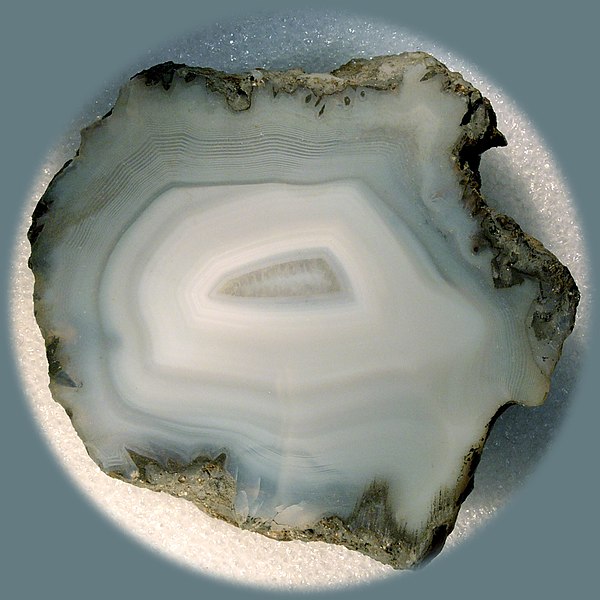
An agate like those found at Perry along the St. Croix River
Photo by Hannes Grobe


Jasper can also be found on Jasper Beach in the district of Machias that is called Starboard along the coast right below the radar station.  The beach here is a shingle beach of rhyolite with some jasper mixed with the rhyolite stones.

There have been reports of black jade coming from the river that flows through Farmington.  If this is true it is one of the few reports of jade on the east coast.  The link for the Farmington locality also contains an extensive list of Maine minerals and their localities.

Literally there are hundreds of localities in Maine where gemstones can be found the best advice is to buy a book about the many collecting localities in the state from one of the local rock shops.

Tuesday, June 14, 2011

Gem Bearing Cavities in Pegmatites

Cavities in rock.
Photo by Ustill


Just about any kind of rock can have cavities some pegmatites are particularly prone to this feature, and it is in these cavities that most gemstones are found. There are many causes of these cavities, but one of the most common is a gas bubble. In many pegmatites cavities can also be formed by a lack of sufficient magma to completely fill the space the pegmatite is occupying.

Cavities are found in pegmatites generally come from one source that is the lack of sufficient material to fill the pegmatites solid. Some of these cavities are quite small and are measured in millimeters. Larger ones are measured in centimeters, and still larger ones are measured in meters. The latter are the most uncommon form of cavity. When they are found in the process of gem mining they often become legendary containing several million dollars worth of gemstones.

Rubbilite tourmaline crystals found in a gem bearing cavity in pegmatite.
Photo by Rob Lavinsky


A cavity that has not been affected by Earth movements grows a fine crop of gem crystals that are attached to the matrix. These crystals are often covered with a fine layer of clay that forms from the last of the mineral bearing solution in the cavity. One might say from the leftovers. Less than one in ten of all the cavities that are found are of this variety. Originally these pegmatites were under considerable pressure as they were formed several miles beneath the surface of the earth. As they were brought up to the surface of the earth by the process of erosion they lost this initial pressurization through the process of a diffusion of their internal gases through the pores in the rock.

Beryl, Cassiterite and Muscovite from a pegmatite cavity.
Photo by Rob Lavinsky


It's the same cavity is fractured by Earth movements so that it loses its internal pressurization crystals that it contains are shattered, and the fragments fall to the bottom of the cavity. Another feature of this type of cavity that is now open for the atmosphere allowing it to be filled with clay that accumulates in the cavity from sources found on the surface of the earth.

Finally, some cavities that remains sealed from the atmosphere are visited by a later type of mineral bearing water that causes the gem crystals inside him to be etched away partially or wholly.

These cavities are known by many names including cavity, geode, pocket and vug.

Tuesday, May 17, 2011

A list of the Gemstones found in Pegmatites

Triphylite found in a cavity in pegmatite in Newry, Maine. This is a rare gemstone
Photo by Rob Lavinsky


The most common gemstones found in pegmatites are beryl, topaz and tourmaline according to the experts there are over 100 other minerals that are found in pegmatites that are used as gemstones. The following list is of some of the many other gemstones that are found in pegmatites. Finding all the gemstones listed here will probably keep you busy for the rest of your life.

The other gemstones found in pegmatites

Name              Color               Mineral           Abundance      Pegmatite Type

achroite            c                      tourmaline        rare                  LCT
albite                g                      feldspar            common           NYF & LCT
amazonite         g                      feldspar            common           NYF > LCT    
amblygonite      y – c                amblygonite      rare                  LCT
aquamarine       b-g                  beryl                 common           LCT
beryllonite         c, pl & y         beryllonite         very rare           LCT
brazilianite        y-g                  brazilianite         very rare           LCT
chrysoberyl       g – y               chrysoberyl        very rare           LCT
danburite          c, y                  danburite            rare                  LCT
elbaite              c, p, g, b           tourmaline         common           LCT
euclase             b – g                euclase               very rare           LCT
fluoapatite         b, p, pur, g      apatite                common           NYF < LCT
goshenite          c                      beryl                  common           NYF < LCT    
hambergite        c, pl, y             hambergite        very rare           NYF & LCT
heliodor            y                      beryl                  rare                  NYF & LCT
hiddenite           g – y                 spodumene       very rare           LCT
hydroxlherderite  c, pl, y, b       hydroxyl “         very rare           LCT
indicolite           bl                     tourmaline         common           LCT
jeremejevite      b                      jeremejevite        very rare          LCT
kunzite              p                      beryl                   rare                 LCT
lazulite              b                      lazulite                rare                 LCT
lepidolite           pur – p             mica                 common           LCT
liddicoatite        p – r                 tourmaline        very rare           LCT
londonite          y – c                 londonite          very rare           LCT
manganotantalite  r                    m-tantalite        very rare           LCT
microlite           y, c-br              microlite            rare                  LCT
montebrasite     c, pl, p-y          montebrasite      rare                  LCT
morganite         p – o                beryl                  rare                  LCT
oligoclase         c                      plagioclase        common           NYF & LCT
petalite             c                      petalite               rare                  LCT
pezzottaite        r                       beryl                 very rare           LCT
phenakite          c, p, y               phenekite          rare                  LCT
pollucite            c                      Pollucite           rare                  LCT
quartz               c, p, sm, pur     quartz               common          NYF & LCT
rhodozite          y-c                   rhodozite          very rare           LCT
rossmanite        p-r, c, g            tourmaline        very rare           LCT
rubelite p-c                               tourmailine       very rare           LCT
sanidine            y, c                   feldspar           common           LCT
simpsonite        y, o                  simpsonite        very rare           LCT
spessertine        o                      garnet               common           LCT
spodumene       c-g                   spodumene       common           LCT
stibiotantalite     y                     stibiotantalite     very rare          LCT
topaz                b-c-p                topaz                 common          NYF & LCT
triplite               r, br, p             triplite               common          NYF
triphyllite           b-g                 triphyllite           rare                  LCT
verdelite           g                      tourmaline         rare                  LCT
zircon               c, p, br, g         zircon                common          NYF & LCT

Abbreviations: c, colorless; g, green; y, yellow; b, blue; p, pink; r, red; o, orange;
br, brown; pur, purple; sm, smokey; pl, pale.

After V.B. Simmons Gem bearing Pegmatites in Geology of Gem Deposits, Editor Lee A. Groat, Yukon Geological Survey

This list is incomplete, but they are always finding new minerals in pegmatites and some of them are gemstones. Some of them are so rare that only one example is known. The hunt goes on!

Sunday, May 15, 2011

The Different Types of Pegmatites

Pegmatite in mica schist.
Photo by Arlette


If we seem to be staying on the subject of pegmatites it is because they are very important in the production of gemstones. There are over 100 different types of gems that are produced from pegmatites. Most of these pegmatites are chemically the same as granite, and the term actually refers to their texture rather than their composition. There are three recognized varieties of granitic pegmatite, and one that is recognized in gabbro. All pegmatites containing crystals that are larger than 2 cm in diameter and can reach truly gigantic proportions. There is a feldspar mine in the Ural Mountains of Russia that has been producing feldspar from any single crystal for many years.

Pegmatites were classified in the mid-20th century by Buddington with a depth zone classification of granitic rocks in 1959. Cerny’s revision of 1991 is the most commonly when used today for the classification of pegmatites. Basically these classifications are based on the depth at which pegmatites were emplaced, metamorphic grade as well as minor element content. Under this classification Abyssal pegmatites are the highest grade that have been in place that either high or low pressure. Muscovite grade pegmatites were emplaced in high-pressure, but a lower temperature. Rare element pegmatites were emplaced at even lower pressures and temperature. In this classification the miarolitic pegmatites having large cavities were emplaced at shallow depths. The most gemstones are found in the miarolitic pegmatites within the enclosed cavities.

Beryl with microcline found in a pegmatite cavity.
Photo by Rob Lavinsky


The simple pegmatite is composed of feldspar, quartz and lesser amounts of muscovite mica. This is the simplest type of pegmatite that is found that can range from tiny veins a few millimeters wide to great masses of pegmatite that can cover several acres, and be meters wide. For the most part simple pegmatites have a very uniform composition, and little variance in the size of the crystals from one side to the other. Approximately 80% of all pegmatites found in nature are of this type. There are very few gemstones found in the simple pegmatites. Most of them contain white colored feldspar and milky quartz with sometimes bands of muscovite mica parallel to the sides of the vein. Under the above classification this type of pegmatite would fall under the classification of being an abyssal pegmatite.

Red tourmaline on lepidolite and quartz from a pegmatite cavity.
Photo by Rob Lavinsky


The rare element class of pegmatites is further divided into the sub classifications LCT and NYF. LCT pegmatites contain lithium, cesium and tantalum. NYf stands for a niobium, yttrium and fluorine. These are perhaps the rarest types of pegmatite. Most of the gemstones bearing pegmatites are of the LCT variety. The closer they form to the surface the more apt they are to have miarolitic cavities containing gemstones.

Saturday, April 30, 2011

Finding Gemstones and Minerals in a Pegmatite

The inside of a pegmatite mine, Ruggles Mine in New Hampshire
Photo by Squelle


Pegmatites are mined not so much for their exotic minerals, but the more mundane feldspar, mica and quartz. The exotic minerals that include gemstones are usually a byproduct of this mining. This is true of most pegmatite mines except for a few like the Maryall mine in Connecticut, and the Himalaya mine in San Diego County California. Because pegmatite it is a very hard rock it is almost impossible to mine without the use of blasting is for this reason the average rockhound is usually excluded. However, from prior mining activities it is possible to go over the mine tailings looking for specimens.

Most miners are more interested in the three primary minerals of feldspar, mica and quartz than they are in the more exotic minerals; therefore these minerals are often thrown onto the waste pile where they remain for the rockhounds to collect later. It is among these tailings where most of the gemstones are found.

By working tailing heaps you are working with stone that has already been mined, and broken up making for much easier collecting. Most of the time you'll encounter stones that are not much more than a foot in diameter, and many of them are usually smaller. You will occasionally encounter a larger stone where it is extremely handy to have in your collection of tools a fairly large sledgehammer weighing more than 8 pounds. Most collecting on a tailings heap can be done with a sledgehammer that weighs 8 pounds, and you can do a considerable amount of damage with an eight pound hammer.

For most collecting in a pegmatite one of the most useless things is a regular geologist’s pick because most of them are too light. What is far more effective is a 4 pound engineer’s hammer and a bullpoint. Bullpoints are a hardened steel rod about three quarters of an inch in diameter having a hexagonal shape about a foot long and coming to a hardened point on one end..

Some of the other things you need in your tool kit for collecting specimens in a pegmatite is a good jeweler's loup is at least 8X magnification on a chain so you can wear around your neck. A stone chisel is another device that should be included. Your kit should also include some old newspapers to wrap your specimens. A small pad and pencil to write down descriptions of the specimens you have found. You should also leave a number on the newspaper holding the specimen so you'll know what it is when you get home.