Total Pageviews

Showing posts with label inclusions. Show all posts

Thursday, June 28, 2012

Inclusions found in Diamonds tell quite a Tale


A flaw seen near the center of a diamond crystal - Wikipedia


The inclusions found in a natural diamond are a window on the interior of the earth.  Basically there are two types of inclusions found in a diamond.  The first type is a Syngenetic inclusion that was formed in the natural process of crystallization was ongoing.  The second type is the Epigenetic inclusion that was formed after the diamond was made.

The most serious flaw is a cleavage that can compromise the stability of a diamond.  These cleavage cracks are straight.  If they are serious enough they can split a diamond along the cleavage crack.  The diamond cutter often takes advantage of this flaw to cleave a diamond into two or more pieces.  They will also cause a diamond to split if accidentally subjected to a sudden high pressure event.

Bearding is hair-like cracks that often happen during the cutting of a diamond usually occurring around the girdle.  This is the area in the Anatomy of a Diamond where the setting prongs grasp the diamond.  Sometimes this flaw is also called “girdle fringes.”

Growth lines are sometimes called grain lines they typically form while the diamond crystal is growing.  If irregular crystallization occurs this is often a reason why these lines form.  If they are colorless they don’t affect the diamond’s clarity.  Sometimes though they are white or colored they are more visible and do affect the value of the diamond.

The next group of inclusions is man made that called ‘laser lines’ and can come from several different operations on the diamond.  The most common type is where the diamond cutter has used a laser for removing dark or prominent inclusions from the diamond.  The second most common is from the use of a microprobe used to analyze the tiny crystals of other minerals that are Syngenetic inclusions in the diamond. 

Feathers derive their name because they actually look like small feathers inside a diamond.  These seem to be Syngenetic tiny cracks that formed with the diamond.  Small feathers seem to be harmless, but if they reach the surface of the diamond crystal then can increase the risk of breakage. 

The last group of inclusions is definitely Syngenetic in nature; they are called pinpoints.  These are crystals of other minerals that were trapped inside the diamond crystal as it formed.  These are true windows into the interior of the earth as they were formed billions of years ago.  These same crystals are used by geochemists using a microprobe to determine their composition, and learn about the interior of the earth.  The most common inclusions are pyrope garnet, pyrite, zircon, eclogite and other rare minerals.  Sometimes an inclusion inside a diamond is what is termed a negative crystal which is just a void looking like a diamond crystal.  Other inclusions are minute drops of liquid usually water or liquid carbon dioxide.

Flaws are the characteristic inclusions found in a diamond.  They are called flaws because their presence means that the diamond is not perfect.  These inclusions act like fingerprints because no two of them are the same they are used to identify individual diamonds if they are lost or stolen.  Other inclusions affect a diamond’s clarity causing it to be less brilliant as they interfere with the light as it passes through a diamond.  There are other inclusions that can cause a diamond to fracture if it is subjected to a sudden sharp blow.


References:

Mineralogical Association of Canada, Editor Lee A. Groat, Geology Of Gem Deposits, Short Course Series, Volume 37, Yukon Geological Survey, © 2007, Yellowknife, Northwest Territories
Gem Deposits, http://amonline.net.au/geoscience/earth/gem.htm
Geology of Gem Deposits, Mineralogical Association of Canada, Editor Lee A. Groat, http://www.mineralogicalassociation.ca/doc/promo_SC37.pdf  Volume 37 © 2007
Industrial Minerals and Rocks, Page 418, http://books.google.com/books?id=zNicdkuulE4C&pg=PA417&lpg=PA417&dq=kimberlites+and+the+occurance+of+diamonds&source=bl&ots=Nhqev_Ebqc&sig=WQyRiIxdpBMtnaZWwhGwKC5o1sY&hl=en&ei=csyvSbDZAojWnQfAmpTNBQ&sa=X&oi=book_result&resnum=9&ct=result#PPA418,M1
Kimberlite, Wikipedia the free encyclopedia, http://en.wikipedia.org/wiki/Kimberlite

Tuesday, February 28, 2012

Amber is Fossilized Tree Resin


Amber with a spider inclusion that came from the Baltic Sea area.
Photo by Elizabeth from Holland 


Although not a gemstone in the proper sense Amber in reality is fossilized tree resin that is several million years old. It is one of the oldest gems known to man where it is mentioned in the Bible and also by Pliny the Elder, who lived during the Roman Empire. Pliny was killed by the eruption of Vesuvius on August 24, 79 A.D.

Although amber is found in many parts of the world its earliest occurrence was when Amber was found around the Baltic Sea where it is still mined to this day.  Other places in the world where amber is found include the United States, the Dominican Republic, New Zealand and Indonesia.  In truth amber enjoys a worldwide occurrence.

Blue amber from the Dominican Republic
Photo by Vassil 


Mankind has admired amber for thousands of years where he appreciated its color and natural beauty since Neolithic times.  Amber is still used as an ingredient in perfumes; it has also been used as a healing agent in folk medicine.  Amber however finds its major use in Jewelry.

Amber pendents with inclusions
Photo by Adrian Pingstone


Geologically there are five recognized classes of amber that are defined according to their chemical composition.  Amber comes from a sticky tree resin that over time hardens by the loss of volatile chemicals it can contain various animal and plant remains as inclusions.  Some amber occurs in coal seams that are called resinite.  The term ambrite is specifically applied to amber that found in the coal seams of New Zealand.

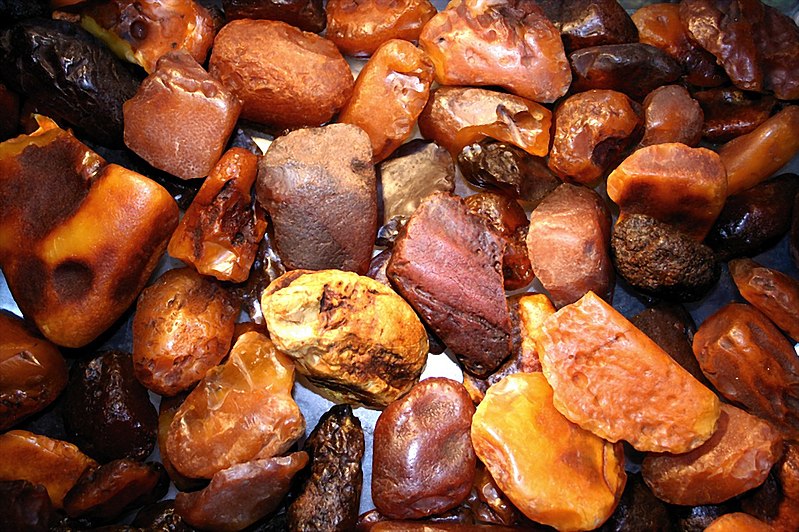
Amber rough from the Baltic Sea where it is washed up after heavy storms.
This amber is waiting to be processed.
Photo by Lanzi


One of the rarest members of the amber family is found in the Dominican Republic that is blue and flouresis under ultraviolet light.  Amber is found in several parts of the eastern United States most notably on Martha’s Vineyard where it is found on Gayhead.  The stone is also found in the marl deposits of New Jersey.  

Thursday, November 24, 2011

How Diamonds are Formed

This shows the Earth's mantle where diamonds are formed.
Courtesy of the Debeers Group.


A vast amount of knowledge has been developed since the 1980s about how diamonds were formed.  It has been through the inclusions found in diamonds that much of the information about how they were formed and their origin was discovered,  Inclusions are all natural materials that are found in diamonds including some that are gaseous, liquid and solid inclusions.  Although theoretically it is possible to form diamonds by squeezing a lump of coal in nature that hasn’t happened although in the lab this had been done under conditions of extreme heat and pressure in giant hydraulic presses,

Some of the diamonds that have been found in meteorites that are more then 4.25 billion years old far exceeding the age of life on Earth.  However natural diamonds on earth were formed at least 990 million years ago.  One of the discoveries made since the 1980s shows that diamond is formed whenever you burn acetylene gas that forms as a coating on metal that has been exposed to burning acetylene that is often deposited during the course of oxy-acetylene welding.  This type of diamond coating has since been made use of industrially for imparting a hard coating onto metals.

How a diamond bearing pipe is formed.
Courtesy of the Debeers Group 


It takes extreme pressure that ranges from 40 to 50 thousand times higher then the pressure found at the earth’s surface of 14,7 pounds or 1,000 millimeters that is termed one bar.  This is the pressure encountered at depths ranging from 125 to 200 kilometers below the surface   Most diamonds are formed from kerogene that was deposited in vast quantities on earth during its formation.  There are other diamonds that were formed from carbonaceous material like fossil coral or shells that have been subducted deep into the earth’s crust where they were also exposed to extreme heat and pressure.  A few diamonds were even formed at depths ranging from 300 to 400 kilometers deep or even further, but these diamonds are extremely rare.  Most diamonds were formed at temperatures that exceeded 9000 to 1,300o Celsius.

Formation and Emplacement of a Kimberlite Pipe

At about 125 kilometers beneath the surface of the earth the pressure of the magma cracks the surrounding rock until the cracks reach the earth’s surface.  Much of this cracking is due to contained carbon dioxide in the magma that causes the magma to bubble and expand.  This is caused either by heat from below or reduced pressure as the magma column reaches towards the surface.  It is this expansion that eventually causes the magma to erupt explosively at the surface.

An eruption like this has never been observed by mankind because it has been millions of years since one occurred on earth predating mankind.  It has been theorized that an eruption of this type rather then being hot like most volcanic eruptions are; it is emplaced under freezing temperatures because of the rapid expansion of the volcanic gases.  In the final few kilometers these gases rise at the speed of sound where they form a pipe following the path of least resistance through the surrounding rock finally reaching the surface.

It is because of this rapid ascent of magma that allows the diamonds to reach the surface of the earth rather then being converted into graphite a far more stable substance at the earth’s surface.  The pressure him pardoned by dissolved gases in the magma eject the diamonds they don't have time to be degraded into graphite.  The diamonds are actually xenoliths, particles caught up in the magma train as foreign objects.  Once the volcanic cone cools it starts too erode releasing the diamonds into the soil. The diamonds that are not eroded state trapped in a kimberlite or lamproite where they are mined.

Different Types of Diamond Deposits

How diamonds are mined.
Courtesy of the Debeers Group.


Diamonds are found in two different types of deposits of which primary deposits come first.  These are deposits found in kimberlite, lamproite or komatiitef pipes and are mined lake any other mineral found in hard rock.  Secondary diamonds are found in river gravel deposits where they are concentrated after traveling for some distance from their primary source.  The gravel found in the Orange River in South Africa is an important source of diamonds.

Often overlooked by many is a third source of diamonds found in a rock type called conglomerate that are really fossilized river gravel.  One important formation like this is found near Marathon, Ontario that not only carries diamonds, but rubies and sapphires as well..