Total Pageviews

Showing posts with label gems. Show all posts

Saturday, July 21, 2012

The easy way of Identifying your gemstones and minerals


Semi precious gemstones
Photo by Mauro Cateb


All gemstones are minerals, but not all minerals are gemstones, so the limited knowledge imparted here can be used on both gemstones and minerals.  If you can’t tell what kind of gems you own don’t feel bad because there have been plenty of emperors and kings that didn’t have a clue about what kind of stones they had in their own crown.  A good example of this is the Black Prince’s Ruby that resided in the Crown of England for hundreds of years before somebody found out it was really a mineral called “spinel.”  This is a stone that looks like a ruby but is a much less expensive stone then real ruby.  Clear white topaz is often mistaken for diamond and in the past many large diamonds have been found to be really topaz.  Identifying these stones is in the realm of the gemologist who is specially trained to identify gemstones.

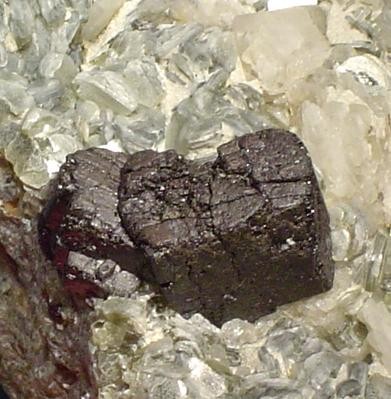
A translucent ruby
Photo by Rob Lavinsky


There are several stones that are treated as gemstones, but aren’t.  Amber is a glaring example of this, a stone that is treated as a gem but in reality is fossilized tree sap having many inclusions of insects and other organic matter.  Petrified wood is another example that is often beautiful and is treated by many as a gemstone, but isn’t.  Jet, the black stone is actually a variety of coal and far from the definition of a gemstone, as are pearls.  Pearls have the distinction of being the most valuable stone, but they aren’t gemstones either.

Identifying gemstones and minerals is really a process of the elimination, for instance if you are presented with a green clear gemstone it is not apt to a ruby. More than likely it is emerald, but you really can't be sure without further tests. There is a variety of garnet called demantoid that is also green and is often mistaken for an emerald. One of the most important tests that are used in mineral identification is the color of the stone.

Hardness is another criterion that is used. This is based on the Moh’s hardness scale that ranges from 1 to 10 with diamond being the hardest and soapstone the softest. Most stones that are used in making jewelry are harder than seven on the Moh’s scale even though some stones that are as soft as three on the Moh’s scale are faceted for collectors. You can buy hardness testing kits or make your own from various minerals that work’s as good as store bought.
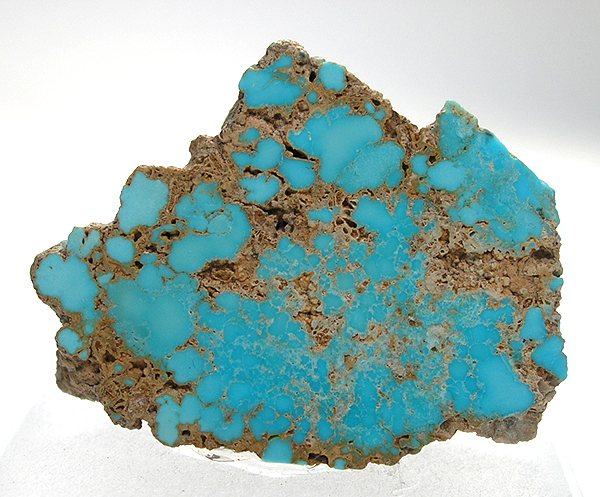
Turquoise from Mojave County, California
Photo by Rob Lavinsky


The looks of the stone are important is it transparent, translucent or opaque.  Transparent means can you see through the stone so things can be seen clearly that are behind the stone.  Translucent means does light pass through the stone, but you can’t make out objects that are in back of the stone.  Opaque means light doesn’t pass through the stone, and you can’t see through it.

Streak is literally a thin mark of the mineral or gemstone composed of very fine powder left on a piece of unglazed porcelain colored either black or white.  Black is often used to test for gold and other precious metals when it is known as a “Touchstone.”  It is often used in conjunction with acid to see if there is a reaction between the streak and the acid.  The karat weight of gold can be determined by treating its streak with various concentrations of nitric acid.

2x2 inch black and white streak plates,  White is pyrite and black is rhodochrosite


We sell streak plates: Click Here 

Cleavage and fracture are other important tests.  Fracture is most important for quartz gemstones that break in a Concoidal fracture that looks like little clam shells.  Some minerals like jade have a hackly fracture i.e. a rough appearance.  Some stones have a pronounced cleavage like topaz or diamond.  Topaz is especially prone to a perfect basal . cleavage causing it to be a poor gemstone.

Specific Gravity was discovered by Archimedes when he was tasked to find out if a gold smith cheated the Tyrant of Syracuse when he was making a golden crown for the tyrant.  This was a job that required quite a lot of forelock tugging on the part of Archimedes until he finally threw his hands up and decided to take a hot bath. His slave girl filled the bathtub to full of hot water so on Archimedes claimed into the tub it overflowed. He had discovered the principle of specific gravity, and with that he jumped out of the bathtub and went streaking through the town agora of Syracuse yelling at the passersby Eureka, Eureka that means I have found it, I have found it. They all thought he had gone nuts, and if it wasn't for the fact his brother-in-law was the tyrant he will probably been slapped in jail.

What Archimedes discovered was the body would displace an equal amount of water according to its volume, or in modern terms its weight per cubic centimeter. This is normally taken by first weighing the object in air and then weighing in water. The difference is its Specific Gravity.

These are some simple tests that can help with gemstone or mineral identification there are others that are far more complicated that can be used in conjunction with the simple tests. Although there are over 2000 recognized minerals in the world there are only about 300 that are common rock forming minerals that you are apt to encounter in the field. A good source of information about most minerals can be found at www.mindat.org

Wednesday, June 27, 2012

Finding Gemstone Deposits:

Ruby crystal on calcite
photo by Rob Lavinsky

Gems have been prized for thousands of years, for their color, luster, durability, hardness and their high intrinsic value per volume.  They are found in all kinds of geologic environments of all ages from thousands of million years to recent times.  Gemstones are also found in all kinds of rocks ranging from igneous to metamorphic to sedimentary and are classified according to the environment where they were formed.  The deposits are rare because of the geological conditions needed to form them are exceptional.  For example, in order for the Emerald to form the beryllium from which it is made has to come in contact with chromium or vanadium.  These elements travel in entirely different geochemical circles that are the exception rather than the rule.

It is important to realize that like any other commodity, gems are subject to the laws of supply and demand.  Even though the demand for gems remains about the same the supplies are becoming depleted.  Many of the gems especially the colored variety are mined in Third World countries by artesianal methods, i.e. by hand.  In any of these countries the discovery of the new deposit often leads to a local prosperity, but many of these stones become involved in the illegal trade that is being used to finance terrorism.

Sapphire crystal
Photo by Rob Lavinsky


These deposits of gemstones are volcanic in origin and are formed deep within the Earth’s crust.  Gemstones from this origin have formed over 100 Km below the surface and are brought to the surface as the result of magma intrusions or lava flows.  Diamonds are one type of this deposit that has formed from 100 to 150 Km below the surface.  These gemstones are found in potassium rich stone called “kimberlite” that is brought to the surface in an explosive eruption that proceeds at near supersonic speeds.  There seems to be a rule known as Clifford's rule that these eruptions take place in Achaean terranes or come up through younger terranes overlying Achaean terrenes.  Kimberlite is quite rich in peridot and appears to be full of xenoliths that are torn off the walls of the magma channel.  A cross-sectional view of the kimberlite is like looking at a carrot.  The stone itself is quite soft and easily eroded away with the diamonds being carried away with the rest of the erosion products.

Diamonds are not the only product that is found in a magmatic deposit so are others stones such as sapphires and zircons.  Sapphires are also formed under some very specific geological conditions the most important one is a magmatic stone that is low in primary silicates such as basalt.  The sapphires form as crystals in the basalt and they're released as products of erosion.  Although they form in the basalt they are rarely mined directly.  Zircons are another example of a gemstone that is found in a magmatic deposit.  Once again these gemstones are not mined directly from the stone that are found as the products of erosion.  In geology zircons are thought to be forever and the oldest dated minerals in the world are some zircons that were found in Western Australia that were dated at 4.5 billion years old.  Zircons are used by geochemists worldwide for dating formations of different ages, and are highly effective in this use.

Some other gemstone minerals that are found in magmatic deposits include:
Peridot, gem quality olivine usually found in mantle xenoliths.
Labradorite, found as gem quality grains in some basalts.
Zircon, found as crystals in granite, basalt and the rarer carbonatites.
Apatite, found as crystals in carbonatites.
Garnets, found as crystals in basalts as xenocrysts and granite.

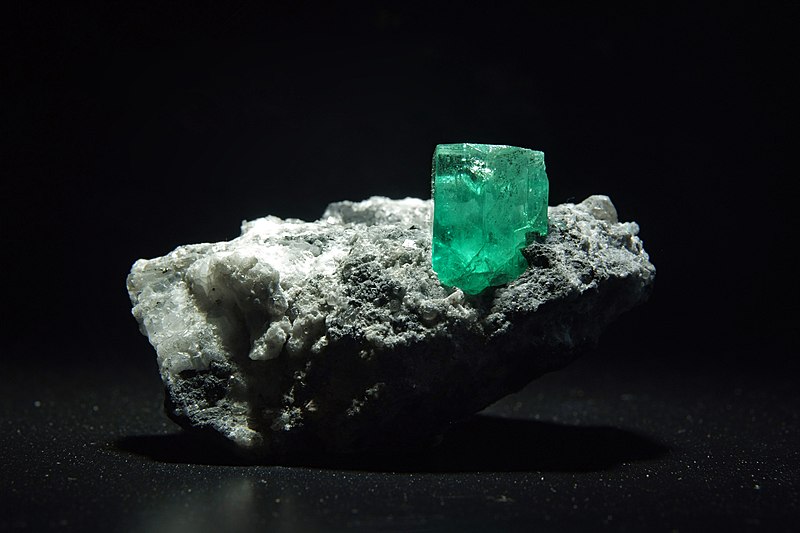
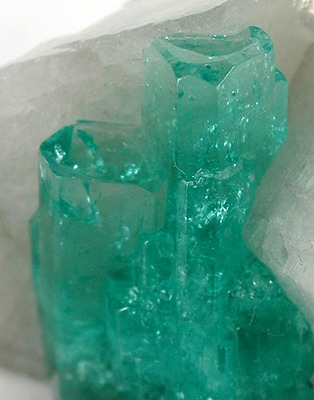
Emerald crystal on calcite
Photo by Eva Krocher


Pegmatites are hydrothermal deposits contain more different types of gemstones in any other rock.  These are formed from the volatile rich fluids that are found in pegmatites when they are formed.  In some geological circles pegmatites are called “Giant granite” because they have the same minerals as granite except the crystals of the individual minerals are much larger.  There are two different kinds of pegmatites simple and complex; most of the valuable minerals are found in complex pegmatites.  Although many of these minerals could be classified as gems other minerals found in pegmatites are the ores for rare metals such as niobium or rare earths. 

Depending on the fluids present when the pegmatite is solidifying different gemstones are deposited.  If the fluid is rich in fluorine topaz will be deposited.  A beryllium rich fluid will produce the mineral beryl in its many forms ranging from aquamarine, emerald, morganite, or heliodor.  Lithium rich fluid is another possibility depositing spodumene or other lithium rich minerals.  Pollucite is deposited from a cesium rich fluid.  In some cases the fluid is rich in several different elements producing “Tourmaline” a gemstone that is actually rarer them diamonds.  A manganese rich fluid will cause spessertine garnet to be deposited.

There are specific zones in a pegmatite where gemstones are found.  Many of them are found in cavities called “Vugs.”  The crystals formed in this environment are usually clear and well formed.  A deposit of this nature containing red and green tourmaline was discovered in the 1970s at Newry, Maine that was worth more then $8 million from a single vug as large as a bedroom.

There are other hydrothermal environments that are also capable of producing gemstones ranging from volcanic rocks to sedimentary rocks.  This is where one is likely to encounter agates, petrified wood, opal, amethyst as well as a whole plethora of gems.  Turquoise is another mineral deposited by hydrothermal waters.  It is copper phosphate and its beautiful sky blue botryoidal masses have been admired for over two thousand years.

Metamorphic deposits:


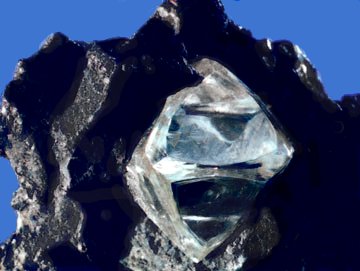
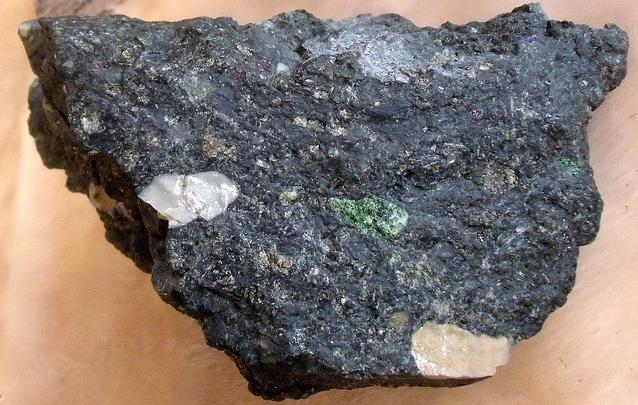
Diamond crystal in matrix - USGS


The only gem minerals normally found in metamorphic rocks are garnet, zoisite (variety tanzanite), rubies and emeralds.  Rubies are the red variety of the mineral corundum that is aluminum oxide.  These gems are found in cordierite rich gneiss as well as marble.  Sometimes rubies are carried up from the depths of the earth as xenocrysts in basalt.  Most of the world's emeralds are found in low grade carbonaceous schist in ColombiaOther gemstones that occur in metamorphic rocks are iolite (the gem-quality lilac-purple variety of cordierite), titanite and kyanite.
Jade is another mineral that is found in high-pressure; low-pressure blue schist metamorphic rocks.  There are two entirely different minerals that are recognized as jade in the trade one of these as jadeite a compact variety of the mineral pyroxene, and the other is nephrite a compact variety of the mineral that is derived from tremolite.  Although these minerals are composed of common minerals it takes a very special environment for them to form.


Sedimentary deposits:


By far the most valuable gemstone found in sedimentary rock is precious opal.  The largest deposits of this mineral in the world are found in central Australia.  Other deposits are found in the United States and Mexico.  Most opal is found as a replacement for fossils.  Opal also occurs as replacement beds or blebs in sedimentary rock.  A good piece of opal showing good colors can be as expensive as a diamond.


Placer deposits:


In some placer deposits gemstones are relatively abundant particularly in areas where the local rocks are known to produce gemstones.  This is especially true in areas underlying by cordierite gneiss or marble.  Another area is where gemstone bearing pegmatites are abundant.  Because of their toughness and hardness gemstones that are eroded from their country rock tend to remain intact preserving the best gemstones.  The same rough and tough treatment these stones go under as a result of natural processes particularly running water the weaker and softer stones are broken up leaving behind the highest quality gemstones.  Most of the gemstones in the world are recovered from placer deposits.  In some cases the work of recovery can be quite primitive; in others the most modern technology and machinery is used.


References:


Mineralogical Association of Canada, Editor Lee A. Groat, Geology Of Gem Deposits, Short Course Series, Volume 37, Yukon Geological Survey, © 2007, Yellowknife, Northwest Territories
Gem Deposits, http://amonline.net.au/geoscience/earth/gem.htm
Geology of Gem Deposits, Mineralogical Association of Canada, Editor Lee A. Groat, http://www.mineralogicalassociation.ca/doc/promo_SC37.pdf  Volume 37 © 2007

Tuesday, February 28, 2012

Amber is Fossilized Tree Resin


Amber with a spider inclusion that came from the Baltic Sea area.
Photo by Elizabeth from Holland 


Although not a gemstone in the proper sense Amber in reality is fossilized tree resin that is several million years old. It is one of the oldest gems known to man where it is mentioned in the Bible and also by Pliny the Elder, who lived during the Roman Empire. Pliny was killed by the eruption of Vesuvius on August 24, 79 A.D.

Although amber is found in many parts of the world its earliest occurrence was when Amber was found around the Baltic Sea where it is still mined to this day.  Other places in the world where amber is found include the United States, the Dominican Republic, New Zealand and Indonesia.  In truth amber enjoys a worldwide occurrence.

Blue amber from the Dominican Republic
Photo by Vassil 


Mankind has admired amber for thousands of years where he appreciated its color and natural beauty since Neolithic times.  Amber is still used as an ingredient in perfumes; it has also been used as a healing agent in folk medicine.  Amber however finds its major use in Jewelry.

Amber pendents with inclusions
Photo by Adrian Pingstone


Geologically there are five recognized classes of amber that are defined according to their chemical composition.  Amber comes from a sticky tree resin that over time hardens by the loss of volatile chemicals it can contain various animal and plant remains as inclusions.  Some amber occurs in coal seams that are called resinite.  The term ambrite is specifically applied to amber that found in the coal seams of New Zealand.

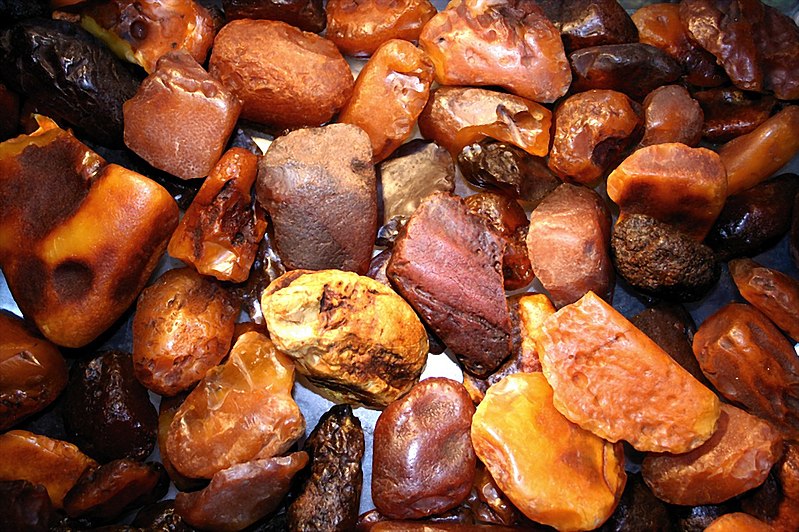
Amber rough from the Baltic Sea where it is washed up after heavy storms.
This amber is waiting to be processed.
Photo by Lanzi


One of the rarest members of the amber family is found in the Dominican Republic that is blue and flouresis under ultraviolet light.  Amber is found in several parts of the eastern United States most notably on Martha’s Vineyard where it is found on Gayhead.  The stone is also found in the marl deposits of New Jersey.  

Friday, February 24, 2012

Apatite as a gemstone


A crystal of gemmy apatite on a matrix of quartz.
Photo by Rob Lavinsky


Apatite is a whole family of minerals some of them are gems, but the place where you are most familiar with is your teeth and skeleton that are composed of hydroxalapatite.  Basically apatite is composed of calcium phosphate with extra ions added to its crystalline structure to cause it to be known as several related names: flourapatite, chlorapatite, bromapatite and in the case of your bones the OH ion. Apatite is used as the defining mineral for number five on the Moh’s hardness scale. Hydroxyapatite is a relatively rare form of the mineral are mostly groups are absent or contain many carbonate and acid phosphate substitutes that form a large part of bone material.

A twinned crystal of Apatite
Photo by Rob Lavinsky


Flourapatite is much more resistant to acid attack than hydroxyapatite it is for this reason that fluorine is added to your drinking water and can also be found in your toothpaste. In the case of the fluoridated water it allows the interchange of fluoride ions that substitute for hydroxyapatite ions. If you get too much fluoride into your system it can result in dental or skeletal flouresis.

Fission tracks are used by geochemists and geophysicists for determining the thermal history of orogenic belts and settlements in sedimentary basins. This is because as a trace element uranium and thorium are found in crystalline apatite. The same phenomenon is also used in paleontology to establish the dates of prehistoric wildfires.

A faceted gemstone of apatite.
Photo by Rob Lavinsky


Apatite in phosphorite is a phosphorus rich sedimentary rock containing between 18 and 40% of phosphorus pentoxide (P2O5). A great deal of the phosphorite is mined in central Florida in an area that is called “Bone Valley” for use as fertilizer. It contains so much uranium that during the Cold War if supplied several thousand tons of yellowcake uranium to the Atomic Energy Commission. The piles of mine slimes resulting from mining and refining this phosphorite presents a serious environmental hazard not only from the uranium, but also from the contained fluorides. The apatite contained in phosphorite is in crypto- crystalline masses that are called colophane. Apatite is also mined from igneous rocks in the Kola Peninsula of northeast Russia as a fertilizer as well..

Clear crystals of apatite can be faceted creating an extremely handsome gem. Because of the sensitivity to heat and shock gems that are cut from apatite are never heat-treated to improve their looks. Although apatite is found all over the world most of it is small crystals disseminated through the rocks; larger crystals are quite rare. Most of the faceting grade apatite crystals are shades of blue, although some are blue-green.

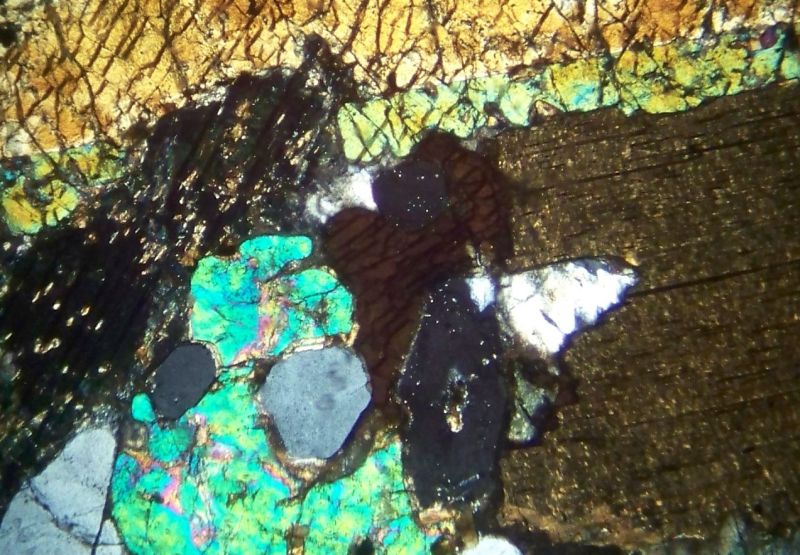
A thin section of hornblende and apatite
Photo by Pitor Sosnowski


Most of this faceting material is found in metamorphosed limestone that is commonly called marble. In general the more impurities that are found in limestone the more apt it is to produce apatite when it is metamorphosed. There is a bed of metamorphosed limestone that reaches all the way from Québec to Alabama just of the West of the Precambrian core of the Appalachians. In many places this is called the Great Valley of the Appalachians but the same marble belt extends all the way to Canada. There is apatite found throughout this entire region, and others like it all over the world.

Saturday, July 30, 2011

Gemstone Occurrences in Connecticut

Almandine garnet, Connecticut's state stone.
Photo by Rob Lavinsky


Connecticut is amply endowed with gemstones ranging from andalusite to zircons.  The stones found in Connecticut are found in a variety of terranes although the primary one is pegmatites, but they are also found in the trap ridges of the Connecticut River Valley.  Even more are found as glacial float if you want to use that method of finding gems.

Just in the town where I live, Barkhamsted there are several different verities of gemstones including almandine garnets, beryl, corundum, kyanite, quartz, soapstone, zircon and the usual rock forming minerals.

Connecticut is blessed with many gem bearing pegmatites one series starts in Glastonbury and Crosses the Connecticut River at Middletown and extends almost to the coast of Long Island Sound.  The other belt of pegmatites extends diagonally across the western portion of the state from Hartland to Ridgefield.  Both of these belts contain many of the gemstones found in LCT type pegmatites.  Many of them are Dana localities and one of them, the Maryall Mine is considered to be one of the most important gemstone mines in the United States.  This mine is famous worldwide for its crystals of aquamarine and golden beryl.  It also contains some bright red garnets that can weigh up to several pounds.

Beryl crystals on Feldspar.
Photo by Rob Lavinsky


The trap ridges of the Connecticut River Valley and in Woodbury contain specimens of amethyst, datolite and prehnite that are found in vugs in the trap rock.  Some of these occurrences are also Dana localities. Many of them are also world famous.  Connecticut has over 600 recognized mines that are now abandoned scattered mainly across the western half of the state, but there is still plenty of gems to be found in eastern Connecticut.

Microlite-Elbalite and Lepidolite found in the pegmatites of Connecticut.
Photo by Rob Lavinsky
The beaches in eastern Connecticut are littered with moonstones that have eroded from the granite eastern Connecticut is known for.  Another stop you should make is the Connecticut Mining Museum that is part of the Sloan-Stanley Museum in Kent where many of the minerals found in Connecticut are displayed along with lots of information about the mining industry that used to be found in the state.  According to many authorities modern mining was developed in Connecticut then spread out all over the world.

Thursday, June 9, 2011

How most Colored Gems are Mined

Artesinal gem miners in Africa using traditional mining techniques.
Photo by Laura Latrigue 


Most people think that a mine is some kind of huge excavation in the ground or a series of deep tunnels that are served by the use of large equipment including 400 ton haul trucks to bring the ore to the mill. This is hardly the kind of mine describing most colored stone operations these are artisnal in nature and have hardly changed since biblical times.

The miners use as their primary tool a conical device that resembles a gold pan with a gently sloping bottom that ends in a point. The same device is also covered with small holes following easy entrance of water. This device has many names, but at least in one country where it is still used it is called the “Batik.”

An example of a rough lavender sapphire from an alluvial deposit.
Photo by Rob Lavinsky 


In use this device is filled with gem bearing gravel and then is pumped up and down in the water allowing heavier minerals to settle to the bottom of the batik. It is necessary to classify the minerals by size before being placed into the batik. Another common name for this device is the jig it because of that takes place while it is in use.

The mining takes place in the sand and gravel deposits found in association with some local stream. The gemstone deposits are usually found in close proximity to the bedrock even as gold is because most of the minerals that are classified as gemstones have a specific gravity ranging from 4 to 5 that the jigging action causes these stones to migrate to the bottom of the batik.

Sometimes the miners excavated to the gravel for 20 or more feet to reach the level of the richest deposits. Although gemstones are usually found in country that is underlain by a special type of gneiss containing the mineral cordierite like that found in the gem bearing areas of Madagascar and Sri Lanka. There is even a deposit of this special gneiss that is found in Connecticut in a narrow band extending northwards from Guilford. It is also found throughout areas that have been highly metamorphosed. It doesn't take this kind of rock to produce gemstones because they are like gold; they are where you find them.

In use once the batik has been jig up and down in the water long enough for the gemstones to settle to the bottom its top is covered with a plank and the batik is turned upside down on the plank so the gemstones are now all on top of the heap. They are then inspected for gemstones that are recovered, and the balance of the stones in the batik is discarded.

Using this method more than 50% of the colored stones that are in the jewelry trade are recovered using this method. You can make a pretty effective batik from a colander that you can buy in a kitchen supply store that is just about as effective as a batik. The most important thing that you can easily learn is what the various gemstone rough looks like.

In these times where gold is looked upon as a new measure of value it should be remembered that as far as concentrated wealth goes there is nothing that can beat gems for a very high value. Some of these gemstones are worth more than $20,000 per carat, and a caret only weighs 1/5 of a gram.

Sunday, May 22, 2011

The LCT Pegmatite and the Production of Gemstones

Beryl crystals on schorl from a vug in a pegmatite
Photo by Rob Laninsky


As can be seen from the list if gemstones found in pegmatites most of them come from LCT pegmatites.  The major components of these pegmatites beside the usual feldspar, quartz and mica are Lithium, Cesium and Tantalum hence LCT pegmatites.  The three primary pegmatites grade into each other according to depth and pressure.  The simple pegmatite is the closest to the body of intrusive granite having the highest pressure and temperature.  As the temperature and pressure decreases the simple pegmatite grades into the LCT pegmatite, and finally grades into a NYF pegmatite.  The NYF pegmatite contains the elements neodymium, yttrium and fluorine hence its name NYF.

The simple pegmatite does not contain miarolitic cavities usually, but as the pegmatite grades into the LCT phase the cavities become more prevalent, and in a NYF pegmatite they are quite common.  It is in these cavities where the gems form usually as flawless crystals under the right conditions.  It is estimated that only about 10% of these cavities produce flawless gems.  These cavities are usually termed “vugs” when they are inside a pegmatite.

Topaz crystal on quartz from a pegmatite
Photo by Rob Lavinsky


If the vug is cracked or broken by earth movements it will lose its pressure causing the crystals to shatter so they are found as fragments on the floor of the vug.  Another common feature of vugs is allowing more hydrothermal fluid to enter causing this additional fluid to etch the minerals present, and sometimes completely removing them.  A late stage in the formation of a vug is the production of clay that coats the crystals with a thin layer.  Unless the integrity of the vug has been breached this clay layer is composed of leftovers from the process of pegmatization. If the vug has been breached the clay is clay that has been washed into the pegmatite from surface sources.  In either case the clay is usually kaolin.

Red tourmaline crystals with quartz and lipidolite on calcite
Photo by Rob Lavinsky


Even though the gem forming minerals are located in vugs in the center zone of the pegmatite the same minerals forming the pegmatite are found locked within the body of the pegmatite in this case the stones contain so many imperfections and fractures to render them useless as gems for the most part.  These minerals can include many of those used as gems, but in this case they can be used as ores for several important metals such as lithium, cesium and niobium and tantalum.

Most of the LCT pegmatites display zoning with each zone carrying a specific suite of minerals.  Some of these pegmatites can have as many as seven different zones. The center zone is composed mainly of quartz, and is also the zone containing the vugs.

The gem containing vugs can range in size from a few centimeters to the size of a large room.  Some of these large vugs can contain several million dollars worth of gemstones as some of the monsters in the Pala district of southern California or the monster found by two hunters in Newry, Maine that yielded $8 million worth of gem grade tourmaline.  Other fabulous finds of pegmatite gems are found all over the world.  Some of the most prominent have been found recently in Afghanistan and Pakistan that have produced many valuable gemstones.  

Friday, April 29, 2011

Hunting Gems in a Pegmatite

A pegmatite is the host rock for many gemstones that are not found any where else along with a host of other rare minerals.  The stone itself is an intrusive igneous rock that chemically is the same as granite in fact one of its nicknames is “Giant Granite” because of its large sized crystals.  Most pegmatites are what are termed simple pegmatites composed of quarts, feldspar and mica that are composed of grains that exceed 2.5 centimeters in size. There are however some other classes of pegmatites that are known as “Dirty Pegmatites” that contain a host of other minerals contaminating them with one of then being the lithium minerals lepidolite, a form of lithium mica that is purple, and spodumene, lithium silicate.  It is in these pegmatites where most gemstones are found.

An "X" shaped cross of pegmatite in a darker colored gneiss.
Photo by Arlette 1


Most gemstones in a pegmatite are found in cavities that are formed inside the pegmatite where there is not a sufficient amount of material to completely close the inside of the vain leading an open space where clean crystals are formed. There are also other areas within the pegmatite where it is possible for gemstones to form the subsequent deposits usually cause these particular stones to be imperfect.

A set of rubbelite crystals from the Pala District of San Diego County, California.
Photo by Rob Lavinsky


Most of these pockets or vugs are found in association a particular rock texture called graphic granite where the vug is found to beneath a layer of graphic granite where the individual crystals displayed keep getting larger. Graphic granite resembles cuneiform writing like that used in ancient Babylon.

There are many different gemstones that are associated with pegmatites including: amblygonite, beryl, corundum, fluorite, topaz and tourmaline among others. Pegmatites are the home of many other exotic minerals that are not classified as gemstones, however some of these minerals are used for ores for lesser-known metals like beryllium, niobium and tantalum. 

Beryl Crystals on dolomite.
Photo by Rob Lavinsky


Several years ago a roadbuilding contractor was working in Oxford County Maine when in the course of blasting a rough cut discovered a crystal of tantalite weighing several tons. Rather than just dumping it with the rest of the rock he sold the tantalite for a not-for-profit that it paid for the entire roadbuilding project. He simply pocketed the profit.

A crystal of tantalite in a pegmatite matrix.
Photo by Rob Lavinsky


Pegmatites are found all over the world wherever you have crystalline rocks. Some of the notable pigmented to the United States are found in the Appalachian Mountains, the Black Hills, the Rocky Mountains into the Pala district in San Diego County, California.

Friday, January 21, 2011

Diamond the Hardest of all Gems

Kimberlite
Photo by Subarcticmike
The very name for the diamond is “adamant” meaning roughly that it is indestructible.  The gem we call diamond was known to the ancients when practically the entire earth’s supply came from the region around Golconda, India.  This region in India supplied most of the diamonds in the world until the discovery of alluvial diamonds in Brazil in 1729.  The diamond fields of Brazil produced most of the world’s diamonds for almost a century until diamonds were discovered in South Africa in 1867.  This led to the discovery of diamonds in an ultramafic rock that was named kimberlite after the South African town of Kimberly where the new rock was discovered.

A diamond crystal in a matrix of kimberlite. USGS

The other source of diamonds during antiquity was from western Borneo where they are found in alluvial deposits of Eocene age.  Most of the stones found in these deposits are small and of poor quality.  These diamonds are still being mined mainly by artesianal methods under primitive methods.  To this day nobody has ever discovered the primary source of these diamonds.

During the post World War II period extensive deposits of diamonds were discovered in the Soviet Union by tracing a special type of pyrope garnet that is in high in chromium to its source.  The source was found in kimberlite pipes in Siberia.  Several mines were opened causing the Soviet Union to become one of the world’s largest producers of diamonds.

A princess cut diamond mounted in a ring.
Photo by Stephen Durham

After the discoveries in the Soviet Union the scene shifted to Australia where a new type of deposit was discovered in a type of rock called lamproite.  This has resulted in the development of the largest diamond mine on earth, the Argylle Mine.  Some pf the diamonds found in this mine are colored purple an extremely rare type of diamond.

The diamond discoveries in the Soviet Union and Australia led to the discovery of kimberlite deposits in Canada, Brazil and India.  There are also deposits producing diamonds in Arkansas and eastern Colorado and Wyoming


Wednesday, January 19, 2011

What is a Gemstone?

A gemstone or gem is also called by several other names such as precious or semi-precious stones or even jewels. These stones when cut and polished are used to make jewelry or other adornments used for decorations on the human body. Most gemstones are minerals but there are certain rocks such as lapis lazuli that are rocks. Other gemstones are made of organic matter such as amber, jet, coral or pearls even though they are not minerals they are still used in the manufacture of jewelry. Because of this use they are still considered to be gemstones. For the most part gemstones are usually hard, but occasionally some soft materials find their way into jewelry because of certain characteristics that are found attractive. In the past gemstones were also used to create major luxury art forms. The carvings made by the Russian lapidariest Carl Faberge were the last significant works that were made during the 19th century of this type.

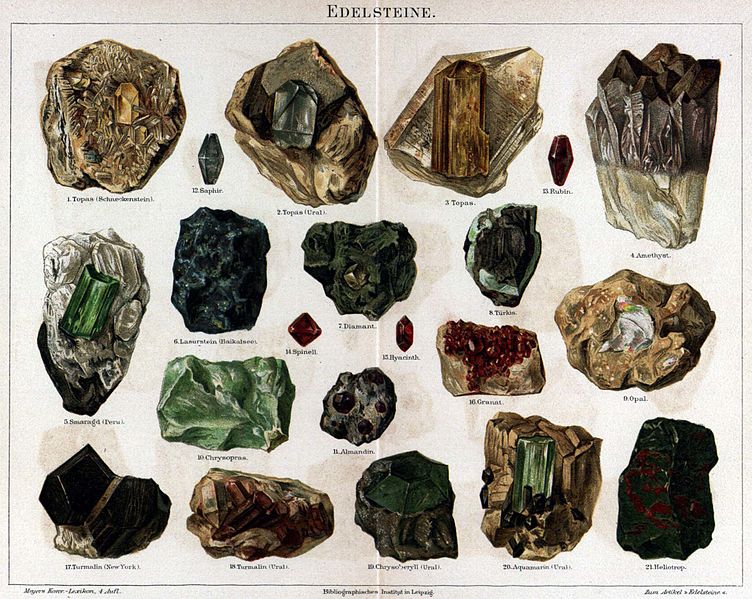
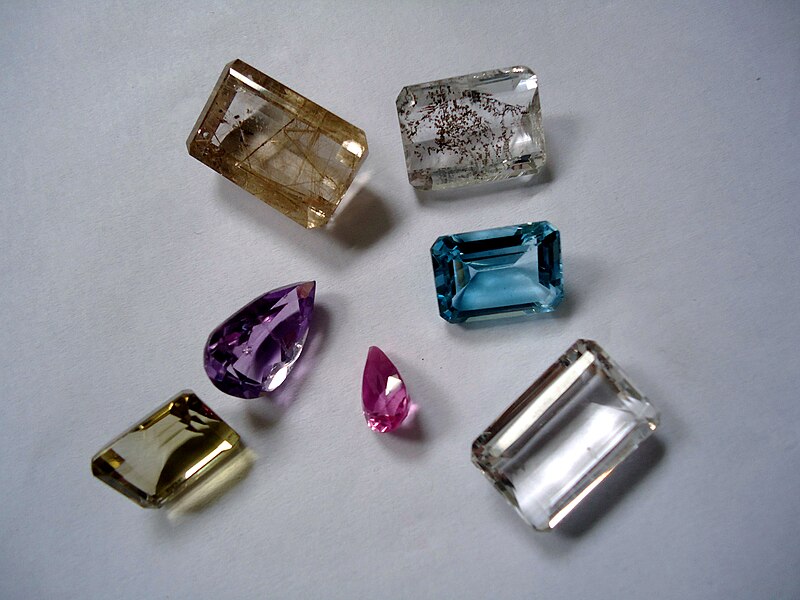
A collection of uncut gemstones.
In the West the traditional classification of gemstones goes back to the ancient Greeks. This classification was split between the precious and semi precious stones; this distinction was also made in many cultures around the world.

In our modern world these are the stones that are considered precious diamond, ruby, sapphire and emerald. Some experts include the natural pearl on this list. The list of precious stones is not particularly scientific it rather tells of the rarity of these stones during ancient times. There are many stones that have as high a value as the so-called precious stones that are only considered to be semi precious. An outstanding example of this is the Alexanderite a variety of crysoberyl the changes from red to green tea pending on the type of light it is exposed too.

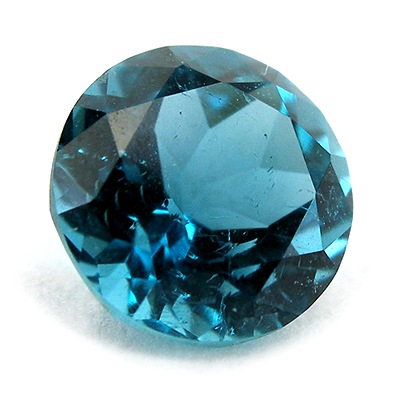
A faceted blue tourmaline
Most of these gemstones grade from transparent to translucent displaying fine color when they are pure and with no inclusions, and are very hard. The diamond is the hardest of all with a hardness on the Mohs scale of 10. Generally to be an acceptable gemstone asset have a hardness of at least 8 on the Mohs scale. A slight amount of tolerance however is allowed for some gems as soft as 5 on the Mohs scale to be used in jewelry providing it is not exposed to wear such as an approach or pendant.

The words precious or semi precious used in the context of commercial gemstones is often misleading because it implies certain gemstones are intrinsically more valuable than others when it is just not true.