Total Pageviews

Showing posts with label cavities. Show all posts

Thursday, January 5, 2012

Gemstone Occurrences in New Jersey


A ruby crystal from Tanzania similar to those found in New Jersey.


Like many of the states of the Northeast New Jersey contains some of the best localities for finding gems in the Eastern United States.  Agate is found throughout the traprock quarries of the state as well as quartz gemstones including amethyst that occurs as cavities in the stone.  Many marine fossils are also found in the state including many fossils of shark teeth. Most of these fossils are found in the Kirkwood formation (Eocene and Miocene) in Monmouth County.

One of the most interesting stones found in the state are so-called Cape May Diamonds that in reality are waterworn quartz crystals that are found on the beaches of Cape May Point along the Delaware River in southern New Jersey.  These stones are the most abundant at Higbee and Sunset beaches in Cape May.  These stones can range in size from the finest sand to one whopper that weighed 3 pounds 14 ounces that is known as the Cape May Diamond that was found in New Castle, Delaware in 1866.

Rubies are rarely found in the white marble at the mining district in Franklin where they are found associated with the zinc mines in Franklin and Sparta.  Many of these stones are small, but are well formed.  The rubies fluoresces red, but the marble matrix doesn’t. Many minerals found on the mine dumps around the area are various minerals of zinc that also fluoresce in brilliant colors under a fluorescent light with some of them even considered gemstones.  Another mineral that is found associated with the zinc minerals is rhodonite a silicate of manganese that is often cut as cabochons.

Bloodstone or heliotrope is found in sparing amounts in the Eastern United States north from Florida with exposures in New Jersey.  This is a member of the quartz family of gemstones that is dark green in color with bright red spots of hematite.  This stone is often cut and used in inexpensive jewelry.
A polished slab of petrified wood.
Photo by Daniel Schwen

In addition to agate the traprock quarries in Passaic County also contain many zeolite minerals as well as datolite and prehnite in large quantities. In many places the traprock quarries have cavities lined with amethyst crystals.  In some areas in eastern New Jersey you can find jasper and petrified wood.

In recent years one of the most valuable gems in North America has been overlooked by collectors is the freshwater pearl found in many of the mollusks in the states many rivers.  The pearl was looked avidly for in the 19th Century, but for a period of inactivity caused by over fishing the mollusks  caused this industry to decline.   

Tuesday, June 14, 2011

Gem Bearing Cavities in Pegmatites

Cavities in rock.
Photo by Ustill


Just about any kind of rock can have cavities some pegmatites are particularly prone to this feature, and it is in these cavities that most gemstones are found. There are many causes of these cavities, but one of the most common is a gas bubble. In many pegmatites cavities can also be formed by a lack of sufficient magma to completely fill the space the pegmatite is occupying.

Cavities are found in pegmatites generally come from one source that is the lack of sufficient material to fill the pegmatites solid. Some of these cavities are quite small and are measured in millimeters. Larger ones are measured in centimeters, and still larger ones are measured in meters. The latter are the most uncommon form of cavity. When they are found in the process of gem mining they often become legendary containing several million dollars worth of gemstones.

Rubbilite tourmaline crystals found in a gem bearing cavity in pegmatite.
Photo by Rob Lavinsky


A cavity that has not been affected by Earth movements grows a fine crop of gem crystals that are attached to the matrix. These crystals are often covered with a fine layer of clay that forms from the last of the mineral bearing solution in the cavity. One might say from the leftovers. Less than one in ten of all the cavities that are found are of this variety. Originally these pegmatites were under considerable pressure as they were formed several miles beneath the surface of the earth. As they were brought up to the surface of the earth by the process of erosion they lost this initial pressurization through the process of a diffusion of their internal gases through the pores in the rock.

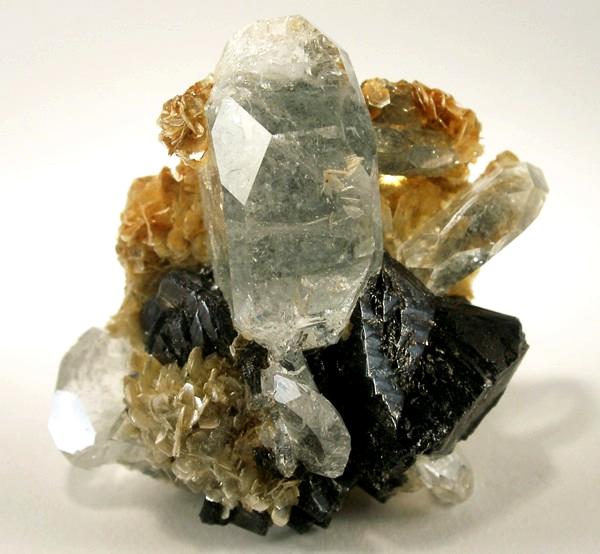
Beryl, Cassiterite and Muscovite from a pegmatite cavity.
Photo by Rob Lavinsky


It's the same cavity is fractured by Earth movements so that it loses its internal pressurization crystals that it contains are shattered, and the fragments fall to the bottom of the cavity. Another feature of this type of cavity that is now open for the atmosphere allowing it to be filled with clay that accumulates in the cavity from sources found on the surface of the earth.

Finally, some cavities that remains sealed from the atmosphere are visited by a later type of mineral bearing water that causes the gem crystals inside him to be etched away partially or wholly.

These cavities are known by many names including cavity, geode, pocket and vug.