Total Pageviews

Showing posts with label precious. Show all posts

Sunday, January 23, 2011

The King of Stones the Ruby

Rubies are a red colored form of corundum a form of aluminum oxide with the chemical formula of Al2O3.  This is the same mineral that produces sapphires that are found in blue and virtually every other color except red that color is reserved for the ruby only.

A ruby crystal on calcite.
Photo by Rob Lavinsky

To be a ruby the mineral corundum has to be colored pink to blood-red where the color is caused by a minute quantity of the element chromium.  The red color gives it its name “ruber” that is the Latin word for red making for an easy move to “ruby” in English.  In the trade ruby is considered one of the four precious stones the others are diamond, emerald and diamond.  Some people consider natural pearls to be the fifth precious stone although the owe their origin to natural processes produced by a living animal.

Hands down a good ruby exceeding 10 carets in weight is the most valuable of all gems.  Like any other gem the prices for rubies are mainly determined by their color, so that the most valuable stones are those that are bright red the so-called pigeon blood-red that commands a huge premium price when compared with any rubies having a similar quality.  The same as grading diamonds the next criteria for rubies is clarity where a clear stone will also command a premium.  However, a ruby containing needle like inclusions of the mineral rutile will often produce a star on a ground specimen that commands a high price as a star ruby.  Most rubies have been heat treated causing the rutile inclusions to vanish indicating that the stone has been treated.  The final quality that can determine a rubies price is cut and its weight in carets.  A recent price quoted for a ten caret pigeon blood-red stone was $24.000 per caret.  This meant the stone had a wholesale value of $240,000.
A cut pigeon blood ruby.

Rubies are most often found in suture zones, a good example is the ruby deposits found in the Mogok Valley of Myanmar where the rubies are found in an altered limestone that when it was laid down received a clay containment that was rich in alumina.  When the limestone was metamorphosed to marble the alumina that is aluminum oxide was converted into corundum.  The addition of a small amount of chromium ions caused the corundum to produce rubies.

Rubies are often a component of marble a good example of this is the occasional ruby crystal found in Franklin, New Jersey.  Sometimes marble undergoes further metamorphism into a rock called amphibolite that also can contain rubies as it does in a newly discovered deposit in southwest Greenland.  Although the stones in this deposit are small they make up for it by being almost perfect pigeon blood-red.

One of the necessary criteria for the formation of all rubies and sapphires it that they form in a rock that is starved of silica;  sometimes these stones are found associated with deposits of ultramafic rocks that is the apparent association where many rubies have been found in the gravel of the Cowee River in Franklin, North Carolina.

This is a place where the general public is invited to find their own rubies by washing, and separating the rubies from gravel.  Most of these stones are heavily contaminated with impurities, but many make some very fine gems.  Occasionally a stone is discovered that rivals the best stones produced in Myanmar.  Rubies are also found in several other parts of the world notably in Madagascar and Sri Lanka where they are found in gem bearing gravel.


Wednesday, January 19, 2011

What is a Gemstone?

A gemstone or gem is also called by several other names such as precious or semi-precious stones or even jewels. These stones when cut and polished are used to make jewelry or other adornments used for decorations on the human body. Most gemstones are minerals but there are certain rocks such as lapis lazuli that are rocks. Other gemstones are made of organic matter such as amber, jet, coral or pearls even though they are not minerals they are still used in the manufacture of jewelry. Because of this use they are still considered to be gemstones. For the most part gemstones are usually hard, but occasionally some soft materials find their way into jewelry because of certain characteristics that are found attractive. In the past gemstones were also used to create major luxury art forms. The carvings made by the Russian lapidariest Carl Faberge were the last significant works that were made during the 19th century of this type.

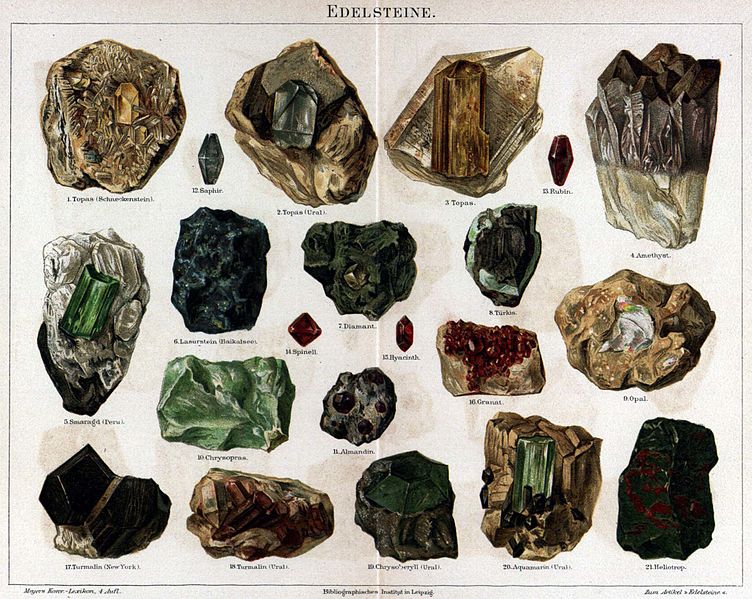
A collection of uncut gemstones.
In the West the traditional classification of gemstones goes back to the ancient Greeks. This classification was split between the precious and semi precious stones; this distinction was also made in many cultures around the world.

In our modern world these are the stones that are considered precious diamond, ruby, sapphire and emerald. Some experts include the natural pearl on this list. The list of precious stones is not particularly scientific it rather tells of the rarity of these stones during ancient times. There are many stones that have as high a value as the so-called precious stones that are only considered to be semi precious. An outstanding example of this is the Alexanderite a variety of crysoberyl the changes from red to green tea pending on the type of light it is exposed too.

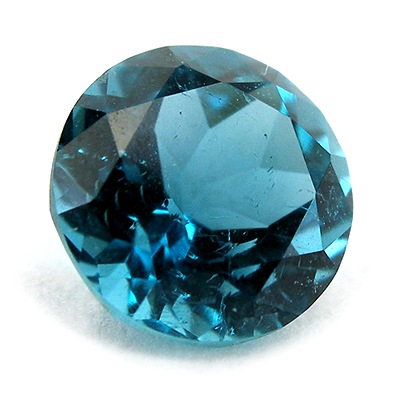
A faceted blue tourmaline
Most of these gemstones grade from transparent to translucent displaying fine color when they are pure and with no inclusions, and are very hard. The diamond is the hardest of all with a hardness on the Mohs scale of 10. Generally to be an acceptable gemstone asset have a hardness of at least 8 on the Mohs scale. A slight amount of tolerance however is allowed for some gems as soft as 5 on the Mohs scale to be used in jewelry providing it is not exposed to wear such as an approach or pendant.

The words precious or semi precious used in the context of commercial gemstones is often misleading because it implies certain gemstones are intrinsically more valuable than others when it is just not true.