Total Pageviews

Showing posts with label minerals. Show all posts

Thursday, August 9, 2012

New Jersey Gemstones

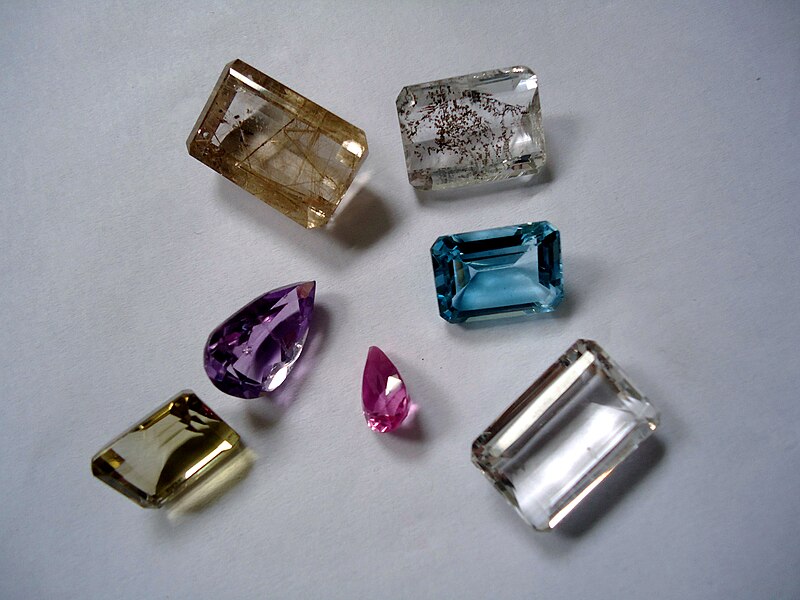
A variety of tumbled gemstones
Scanned by Adrian Pingstone


Amber that has been preserved since the age of dinosaurs is found in several places in New Jersey where there are Cretaceous rocks one of these places in the area around Sayreville although they can be found scattered throughout the Cretaceous rocks and various localities throughout southern New Jersey. Although there are several deposits of Cretaceous aged rocks in the United States Amber is only found with appreciable quantities in New Jersey.

Amethyst is found in the many trap ridges of New Jersey in both the area of the Palisades and in the Ramapo Mountains.  This variety of quartz is usually found in the cavities in the rock. Many other minerals of the zoisite family are also associated with traprock quarries.

In the past there was extensive zinc mining activity in Franklin and Sterling Hill in Ogdensburg that produced large quantities of zinc minerals.  The mine dumps in these areas are one of the most noted areas in the United States that have produced fluorescent minerals.  Some of these minerals are gemstones in their own right notably rhodonite and sphalerite.  In addition Sussex County is also known for producing other minerals including aragonite, corundum, garnet, pyrrhotite, rhodonite, spinel, tourmaline and williamsite.

Bergen County has produced amethyst, natrolite and opal that are found in the county’s trap ridges.

Mercer County has been known to produce albite, calcite, chabazite, datolite, natrolite, stilbite and tourmaline. Calcite, chabazite and datolite are produced from the trap ridges in the county.

In the far southern part of New Jersey can be found quartz crystals that are called by many Cape May diamonds although the source of these stones remains unknown it is thought they are washed down from some underwater formation further upstream in the Delaware River.  They are found on the beaches of Cape May and surrounding communities at the mouth of the river. The same area also produces jasper. 

Corundum has been found in Sussex County associated with the Franklin limestone as almost perfect crystals seen in cavities in the limestone.  These stones are blue, grey and red that in some places are clear enough to be cut into gems. 

Other counties where gemstones can be found include:

Middlesex - marcasite, petrified wood, pyrite

Morris - carnelian, serpentine

Passaic - agate, amethyst, carnelian, chabazite, datolite, heulandite, pectolite, prehnite

Sussex - aragonite, corundum, garnet, pyrrhotite, rhodonite, spinel, tourmaline, williamsite

Union - calcite, chalcedony, prehnite, sphalerlite

Warren - calcite, chalcedony, garnet, molybdenite, prehnite, serpentine, sphalerlite

Most of the collecting sites are located in Northern New Jersey.  Many of these sites are found at old mines or rockcuts.

Saturday, July 21, 2012

The easy way of Identifying your gemstones and minerals


Semi precious gemstones
Photo by Mauro Cateb


All gemstones are minerals, but not all minerals are gemstones, so the limited knowledge imparted here can be used on both gemstones and minerals.  If you can’t tell what kind of gems you own don’t feel bad because there have been plenty of emperors and kings that didn’t have a clue about what kind of stones they had in their own crown.  A good example of this is the Black Prince’s Ruby that resided in the Crown of England for hundreds of years before somebody found out it was really a mineral called “spinel.”  This is a stone that looks like a ruby but is a much less expensive stone then real ruby.  Clear white topaz is often mistaken for diamond and in the past many large diamonds have been found to be really topaz.  Identifying these stones is in the realm of the gemologist who is specially trained to identify gemstones.

A translucent ruby
Photo by Rob Lavinsky


There are several stones that are treated as gemstones, but aren’t.  Amber is a glaring example of this, a stone that is treated as a gem but in reality is fossilized tree sap having many inclusions of insects and other organic matter.  Petrified wood is another example that is often beautiful and is treated by many as a gemstone, but isn’t.  Jet, the black stone is actually a variety of coal and far from the definition of a gemstone, as are pearls.  Pearls have the distinction of being the most valuable stone, but they aren’t gemstones either.

Identifying gemstones and minerals is really a process of the elimination, for instance if you are presented with a green clear gemstone it is not apt to a ruby. More than likely it is emerald, but you really can't be sure without further tests. There is a variety of garnet called demantoid that is also green and is often mistaken for an emerald. One of the most important tests that are used in mineral identification is the color of the stone.

Hardness is another criterion that is used. This is based on the Moh’s hardness scale that ranges from 1 to 10 with diamond being the hardest and soapstone the softest. Most stones that are used in making jewelry are harder than seven on the Moh’s scale even though some stones that are as soft as three on the Moh’s scale are faceted for collectors. You can buy hardness testing kits or make your own from various minerals that work’s as good as store bought.

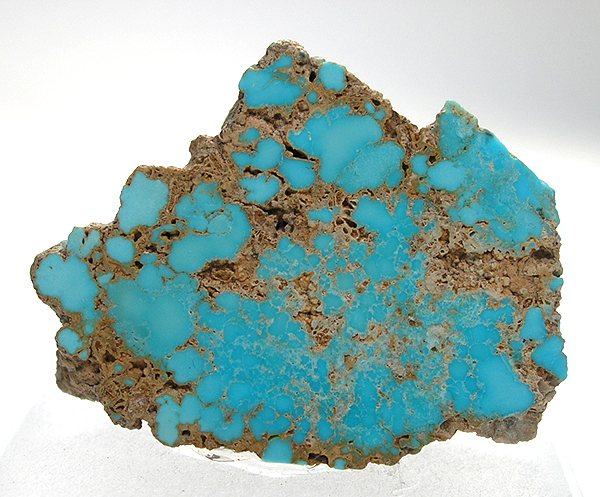
Turquoise from Mojave County, California
Photo by Rob Lavinsky


The looks of the stone are important is it transparent, translucent or opaque.  Transparent means can you see through the stone so things can be seen clearly that are behind the stone.  Translucent means does light pass through the stone, but you can’t make out objects that are in back of the stone.  Opaque means light doesn’t pass through the stone, and you can’t see through it.

Streak is literally a thin mark of the mineral or gemstone composed of very fine powder left on a piece of unglazed porcelain colored either black or white.  Black is often used to test for gold and other precious metals when it is known as a “Touchstone.”  It is often used in conjunction with acid to see if there is a reaction between the streak and the acid.  The karat weight of gold can be determined by treating its streak with various concentrations of nitric acid.

2x2 inch black and white streak plates,  White is pyrite and black is rhodochrosite


We sell streak plates: Click Here 

Cleavage and fracture are other important tests.  Fracture is most important for quartz gemstones that break in a Concoidal fracture that looks like little clam shells.  Some minerals like jade have a hackly fracture i.e. a rough appearance.  Some stones have a pronounced cleavage like topaz or diamond.  Topaz is especially prone to a perfect basal . cleavage causing it to be a poor gemstone.

Specific Gravity was discovered by Archimedes when he was tasked to find out if a gold smith cheated the Tyrant of Syracuse when he was making a golden crown for the tyrant.  This was a job that required quite a lot of forelock tugging on the part of Archimedes until he finally threw his hands up and decided to take a hot bath. His slave girl filled the bathtub to full of hot water so on Archimedes claimed into the tub it overflowed. He had discovered the principle of specific gravity, and with that he jumped out of the bathtub and went streaking through the town agora of Syracuse yelling at the passersby Eureka, Eureka that means I have found it, I have found it. They all thought he had gone nuts, and if it wasn't for the fact his brother-in-law was the tyrant he will probably been slapped in jail.

What Archimedes discovered was the body would displace an equal amount of water according to its volume, or in modern terms its weight per cubic centimeter. This is normally taken by first weighing the object in air and then weighing in water. The difference is its Specific Gravity.

These are some simple tests that can help with gemstone or mineral identification there are others that are far more complicated that can be used in conjunction with the simple tests. Although there are over 2000 recognized minerals in the world there are only about 300 that are common rock forming minerals that you are apt to encounter in the field. A good source of information about most minerals can be found at www.mindat.org

Saturday, May 19, 2012

Minerals of Litchfield County, Connecticut

Platy ilmenite crystals encrusted on feldspar from Litchfield, Connecticut
Make an offer over $2,500
itchfield County, Connecticut has a very complex geology and a wide variety of minerals that ti date have been largely out of scope to the mineral collector.  It is our aim to make some of these minerals available to the collector.  Our first selection of minerals comes from a long abandoned mine in Litchfield , Connecticut that according to the records produced "soapstone" during the 1700s. Some of the minerals found at this locality include such world class specimens as kyanite, ilmenite, magnetite, quartz and many others.  There are over two-hundred minerals that have been identified in the county that was the home to over two-hundred mines in the past that have been long since abandoned and mainly forgotten.
James Dwight Dana in a painting by Danial Huntington - 1858

It is possible our long abandoned mine site is a Dana Locality because of some mineral specimens that were collected in Litchfield that are now in the collection of the Yale Peabody Museum in New Haven, Connecticut including ilmenite of which our locality still has world class specimens in sizes ranging from mere chips to boulders weighing up to several hundred pounds.  The size range of the specimens range from micro specimens to boulders that can be used in landscape arrangements.

We are making these specimens for sale to the mineral collector.  You can contact us at: geotekllc@gmail.com for prices and additional information.

Below are illustrations of some of the specimens we have for sale:
This is a large specimen of staurolite in feldspar from Litchfield, Connecticut
Make an offer more then $150
Schorl wisps in quartz from the Whodunit Mine in Litchfield, CT
Price $25.00
Goethits pebble from an alluvial deposit in Salisbury, CT
Price $12,00
Stepped layers of ilmenite is feldspar from the Whodunit Mine in Litchfield, CT
Price $25.00
Platy ilmenite crystals in feldspar from the Whodunit Mine in Litchfield, CT
Price $50.00

This is a sample of kyanite from our locality in Litchfield, Connecticut.  This is a large specimen as can be seen by the quarter coin used to illustrate its size.  This specimen is truly spectacular with a mere photograph failing to do it justice.
Price $50

Blue kyanite in smoky quartz from the Whodunit Mine in Litchfield, CT
Price $45.00

About the Whodunit Mine we still don't know what they were mining except it is in a highly mineralised zone that contains many mineral specimens of all sizes and old artifacts.  


We will display more specimens that are for sale as they are prepared and photographed.


For further information about these specimens please contact us at geotekllc@gmail.com