Total Pageviews

Showing posts with label jewelry. Show all posts

Thursday, February 23, 2012

Almandine Garnets


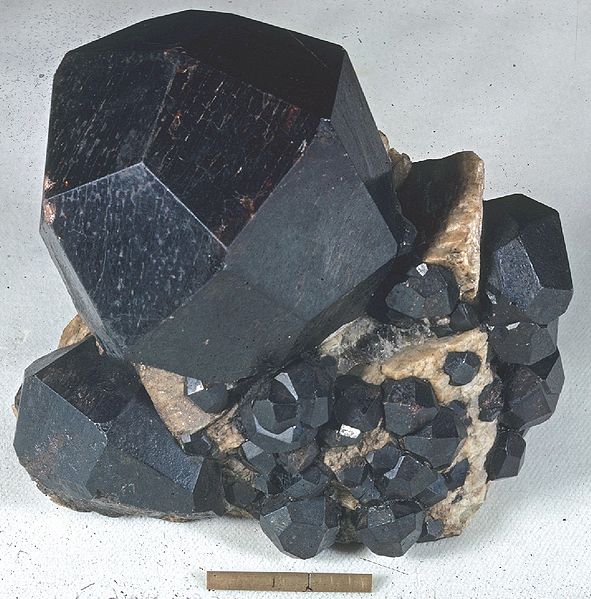
A cluster of almandine garnets in matrix.
Photo by Rock Currier
Almandine is a member of the garnet family that was known to the ancient Romans where it was pronounced “alabandicus” where it was known to Pliny the Elder. This was a stone that was either found near or worked at the town of Alabanda a town in Cariua in Asia Minor. In composition it is an iron aluminum garnet possessing a deep red color that inclines toward purple. Almandine as a stone entering the jewelry trade is either faceted or cut with a convex face en cabochon when it is then called a carbuncle. When the stone was viewed through a spectroscope in a strong light, it generally shows that has three characteristic absorption bands.

The stone is one end member of a solid solution series the other end up being the pyrope garnet that is magnesium rich rather than iron. The chemical formula for almandine garnets is: Fe3Al2Si3O12. The solid solution occurs when magnesium substitutes for the iron causing an increasingly rich pyrope composition. Almandine is the ferrous iron member of the class of garnet minerals that are important group of rock forming silicates that are the main rock forming minerals in the Earth's crust. Crystals of almandine are often seen in mica schist fillet very much like raisins in a pudding. This type of garnet crystallizes in the cubic space group Ia3d having a that a cell parameter of 11.512 Å at 100° Kelvin.
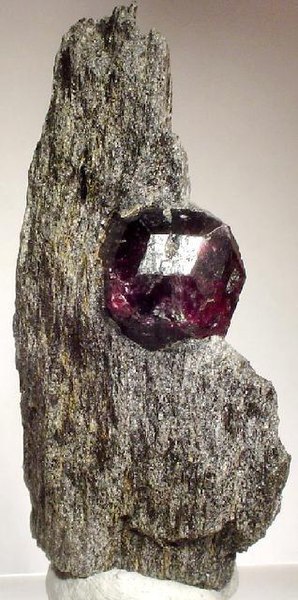
A gemmy red almandine garnet on a matrix of mica schist
Photo by Rob Lavinsky


Almandine can be found rather abundantly in gem gravels found in Sri_Lanka, but are actually pretty abundant in any stream gravel that is found adjacent to metamorphic or igneous rock. In this case almandine garnets are a constituent of the black sand that are classified as stream heavies. Sometimes almandine garnets are so abundant on beaches that they are mind commercially for their abrasive qualities.

In the gem trade almandine garnets have gone by many names among them are Ceylon ruby. If their color takes a violet tint the stone is sometimes called a Syrian Garnet. Large deposits of some especially fine album being garnets were found in the Northern Territory of Australia that were marketed for years as Australian rubies. An especially interesting variety of the stone that is found in stream gravel's in parts of Idaho show a star when they are cut, and marketed as star garnets.

A collection of jewlery in Kracow, Poland made from pearls, diamonds, almandine garnet and enamel.
Photo by S.F. Burgerer


As a mineral almandine is widely distributed throughout the world with fine rhombic crystals that are called to dodecahedra that are found in the schistose rocks wherever crystalline bedrock is found. In

One of the best localities in the United States is located at Gore Mountain in the Adirondack mountains of New York State at the town of North Creek. Some of the crystals that are found enclosed in gabbro are more than a meter across they are mined by the Gore Mountain mining company that crushes them for abrasives. Many of these garnets from this particular deposit are faceting grade and makes an extremely attractive gems.

Wednesday, January 19, 2011

What is a Gemstone?

A gemstone or gem is also called by several other names such as precious or semi-precious stones or even jewels. These stones when cut and polished are used to make jewelry or other adornments used for decorations on the human body. Most gemstones are minerals but there are certain rocks such as lapis lazuli that are rocks. Other gemstones are made of organic matter such as amber, jet, coral or pearls even though they are not minerals they are still used in the manufacture of jewelry. Because of this use they are still considered to be gemstones. For the most part gemstones are usually hard, but occasionally some soft materials find their way into jewelry because of certain characteristics that are found attractive. In the past gemstones were also used to create major luxury art forms. The carvings made by the Russian lapidariest Carl Faberge were the last significant works that were made during the 19th century of this type.

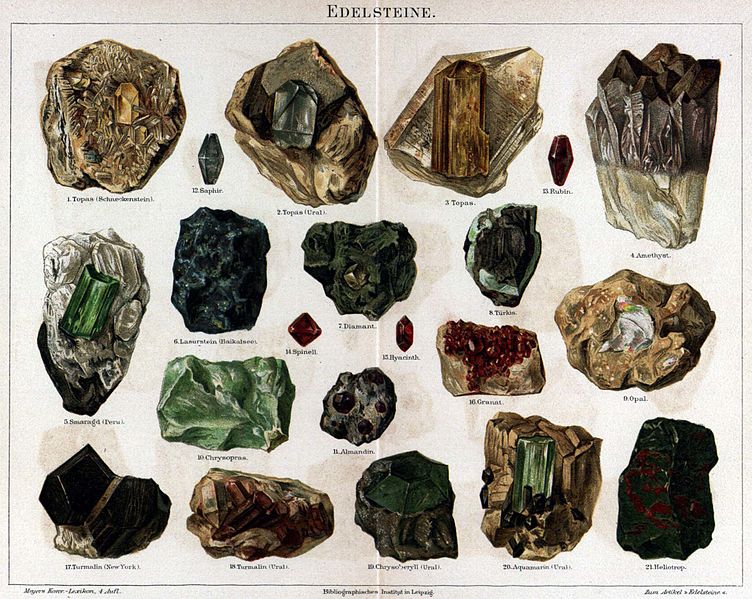
A collection of uncut gemstones.
In the West the traditional classification of gemstones goes back to the ancient Greeks. This classification was split between the precious and semi precious stones; this distinction was also made in many cultures around the world.

In our modern world these are the stones that are considered precious diamond, ruby, sapphire and emerald. Some experts include the natural pearl on this list. The list of precious stones is not particularly scientific it rather tells of the rarity of these stones during ancient times. There are many stones that have as high a value as the so-called precious stones that are only considered to be semi precious. An outstanding example of this is the Alexanderite a variety of crysoberyl the changes from red to green tea pending on the type of light it is exposed too.

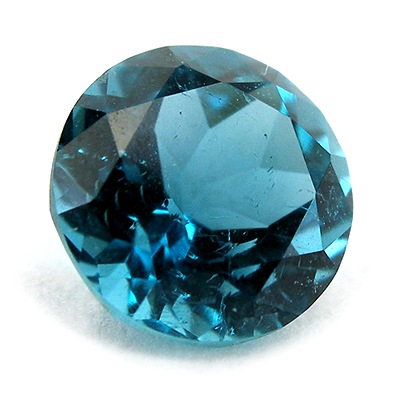
A faceted blue tourmaline
Most of these gemstones grade from transparent to translucent displaying fine color when they are pure and with no inclusions, and are very hard. The diamond is the hardest of all with a hardness on the Mohs scale of 10. Generally to be an acceptable gemstone asset have a hardness of at least 8 on the Mohs scale. A slight amount of tolerance however is allowed for some gems as soft as 5 on the Mohs scale to be used in jewelry providing it is not exposed to wear such as an approach or pendant.

The words precious or semi precious used in the context of commercial gemstones is often misleading because it implies certain gemstones are intrinsically more valuable than others when it is just not true.