Total Pageviews

Saturday, April 30, 2011

Finding Gemstones and Minerals in a Pegmatite

The inside of a pegmatite mine, Ruggles Mine in New Hampshire
Photo by Squelle


Pegmatites are mined not so much for their exotic minerals, but the more mundane feldspar, mica and quartz. The exotic minerals that include gemstones are usually a byproduct of this mining. This is true of most pegmatite mines except for a few like the Maryall mine in Connecticut, and the Himalaya mine in San Diego County California. Because pegmatite it is a very hard rock it is almost impossible to mine without the use of blasting is for this reason the average rockhound is usually excluded. However, from prior mining activities it is possible to go over the mine tailings looking for specimens.

Most miners are more interested in the three primary minerals of feldspar, mica and quartz than they are in the more exotic minerals; therefore these minerals are often thrown onto the waste pile where they remain for the rockhounds to collect later. It is among these tailings where most of the gemstones are found.

By working tailing heaps you are working with stone that has already been mined, and broken up making for much easier collecting. Most of the time you'll encounter stones that are not much more than a foot in diameter, and many of them are usually smaller. You will occasionally encounter a larger stone where it is extremely handy to have in your collection of tools a fairly large sledgehammer weighing more than 8 pounds. Most collecting on a tailings heap can be done with a sledgehammer that weighs 8 pounds, and you can do a considerable amount of damage with an eight pound hammer.

For most collecting in a pegmatite one of the most useless things is a regular geologist’s pick because most of them are too light. What is far more effective is a 4 pound engineer’s hammer and a bullpoint. Bullpoints are a hardened steel rod about three quarters of an inch in diameter having a hexagonal shape about a foot long and coming to a hardened point on one end..

Some of the other things you need in your tool kit for collecting specimens in a pegmatite is a good jeweler's loup is at least 8X magnification on a chain so you can wear around your neck. A stone chisel is another device that should be included. Your kit should also include some old newspapers to wrap your specimens. A small pad and pencil to write down descriptions of the specimens you have found. You should also leave a number on the newspaper holding the specimen so you'll know what it is when you get home.

Friday, April 29, 2011

Hunting Gems in a Pegmatite

A pegmatite is the host rock for many gemstones that are not found any where else along with a host of other rare minerals.  The stone itself is an intrusive igneous rock that chemically is the same as granite in fact one of its nicknames is “Giant Granite” because of its large sized crystals.  Most pegmatites are what are termed simple pegmatites composed of quarts, feldspar and mica that are composed of grains that exceed 2.5 centimeters in size. There are however some other classes of pegmatites that are known as “Dirty Pegmatites” that contain a host of other minerals contaminating them with one of then being the lithium minerals lepidolite, a form of lithium mica that is purple, and spodumene, lithium silicate.  It is in these pegmatites where most gemstones are found.

An "X" shaped cross of pegmatite in a darker colored gneiss.
Photo by Arlette 1


Most gemstones in a pegmatite are found in cavities that are formed inside the pegmatite where there is not a sufficient amount of material to completely close the inside of the vain leading an open space where clean crystals are formed. There are also other areas within the pegmatite where it is possible for gemstones to form the subsequent deposits usually cause these particular stones to be imperfect.

A set of rubbelite crystals from the Pala District of San Diego County, California.
Photo by Rob Lavinsky


Most of these pockets or vugs are found in association a particular rock texture called graphic granite where the vug is found to beneath a layer of graphic granite where the individual crystals displayed keep getting larger. Graphic granite resembles cuneiform writing like that used in ancient Babylon.

There are many different gemstones that are associated with pegmatites including: amblygonite, beryl, corundum, fluorite, topaz and tourmaline among others. Pegmatites are the home of many other exotic minerals that are not classified as gemstones, however some of these minerals are used for ores for lesser-known metals like beryllium, niobium and tantalum. 

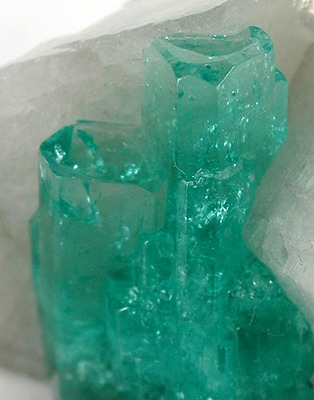
Beryl Crystals on dolomite.
Photo by Rob Lavinsky


Several years ago a roadbuilding contractor was working in Oxford County Maine when in the course of blasting a rough cut discovered a crystal of tantalite weighing several tons. Rather than just dumping it with the rest of the rock he sold the tantalite for a not-for-profit that it paid for the entire roadbuilding project. He simply pocketed the profit.

A crystal of tantalite in a pegmatite matrix.
Photo by Rob Lavinsky


Pegmatites are found all over the world wherever you have crystalline rocks. Some of the notable pigmented to the United States are found in the Appalachian Mountains, the Black Hills, the Rocky Mountains into the Pala district in San Diego County, California.

Sunday, January 23, 2011

The King of Stones the Ruby

Rubies are a red colored form of corundum a form of aluminum oxide with the chemical formula of Al2O3.  This is the same mineral that produces sapphires that are found in blue and virtually every other color except red that color is reserved for the ruby only.

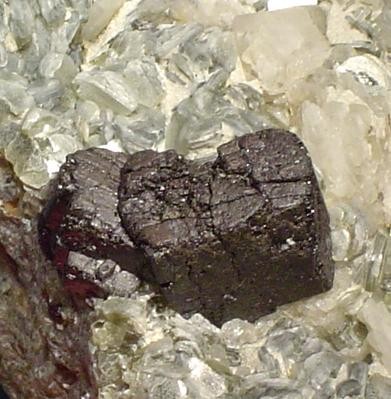
A ruby crystal on calcite.
Photo by Rob Lavinsky

To be a ruby the mineral corundum has to be colored pink to blood-red where the color is caused by a minute quantity of the element chromium.  The red color gives it its name “ruber” that is the Latin word for red making for an easy move to “ruby” in English.  In the trade ruby is considered one of the four precious stones the others are diamond, emerald and diamond.  Some people consider natural pearls to be the fifth precious stone although the owe their origin to natural processes produced by a living animal.

Hands down a good ruby exceeding 10 carets in weight is the most valuable of all gems.  Like any other gem the prices for rubies are mainly determined by their color, so that the most valuable stones are those that are bright red the so-called pigeon blood-red that commands a huge premium price when compared with any rubies having a similar quality.  The same as grading diamonds the next criteria for rubies is clarity where a clear stone will also command a premium.  However, a ruby containing needle like inclusions of the mineral rutile will often produce a star on a ground specimen that commands a high price as a star ruby.  Most rubies have been heat treated causing the rutile inclusions to vanish indicating that the stone has been treated.  The final quality that can determine a rubies price is cut and its weight in carets.  A recent price quoted for a ten caret pigeon blood-red stone was $24.000 per caret.  This meant the stone had a wholesale value of $240,000.
A cut pigeon blood ruby.

Rubies are most often found in suture zones, a good example is the ruby deposits found in the Mogok Valley of Myanmar where the rubies are found in an altered limestone that when it was laid down received a clay containment that was rich in alumina.  When the limestone was metamorphosed to marble the alumina that is aluminum oxide was converted into corundum.  The addition of a small amount of chromium ions caused the corundum to produce rubies.

Rubies are often a component of marble a good example of this is the occasional ruby crystal found in Franklin, New Jersey.  Sometimes marble undergoes further metamorphism into a rock called amphibolite that also can contain rubies as it does in a newly discovered deposit in southwest Greenland.  Although the stones in this deposit are small they make up for it by being almost perfect pigeon blood-red.

One of the necessary criteria for the formation of all rubies and sapphires it that they form in a rock that is starved of silica;  sometimes these stones are found associated with deposits of ultramafic rocks that is the apparent association where many rubies have been found in the gravel of the Cowee River in Franklin, North Carolina.

This is a place where the general public is invited to find their own rubies by washing, and separating the rubies from gravel.  Most of these stones are heavily contaminated with impurities, but many make some very fine gems.  Occasionally a stone is discovered that rivals the best stones produced in Myanmar.  Rubies are also found in several other parts of the world notably in Madagascar and Sri Lanka where they are found in gem bearing gravel.


Friday, January 21, 2011

Diamond the Hardest of all Gems

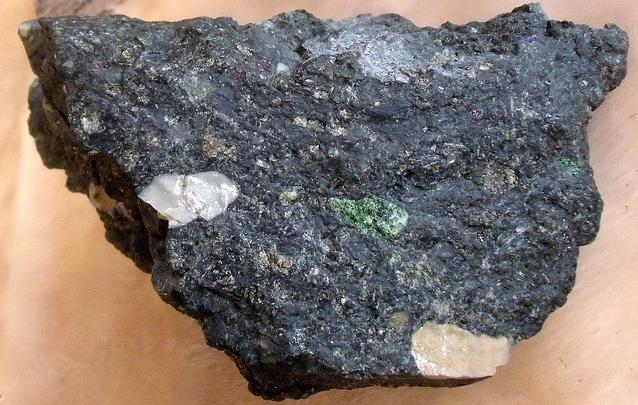
Kimberlite
Photo by Subarcticmike
The very name for the diamond is “adamant” meaning roughly that it is indestructible.  The gem we call diamond was known to the ancients when practically the entire earth’s supply came from the region around Golconda, India.  This region in India supplied most of the diamonds in the world until the discovery of alluvial diamonds in Brazil in 1729.  The diamond fields of Brazil produced most of the world’s diamonds for almost a century until diamonds were discovered in South Africa in 1867.  This led to the discovery of diamonds in an ultramafic rock that was named kimberlite after the South African town of Kimberly where the new rock was discovered.

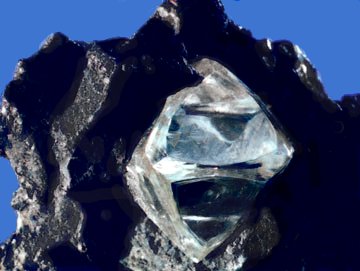
A diamond crystal in a matrix of kimberlite. USGS

The other source of diamonds during antiquity was from western Borneo where they are found in alluvial deposits of Eocene age.  Most of the stones found in these deposits are small and of poor quality.  These diamonds are still being mined mainly by artesianal methods under primitive methods.  To this day nobody has ever discovered the primary source of these diamonds.

During the post World War II period extensive deposits of diamonds were discovered in the Soviet Union by tracing a special type of pyrope garnet that is in high in chromium to its source.  The source was found in kimberlite pipes in Siberia.  Several mines were opened causing the Soviet Union to become one of the world’s largest producers of diamonds.

A princess cut diamond mounted in a ring.
Photo by Stephen Durham

After the discoveries in the Soviet Union the scene shifted to Australia where a new type of deposit was discovered in a type of rock called lamproite.  This has resulted in the development of the largest diamond mine on earth, the Argylle Mine.  Some pf the diamonds found in this mine are colored purple an extremely rare type of diamond.

The diamond discoveries in the Soviet Union and Australia led to the discovery of kimberlite deposits in Canada, Brazil and India.  There are also deposits producing diamonds in Arkansas and eastern Colorado and Wyoming


Wednesday, January 19, 2011

What is a Gemstone?

A gemstone or gem is also called by several other names such as precious or semi-precious stones or even jewels. These stones when cut and polished are used to make jewelry or other adornments used for decorations on the human body. Most gemstones are minerals but there are certain rocks such as lapis lazuli that are rocks. Other gemstones are made of organic matter such as amber, jet, coral or pearls even though they are not minerals they are still used in the manufacture of jewelry. Because of this use they are still considered to be gemstones. For the most part gemstones are usually hard, but occasionally some soft materials find their way into jewelry because of certain characteristics that are found attractive. In the past gemstones were also used to create major luxury art forms. The carvings made by the Russian lapidariest Carl Faberge were the last significant works that were made during the 19th century of this type.

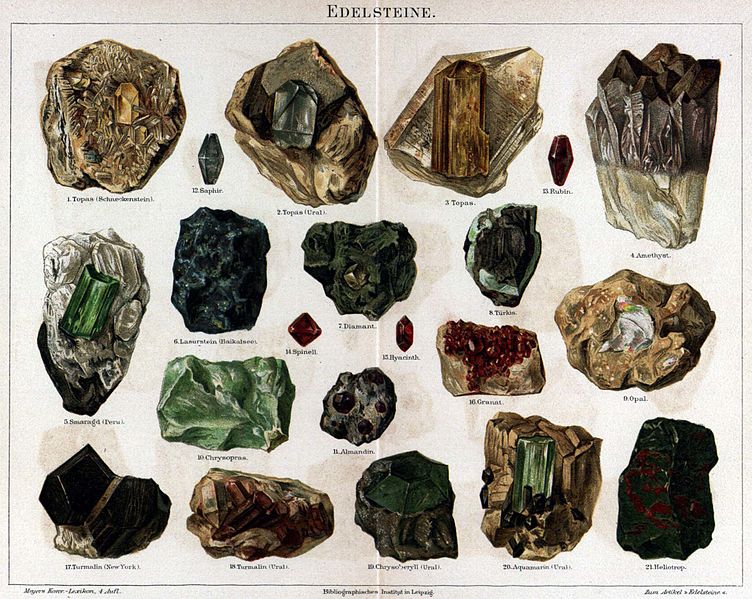
A collection of uncut gemstones.
In the West the traditional classification of gemstones goes back to the ancient Greeks. This classification was split between the precious and semi precious stones; this distinction was also made in many cultures around the world.

In our modern world these are the stones that are considered precious diamond, ruby, sapphire and emerald. Some experts include the natural pearl on this list. The list of precious stones is not particularly scientific it rather tells of the rarity of these stones during ancient times. There are many stones that have as high a value as the so-called precious stones that are only considered to be semi precious. An outstanding example of this is the Alexanderite a variety of crysoberyl the changes from red to green tea pending on the type of light it is exposed too.

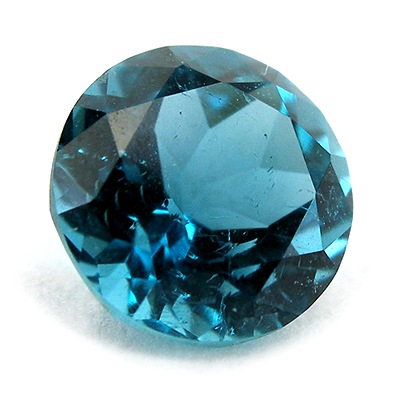
A faceted blue tourmaline
Most of these gemstones grade from transparent to translucent displaying fine color when they are pure and with no inclusions, and are very hard. The diamond is the hardest of all with a hardness on the Mohs scale of 10. Generally to be an acceptable gemstone asset have a hardness of at least 8 on the Mohs scale. A slight amount of tolerance however is allowed for some gems as soft as 5 on the Mohs scale to be used in jewelry providing it is not exposed to wear such as an approach or pendant.

The words precious or semi precious used in the context of commercial gemstones is often misleading because it implies certain gemstones are intrinsically more valuable than others when it is just not true.

Monday, July 12, 2010

Where gems are found

There is no specific ore associated with gems rather there is a whole suite of rock types termed an environment containing one or more minerals that are classified as a gem. These rocks range from sand and gravel deposits to ultramafic igneous rocks that are composed of dark colored minerals. Even if you identify a specific rock that contains a specific gem the odds are still about 300 to one it will develop into a commercial deposit. The best way to prospect for gems is to choose a specific gem and learn everything about that gem you can. More gem deposits have been found in the library through diligent research then going into the field unprepared.

Once you have chosen a specific gem you will then have to find out everything you can about that specific gem. This begins in a library where you do your basic research on that specific gem. You find out what it is composed of, in what environment, and finally pay close attention to any pictures that show the surrounding rocks. This is only the first part of a very complicated and long process, but it is a good beginning. You can also find out what kinds of gems are in your area at your local historical society by reading your town’s history. You are not usually the first person that has gone looking for gems in your area. Even more information is available from the US Geological Survey (USGS) or your state geologist.

The next step in this process is a trip to a major museum that has a rock and mineral collection. While at the museum study all the gems they have on display especially those that interest you. After you have made a thorough study of the gems you then go to the rock collection to look at the specific rocks your favorite gem is found. Study everything you can about these rocks while you are in the museum so you can identify them when you finally get out into the field. The trip to the museum will afford you a chance to see the rocks in specimens large enough so that when you finally take to the field you will readily recognize the rocks that are apt to contain gems, and those that are barren.

When in the field you will be able to put the lessons you have learned in both the library and the museum into practice. When you see a rock outcrop you should be able to make positive field identification. Even this isn’t the end because samples of the rock have to be taken into the lab for a positive identification using various instruments.

Like any science, geology or prospecting begins in the classroom or library. The better you are forearmed with knowledge the better you can perform your job. The most important book you should study is a fieldbook on rocks and minerals. As your abilities become more advanced there are other books that you can read especially those that deal with mineralogy and petrology. These are also some very good periodicals available that deal specifically with gem hunting that give many tips and hints about finding gems. Most of these can be found on the Internet by entering the subject matter into a search engine.


References:


Geology of Gem Deposits, ed. Lee A. Groat, Springer Verlag, 2008, http://www.springerlink.com/content/x3808h2267r56w54/

Smithsonian Gem & Mineral Collection, Ronald Louis Bonewitz, 2005
http://www.gimizu.de/sgmcol/