Total Pageviews

Showing posts with label colors. Show all posts

Thursday, June 28, 2012

What Diamond Crystals look Like


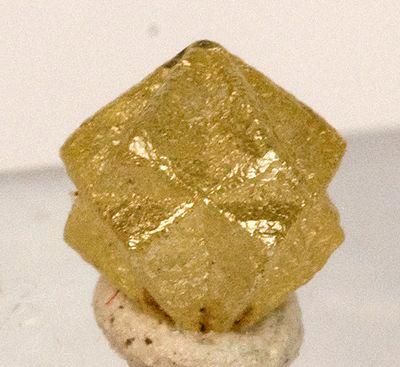
Interpenetrating cubes of diamond
Photo by Rob Lavinsky


The word morphology means what it looks like.  Diamond crystals are a good example of this as in the growth process they are able to take on many guises.  They all however are caused by the basic shape of the carbon cell that controls the diamond growth.  The carbon cell is used to build the diamond crystal or stated in another way a diamond molecule.  These carbon cells are deposited onto the nucleus of the diamond one layer at a time until the diamond finishes growing.  In its purest form a diamond crystal is cubic like a crystal of sugar.  The addition of various elements however causes a diamond to morph into different shapes or colors.

The most common of these shapes are the cubic form that is square like a salt crystal or the octahedron which is two pyramids stuck together base to base.  From this simple crystal form the shape of a diamond becomes more complex.  This is caused by many different physical process; the most common being the physical space allotted to the diamond crystal to grow.  If this allotted space is cramped and not shaped like a typical space the diamond crystal will grow into the shape of the space.   Something that will further complicate the final shape of the diamond crystal that is delivered to the surface of the Earth is the dissolution of the diamond in carbonate or silicate bearing water at the pressure-temperature conditions encountered in the diamond stability field.  This was established experimentally by Alexander F. Khokhryakov and Yuri N. Pal.Yanov of the Siberian Branch of the Russian Academy of Science in Novosibirsk Russia. 

The macle another form of diamond crystal
Photo by Rob Lavinsky


One of the stranger forms of diamond growth is exemplified by the rough diamonds from the Ekati, Diavik and Snap Lake mines in Canada.  These diamonds are dug out of the ground wearing fur coats that are fibrous overgrowths of diamond crystals with a transparent diamond crystal at the center.  Apparently somebody told these diamonds they were coming from Canada, so they came prepared for the Canadian weather.  How this came about was the diamond crystal had more then one stage of growth. 

There are one or more generations of crystal growth in most diamond crystals.  A diamond crystal can also undergo retrograde growth where conditions either in the area in the mantle where it was formed or on its way to the surface in kimberlite magma.  Some of these crystals can become bizarre in their appearance, and some of the more bizarre are what are called skeletal crystals.  Sometimes the diamonds are etched into more rounded shapes by the action of the chemistry of where they are formed or transported.

The macle is another shape the diamond can naturally take this is a twinned diamond taking a triangular shape and has two large triangular sides.


References:

Harlow, George E., The Nature of Diamonds, American Museum of Natural History, © 1995

Thursday, March 8, 2012

Beryl the Genstone of Many Colors


Beryl crystals from Pakistan var. aquamarine
Photo by Gia Cassa


As a mineral beryl is beryllium aluminum cyclosilicate possessing the chemical formula Be3Al2(SiO3)6­.   As a gem it comes in many colors although pure beryl is colorless of the variety goshenite named after the town of Goshen in the central Berkshires of Massachusetts its type locality.  It is tinted by different colors causing it to be colored blue, green, red, yellow and white.  This is a mineral that is usually found in pegmatites although it is often found in biotite schists and in intruded limestone.  A rare occurrence is found in Utah called bixbite that has been colored red by manganese as an impurity.  Other gems in this family include aquamarine, emerald, green beryl, heliodor and morganite. 

An emerald crystal from Colombia
Photo by Gery Parent


Aquamarine is the color of sea water a bluish green with green beryl as a sub-order of aquamarine.  Emerald of course is bright green that is usually found in heavily intruded limestone although some occurrences are in biotite schist.  Heliodor is the yellow variety of beryl that is sometimes galled “golden beryl.”  Morganite is sometimes found associated with both aquamarine and golden beryl, bit is differentiated by its pink color.  Red beryl is also called bixbite or red emerald because of its red coloration.  Of all the beryl’s bixbite is the rarest, but only occurs in small crystals allowing gems cut from it to be lass then 5 carets in weight,

Golden beryl or heliodor
unknown


Beryl aside from its use as a gem is also the ore of beryllium where it occurs in granitic pegmatites.  One such crystal was a giant that occurred in the Bumpus Quarry in Albany, Maine that was about 5.5 meters long by 1.2 meters in diameter that weighed around 18 metric tons.  The largest crystal of any kind of mineral was found in Madagascar is a beryl crystal that was 18 meters long by 3.5 meters in diameter.  That is the size as the boiler on a steam locomotive.

A crystal of red beryl var. bixbite from Utah
Photo by Rob Lavinsky


Beryl is found on all the continents wherever crystalline igneous or metamorphic rocks are found.  The gems are found in the core of pegmatites where at times terminated crystals are found growing into cavities or vugs in the rock.  Some beryl like the emeralds found in Columbia are found in a peculiar black limestone that has been intruded with granite that contain in addition to the beryl an abundant amount of pyrite that certainly predates the formation of the emerald crystals.. Beryl is also found associated with biotite schist.   Many of the emeralds found in the Ural Mountains of Russia are this type of deposit.  The emeralds found at the Crabtree Corners deposit in North Carolina are also an example of this kind of deposit.

A crystal of morganite on albite and quartz.
Photo by Rob Lavinsky


One of the most important deposits of aquamarine in the United States is found in the Maryall district of New Milford, Connecticut where they occur in a large pegmatite that that was originally mined for feldspar and mica.  This mine has produced some fine specimens of both aquamarine and heliodor beryl including a 44 carat heart on display in the American Museum of Natural History in New York City.  It is also known to produce many other minerals especially large garnets and uranium minerals.