Total Pageviews

Showing posts with label aquamarine. Show all posts

Thursday, March 8, 2012

Beryl the Genstone of Many Colors


Beryl crystals from Pakistan var. aquamarine
Photo by Gia Cassa


As a mineral beryl is beryllium aluminum cyclosilicate possessing the chemical formula Be3Al2(SiO3)6­.   As a gem it comes in many colors although pure beryl is colorless of the variety goshenite named after the town of Goshen in the central Berkshires of Massachusetts its type locality.  It is tinted by different colors causing it to be colored blue, green, red, yellow and white.  This is a mineral that is usually found in pegmatites although it is often found in biotite schists and in intruded limestone.  A rare occurrence is found in Utah called bixbite that has been colored red by manganese as an impurity.  Other gems in this family include aquamarine, emerald, green beryl, heliodor and morganite

An emerald crystal from Colombia
Photo by Gery Parent


Aquamarine is the color of sea water a bluish green with green beryl as a sub-order of aquamarine.  Emerald of course is bright green that is usually found in heavily intruded limestone although some occurrences are in biotite schist.  Heliodor is the yellow variety of beryl that is sometimes galled “golden beryl.”  Morganite is sometimes found associated with both aquamarine and golden beryl, bit is differentiated by its pink color.  Red beryl is also called bixbite or red emerald because of its red coloration.  Of all the beryl’s bixbite is the rarest, but only occurs in small crystals allowing gems cut from it to be lass then 5 carets in weight,

Golden beryl or heliodor
unknown


Beryl aside from its use as a gem is also the ore of beryllium where it occurs in granitic pegmatites.  One such crystal was a giant that occurred in the Bumpus Quarry in Albany, Maine that was about 5.5 meters long by 1.2 meters in diameter that weighed around 18 metric tons.  The largest crystal of any kind of mineral was found in Madagascar is a beryl crystal that was 18 meters long by 3.5 meters in diameter.  That is the size as the boiler on a steam locomotive.

A crystal of red beryl var. bixbite from Utah
Photo by Rob Lavinsky


Beryl is found on all the continents wherever crystalline igneous or metamorphic rocks are found.  The gems are found in the core of pegmatites where at times terminated crystals are found growing into cavities or vugs in the rock.  Some beryl like the emeralds found in Columbia are found in a peculiar black limestone that has been intruded with granite that contain in addition to the beryl an abundant amount of pyrite that certainly predates the formation of the emerald crystals.. Beryl is also found associated with biotite schist.   Many of the emeralds found in the Ural Mountains of Russia are this type of deposit.  The emeralds found at the Crabtree Corners deposit in North Carolina are also an example of this kind of deposit.

A crystal of morganite on albite and quartz.
Photo by Rob Lavinsky


One of the most important deposits of aquamarine in the United States is found in the Maryall district of New Milford, Connecticut where they occur in a large pegmatite that that was originally mined for feldspar and mica.  This mine has produced some fine specimens of both aquamarine and heliodor beryl including a 44 carat heart on display in the American Museum of Natural History in New York City.  It is also known to produce many other minerals especially large garnets and uranium minerals.  

Monday, February 20, 2012

Aquamarine as a Gemstone


Aquamarine is a member of the beryl family of gemstones that is usually colored various shades of blue/green or may appear as either light green or even as dark blue stones rivaling sapphire in color.  The mineral is a beryllium aluminum cyclosilicate with the formula Be3Al2(SiO3)6Terminated crystals of beryl are relatively rare, but are known to occur.  The stone has a value as a gemstone, and is a common ore of the metal beryllium.  In the case of aquamarine a small amount of iron that causes crystal defects in the crystal is the cause of its color.  The mineral beryl because of impurities in the crystal does occur in several different colors including green blue, yellow, red and white.

Aquamarine in a matrix of feldspar crystals.and other minerals including schorl the black crystal in the middle of the specimen.
Photo by Rob Lavinsky


The colors of aquamarine can range from light blue like that of the sky to a deep blue of the sea.  The darker the color the higher the price some aquamarines can sell for as much as $2,000 per caret although lighter stones only fetch a few dollars per carat.  The stone itself is fascinatingly beautiful with much appeal to women all over the world because it can complement or eye color.  For creative gemstone cutters it is an inspiration because of its ability to be cut in so many designs and still keep its beauty.

A water etched crystal of aquamarine from Brazil
Photo by Rob Lavinsky

Aquamarine is epitomized by its blue color, and the deeper blue the color the more expensive the stone making it one of the most popular stones rivaling at times its more expensive cousin emerald that also belongs to the beryl family.  The stone is hard enough at Mohs hardness of 7.5 to 8 so it can be used in most types of jewelry making it almost as popular as the classic stones emerald, ruby and sapphire.  In reality aquamarine is related to the emerald, but unlike its more famous cousin it usually free of flaws.  One flaw that is sometimes seen in aquamarine is long thin tubes that sometimes lend to its beauty in the form of chatoyancy forming tiger eyes or more rarely a star stone much like star sapphire.  Both forms of the stone command very high prices.

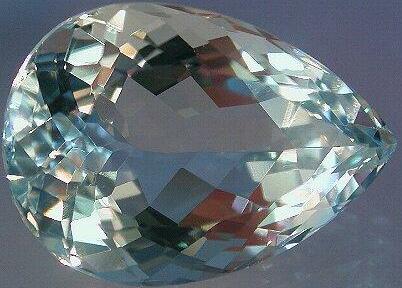
An example of a pear shaped aquamarine faceted gem.
Photographer Unknown


The color of aquamarine is caused by ions of iron causing crystal defects in the mineral beryl that is normally clear that is called goshenite my mineralogists because its type locality is in Goshen, Massachusetts were it is found in lithium bearing pegmatites.  Aquamarine can range from a pale blue to a strongly colored sea blue.  In some aquamarines you can see a light greenish simmer that is a typical feature of the stone.  Thee most prized color however is a pure clear blue transparent stone bringing out the transparency and shine of this magnificent stone.