Total Pageviews

Showing posts with label diamond. Show all posts

Tuesday, July 24, 2012

The Great Arizona Diamond Swindle


Ship Rock close to the diamond fields


The guys that dreamed up the Great Arizona Diamond Swindle sure did a good job of it, and one that sucked in some smart money from both coasts.  Its locality was way out in the boonies of New Mexico.  Bluntly it was salted with uncut stones from Africa where vast amounts of diamonds were found in the newly discovered kimberlite deposits.  The so-called rubies that accompanied the diamonds turned out to be garnets that were mistaken for rubies. The swindlers salted so many diamonds of the property that even after the swindle was exposed people were still finding diamond crystals on the site.

This was a well organized swindle based on the idea in many American’s heads that the West was a treasure house of riches waiting to be tapped.  At the time companies were organized to tap these riches, and the locality the swindlers chose in New Mexico was made for a swindle.  At this locality there were not only diamonds, but rubies, emeralds and sapphires too.  This scheme got off the ground in 1870 that was represented in San Francisco by Phillip Arnold and John B. Slack who claimed to have found precious gems in the Territory of New Mexico.  On their part they showed off more then 80,000 carats of rubies and a large quantity of diamonds including one crystal weighing 108 carats.

A large group of investors visited the diggings and collected a large number of gemstones that were literally scooped off the ground, and returned to San Francisco where the gems were put on display so other suckers could be reeled into the scheme. At the time someone remarked it was not expected they could pick them up by the bushel, but there they were.

They even roped in the Federal Government because on May 10, 1872 a bill was passed in Congress in the interests of the diamond miner who had made the discovery.

A larger expedition was planned that included a mining expert that had graduated from the Royal School of Mines in Freiberg, Germany.  This expedition was expected to last for sixty days.  This expedition left Rawlings, Wyoming on May 28, 1873 going southwest to the gem mines, but after a while they claimed they had lost their way and proceeded northwest for several days.  Some of the party began to doubt the truth od the scheme, but finally after a circuitous route then finally arrived at the site, and the mountain promised to be a real Golconda.  Everybody found gems, and gems aplenty with their hope rising accordingly.

A third party set out late in the season to return to this fabulous locality, but never got there, and this expedition was abandoned.  When Clarence King the head of the United States Geological Survey heard this third expedition had come to naught he organized an expedition of his own.  It was King’s expedition that proved the whole scheme was a Humbug and brought the whole scheme crashing down around the ears of the plotters. It's estimated this pack of crooks got around $750,000 in 1870s dollars.

The Diamonds of the Wyoming Craton


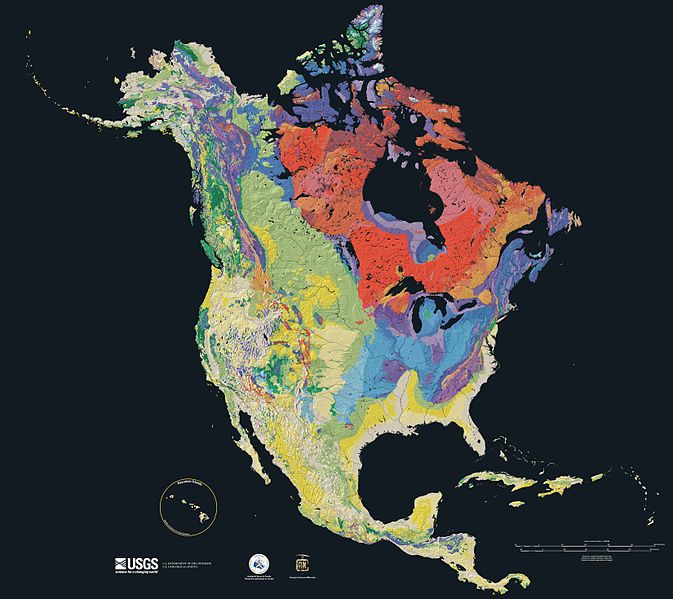
Bedrock map of North America   USGS


This is a tale about how riches were overlooked in Colorado, Montana and Wyoming by gold seekers in days of yore.  In these three states a whole diamond province has been overlooked in the kimberlites by the hundreds that underlie these states.  The diamonds can also be found in lamproites, lamprophyres and other cryptovolcanic structures that are associated by the Wyoming Craton underlying these three states.  Many of the larger targets lie right next to I-80 between Cheyenne and Laramie that remain unexplored.  This area was originally discovered by early gold miners who discovered it contained little or no gold so they passed it on.

Subsequent discoveries indicate this may be one of the most unexplored diamond provinces in North America where the diamonds can be found in the carbonate rich sediments found in a Archean gneiss.  More then fifty depressions have been discovered here suggesting cryptovolcanic activity that lie east of the State Line diamond district.  It is thought these depressions could be kimberlites containing possibly large amounts of diamonds. 

Ongoing exploration suggests that the Wyoming Craton contains a world-class diamond province and like the diamond province near Marathon, Ontario also contains large deposits of colored gemstones as rubies and sapphires.  This craton is found covering a large portion of Canada.

The Wyoming Craton aside from covering several western states also includes exposures in Alberta and Saskatchewan. Diamonds have been discovered in both the kimberlites and lamprophyres in Montana, Wyoming, Colorado, Kansas and Nebraska as well as Canada.

Another potential place where you can look is in any conglomerates that are derived from the lamprophyres and kimberlites of the Wyoming Craton.  One of my prospecting buddies has found a diamond deposit like this near Marathon, Ontario.  Another Canadian prospecting buddy that lives in western Ontario has also found probable diamonds in his part of the province.

It isn’t just diamonds that can be found there; recently one of the world’s largest deposits of rare earth metals was found in Nebraska,  When you start poking around in this ancient craton you never know what you’re likely to find.

The Wyoming Craton has the greatest southwestern outcrops of Archean rocks in North America.  Theoretically terranes like this have deep roots in the lithosphere that according to Clifford’s rule this deep keel is necessary for the formation of kimberlites with their association with diamonds.  Although this terrane wasn’t deformed during the
Ancestral Rockies Orogeny it was pervasively deformed during the Laramide Orogeny and one theory has it that its deep keel was removed partially or wholly allowing it to be deformed during the Cretaceous or later.  

Thursday, June 28, 2012

What Diamond Crystals look Like


Interpenetrating cubes of diamond
Photo by Rob Lavinsky


The word morphology means what it looks like.  Diamond crystals are a good example of this as in the growth process they are able to take on many guises.  They all however are caused by the basic shape of the carbon cell that controls the diamond growth.  The carbon cell is used to build the diamond crystal or stated in another way a diamond molecule.  These carbon cells are deposited onto the nucleus of the diamond one layer at a time until the diamond finishes growing.  In its purest form a diamond crystal is cubic like a crystal of sugar.  The addition of various elements however causes a diamond to morph into different shapes or colors.

The most common of these shapes are the cubic form that is square like a salt crystal or the octahedron which is two pyramids stuck together base to base.  From this simple crystal form the shape of a diamond becomes more complex.  This is caused by many different physical process; the most common being the physical space allotted to the diamond crystal to grow.  If this allotted space is cramped and not shaped like a typical space the diamond crystal will grow into the shape of the space.   Something that will further complicate the final shape of the diamond crystal that is delivered to the surface of the Earth is the dissolution of the diamond in carbonate or silicate bearing water at the pressure-temperature conditions encountered in the diamond stability field.  This was established experimentally by Alexander F. Khokhryakov and Yuri N. Pal.Yanov of the Siberian Branch of the Russian Academy of Science in Novosibirsk Russia

The macle another form of diamond crystal
Photo by Rob Lavinsky


One of the stranger forms of diamond growth is exemplified by the rough diamonds from the Ekati, Diavik and Snap Lake mines in Canada.  These diamonds are dug out of the ground wearing fur coats that are fibrous overgrowths of diamond crystals with a transparent diamond crystal at the center.  Apparently somebody told these diamonds they were coming from Canada, so they came prepared for the Canadian weather.  How this came about was the diamond crystal had more then one stage of growth. 

There are one or more generations of crystal growth in most diamond crystals.  A diamond crystal can also undergo retrograde growth where conditions either in the area in the mantle where it was formed or on its way to the surface in kimberlite magma.  Some of these crystals can become bizarre in their appearance, and some of the more bizarre are what are called skeletal crystals.  Sometimes the diamonds are etched into more rounded shapes by the action of the chemistry of where they are formed or transported.

The macle is another shape the diamond can naturally take this is a twinned diamond taking a triangular shape and has two large triangular sides.


References:

Harlow, George E., The Nature of Diamonds, American Museum of Natural History, © 1995

How Diamond Crystals Grow


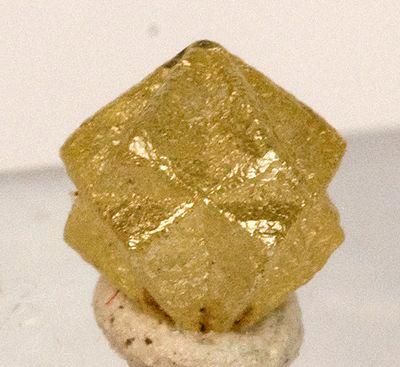
A diamond crystal from Crater of Diamonds State Park, Arkansas
Photo by Rob Lavinsky


Diamonds don’t grow overnight because in nature their growth proceeds one atom of carbon at a time with four carbon atoms bound together by chemical bonds.  The natural way that this bonding occurs will normally create a crystal that is an octahedron in shape.  This shape however can be altered by several different parameters imposed by the space allocated to the growth of the crystal in the media in which it is formed.  In the process of growing diamonds are apt to include small crystals of the surrounding material into their crystal shape.  These inclusions are literally windows into the mantle of the earth that are brought to the surface when the diamond is carried to the surface of the earth by a kimberlite or lamproite.

Diamonds are nothing more complicated then a crystal of pure carbon, and are in fact an allotropic form of an element that can have other crystalline forms either amorphous as lampblack or as graphite from which we make pencils.  There is another rarer amorphic form of carbon termed ‘lonsdalite’ that is somewhere between graphite and diamond in physical structure.  Lonsdalite is not a variety of diamond but is instead a different material.  In lonsdalite there is a repeating networking of carbon atoms that all point in the same direction rather then alternating back and forth as in a diamond.  Its crystals instead of forming cubes or tetrahedra as the diamond does are instead hexagonal.  Although it is often found with diamonds it is considered to be an allotropic form of carbon formed as the result of shock from a large meteorite.

From work performed on some of the diamonds from the Ekati diamond mine in the Northwest Territories of Canada it would appear that the growth of diamond crystals begin with a small fragment of graphite upon which the diamond crystals are deposited over time.  A matter of controversy is the actual speed in which diamond crystals are formed.  Experiments in Japan with manmade diamond crystals suggest that it is possible to grow a ten caret crystal in several hundred hours.  This of course is under ideal conditions and in nature would probably take much longer as the diamond crystal would have to scavenge its carbon atoms from the surrounding rocks.  Carbon is a rare element in the earth’s rocks.

Most of the carbon available to create a diamond has been postulated to come from oceanic crust that has been subducted beneath a continental crust as deceased life forms of coral reefs with the necessary temperature to cause their disassociation into the components making up the coral reef.  This would be carbon and the carbonate radical.  The calcium or magnesium from this reaction would be incorporated into the earth’s mantle.  Whatever free carbon remains from this reaction would be available at this temperature and pressure to form diamond crystals.

As the diamond crystal grows it is also scavenging other elements that are incorporated into the crystal as crystal defects.  The most common of these elements are nitrogen and iron.  These elements cause the diamond crystal to become colored with the coloration being dependent upon the amount of these elements.

References:
Harlow, George E., The Nature of Diamonds, American Museum of Natural History, © 1995
Mineralogical Association of Canada, Editor Lee A. Groat, Geology Of Gem Deposits, Short Course Series, Volume 37, Yukon Geological Survey, © 2007, Yellowknife, Northwest Territories
Gem Deposits, http://amonline.net.au/geoscience/earth/gem.htm
Geology of Gem Deposits, Mineralogical Association of Canada, Editor Lee A. Groat, http://www.mineralogicalassociation.ca/doc/promo_SC37.pdf  Volume 37 © 2007

Inclusions found in Diamonds tell quite a Tale


A flaw seen near the center of a diamond crystal - Wikipedia


The inclusions found in a natural diamond are a window on the interior of the earth.  Basically there are two types of inclusions found in a diamond.  The first type is a Syngenetic inclusion that was formed in the natural process of crystallization was ongoing.  The second type is the Epigenetic inclusion that was formed after the diamond was made.

The most serious flaw is a cleavage that can compromise the stability of a diamond.  These cleavage cracks are straight.  If they are serious enough they can split a diamond along the cleavage crack.  The diamond cutter often takes advantage of this flaw to cleave a diamond into two or more pieces.  They will also cause a diamond to split if accidentally subjected to a sudden high pressure event.

Bearding is hair-like cracks that often happen during the cutting of a diamond usually occurring around the girdle.  This is the area in the Anatomy of a Diamond where the setting prongs grasp the diamond.  Sometimes this flaw is also called “girdle fringes.”

Growth lines are sometimes called grain lines they typically form while the diamond crystal is growing.  If irregular crystallization occurs this is often a reason why these lines form.  If they are colorless they don’t affect the diamond’s clarity.  Sometimes though they are white or colored they are more visible and do affect the value of the diamond.

The next group of inclusions is man made that called ‘laser lines’ and can come from several different operations on the diamond.  The most common type is where the diamond cutter has used a laser for removing dark or prominent inclusions from the diamond.  The second most common is from the use of a microprobe used to analyze the tiny crystals of other minerals that are Syngenetic inclusions in the diamond. 

Feathers derive their name because they actually look like small feathers inside a diamond.  These seem to be Syngenetic tiny cracks that formed with the diamond.  Small feathers seem to be harmless, but if they reach the surface of the diamond crystal then can increase the risk of breakage. 

The last group of inclusions is definitely Syngenetic in nature; they are called pinpoints.  These are crystals of other minerals that were trapped inside the diamond crystal as it formed.  These are true windows into the interior of the earth as they were formed billions of years ago.  These same crystals are used by geochemists using a microprobe to determine their composition, and learn about the interior of the earth.  The most common inclusions are pyrope garnet, pyrite, zircon, eclogite and other rare minerals.  Sometimes an inclusion inside a diamond is what is termed a negative crystal which is just a void looking like a diamond crystal.  Other inclusions are minute drops of liquid usually water or liquid carbon dioxide.

Flaws are the characteristic inclusions found in a diamond.  They are called flaws because their presence means that the diamond is not perfect.  These inclusions act like fingerprints because no two of them are the same they are used to identify individual diamonds if they are lost or stolen.  Other inclusions affect a diamond’s clarity causing it to be less brilliant as they interfere with the light as it passes through a diamond.  There are other inclusions that can cause a diamond to fracture if it is subjected to a sudden sharp blow.


References:

Mineralogical Association of Canada, Editor Lee A. Groat, Geology Of Gem Deposits, Short Course Series, Volume 37, Yukon Geological Survey, © 2007, Yellowknife, Northwest Territories
Gem Deposits, http://amonline.net.au/geoscience/earth/gem.htm
Geology of Gem Deposits, Mineralogical Association of Canada, Editor Lee A. Groat, http://www.mineralogicalassociation.ca/doc/promo_SC37.pdf  Volume 37 © 2007
Industrial Minerals and Rocks, Page 418, http://books.google.com/books?id=zNicdkuulE4C&pg=PA417&lpg=PA417&dq=kimberlites+and+the+occurance+of+diamonds&source=bl&ots=Nhqev_Ebqc&sig=WQyRiIxdpBMtnaZWwhGwKC5o1sY&hl=en&ei=csyvSbDZAojWnQfAmpTNBQ&sa=X&oi=book_result&resnum=9&ct=result#PPA418,M1
Kimberlite, Wikipedia the free encyclopedia, http://en.wikipedia.org/wiki/Kimberlite

Wednesday, June 27, 2012

Finding Gemstone Deposits:

Ruby crystal on calcite
photo by Rob Lavinsky

Gems have been prized for thousands of years, for their color, luster, durability, hardness and their high intrinsic value per volume.  They are found in all kinds of geologic environments of all ages from thousands of million years to recent times.  Gemstones are also found in all kinds of rocks ranging from igneous to metamorphic to sedimentary and are classified according to the environment where they were formed.  The deposits are rare because of the geological conditions needed to form them are exceptional.  For example, in order for the Emerald to form the beryllium from which it is made has to come in contact with chromium or vanadium.  These elements travel in entirely different geochemical circles that are the exception rather than the rule.

It is important to realize that like any other commodity, gems are subject to the laws of supply and demand.  Even though the demand for gems remains about the same the supplies are becoming depleted.  Many of the gems especially the colored variety are mined in Third World countries by artesianal methods, i.e. by hand.  In any of these countries the discovery of the new deposit often leads to a local prosperity, but many of these stones become involved in the illegal trade that is being used to finance terrorism.

Sapphire crystal
Photo by Rob Lavinsky


These deposits of gemstones are volcanic in origin and are formed deep within the Earth’s crust.  Gemstones from this origin have formed over 100 Km below the surface and are brought to the surface as the result of magma intrusions or lava flows.  Diamonds are one type of this deposit that has formed from 100 to 150 Km below the surface.  These gemstones are found in potassium rich stone called “kimberlite” that is brought to the surface in an explosive eruption that proceeds at near supersonic speeds.  There seems to be a rule known as Clifford's rule that these eruptions take place in Achaean terranes or come up through younger terranes overlying Achaean terrenes.  Kimberlite is quite rich in peridot and appears to be full of xenoliths that are torn off the walls of the magma channel.  A cross-sectional view of the kimberlite is like looking at a carrot.  The stone itself is quite soft and easily eroded away with the diamonds being carried away with the rest of the erosion products.

Diamonds are not the only product that is found in a magmatic deposit so are others stones such as sapphires and zircons.  Sapphires are also formed under some very specific geological conditions the most important one is a magmatic stone that is low in primary silicates such as basalt.  The sapphires form as crystals in the basalt and they're released as products of erosion.  Although they form in the basalt they are rarely mined directly.  Zircons are another example of a gemstone that is found in a magmatic deposit.  Once again these gemstones are not mined directly from the stone that are found as the products of erosion.  In geology zircons are thought to be forever and the oldest dated minerals in the world are some zircons that were found in Western Australia that were dated at 4.5 billion years old.  Zircons are used by geochemists worldwide for dating formations of different ages, and are highly effective in this use.

Some other gemstone minerals that are found in magmatic deposits include:
Peridot, gem quality olivine usually found in mantle xenoliths.
Labradorite, found as gem quality grains in some basalts.
Zircon, found as crystals in granite, basalt and the rarer carbonatites.
Apatite, found as crystals in carbonatites.
Garnets, found as crystals in basalts as xenocrysts and granite.

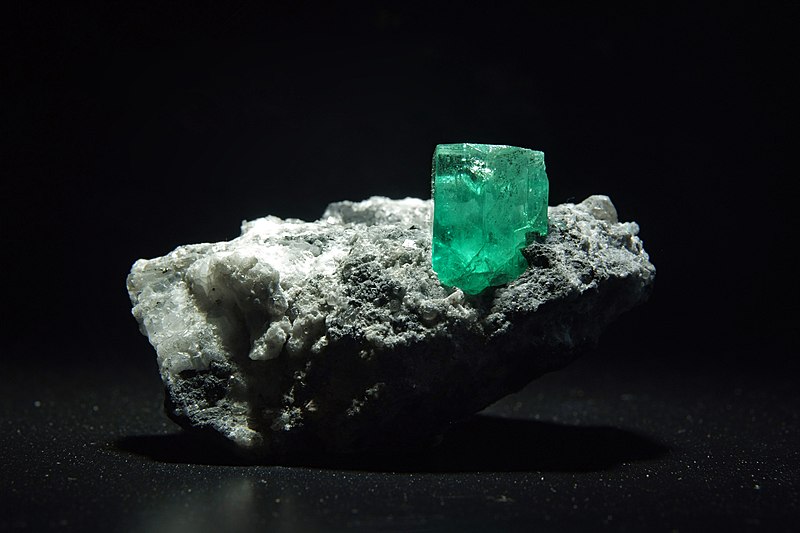
Emerald crystal on calcite
Photo by Eva Krocher


Pegmatites are hydrothermal deposits contain more different types of gemstones in any other rock.  These are formed from the volatile rich fluids that are found in pegmatites when they are formed.  In some geological circles pegmatites are called “Giant granite” because they have the same minerals as granite except the crystals of the individual minerals are much larger.  There are two different kinds of pegmatites simple and complex; most of the valuable minerals are found in complex pegmatites.  Although many of these minerals could be classified as gems other minerals found in pegmatites are the ores for rare metals such as niobium or rare earths. 

Depending on the fluids present when the pegmatite is solidifying different gemstones are deposited.  If the fluid is rich in fluorine topaz will be deposited.  A beryllium rich fluid will produce the mineral beryl in its many forms ranging from aquamarine, emerald, morganite, or heliodor.  Lithium rich fluid is another possibility depositing spodumene or other lithium rich minerals.  Pollucite is deposited from a cesium rich fluid.  In some cases the fluid is rich in several different elements producing “Tourmaline” a gemstone that is actually rarer them diamonds.  A manganese rich fluid will cause spessertine garnet to be deposited.

There are specific zones in a pegmatite where gemstones are found.  Many of them are found in cavities called “Vugs.”  The crystals formed in this environment are usually clear and well formed.  A deposit of this nature containing red and green tourmaline was discovered in the 1970s at Newry, Maine that was worth more then $8 million from a single vug as large as a bedroom.

There are other hydrothermal environments that are also capable of producing gemstones ranging from volcanic rocks to sedimentary rocks.  This is where one is likely to encounter agates, petrified wood, opal, amethyst as well as a whole plethora of gems.  Turquoise is another mineral deposited by hydrothermal waters.  It is copper phosphate and its beautiful sky blue botryoidal masses have been admired for over two thousand years.

Metamorphic deposits:


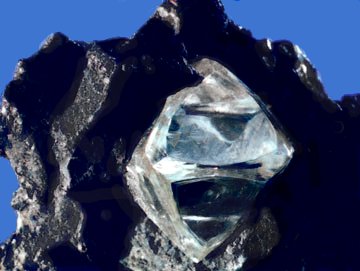
Diamond crystal in matrix - USGS


The only gem minerals normally found in metamorphic rocks are garnet, zoisite (variety tanzanite), rubies and emeralds.  Rubies are the red variety of the mineral corundum that is aluminum oxide.  These gems are found in cordierite rich gneiss as well as marble.  Sometimes rubies are carried up from the depths of the earth as xenocrysts in basalt.  Most of the world's emeralds are found in low grade carbonaceous schist in ColombiaOther gemstones that occur in metamorphic rocks are iolite (the gem-quality lilac-purple variety of cordierite), titanite and kyanite.
Jade is another mineral that is found in high-pressure; low-pressure blue schist metamorphic rocks.  There are two entirely different minerals that are recognized as jade in the trade one of these as jadeite a compact variety of the mineral pyroxene, and the other is nephrite a compact variety of the mineral that is derived from tremolite.  Although these minerals are composed of common minerals it takes a very special environment for them to form.


Sedimentary deposits:


By far the most valuable gemstone found in sedimentary rock is precious opal.  The largest deposits of this mineral in the world are found in central Australia.  Other deposits are found in the United States and Mexico.  Most opal is found as a replacement for fossils.  Opal also occurs as replacement beds or blebs in sedimentary rock.  A good piece of opal showing good colors can be as expensive as a diamond.


Placer deposits:


In some placer deposits gemstones are relatively abundant particularly in areas where the local rocks are known to produce gemstones.  This is especially true in areas underlying by cordierite gneiss or marble.  Another area is where gemstone bearing pegmatites are abundant.  Because of their toughness and hardness gemstones that are eroded from their country rock tend to remain intact preserving the best gemstones.  The same rough and tough treatment these stones go under as a result of natural processes particularly running water the weaker and softer stones are broken up leaving behind the highest quality gemstones.  Most of the gemstones in the world are recovered from placer deposits.  In some cases the work of recovery can be quite primitive; in others the most modern technology and machinery is used.


References:


Mineralogical Association of Canada, Editor Lee A. Groat, Geology Of Gem Deposits, Short Course Series, Volume 37, Yukon Geological Survey, © 2007, Yellowknife, Northwest Territories
Gem Deposits, http://amonline.net.au/geoscience/earth/gem.htm
Geology of Gem Deposits, Mineralogical Association of Canada, Editor Lee A. Groat, http://www.mineralogicalassociation.ca/doc/promo_SC37.pdf  Volume 37 © 2007