Total Pageviews

Showing posts with label gabbro. Show all posts

Sunday, May 15, 2011

The Different Types of Pegmatites

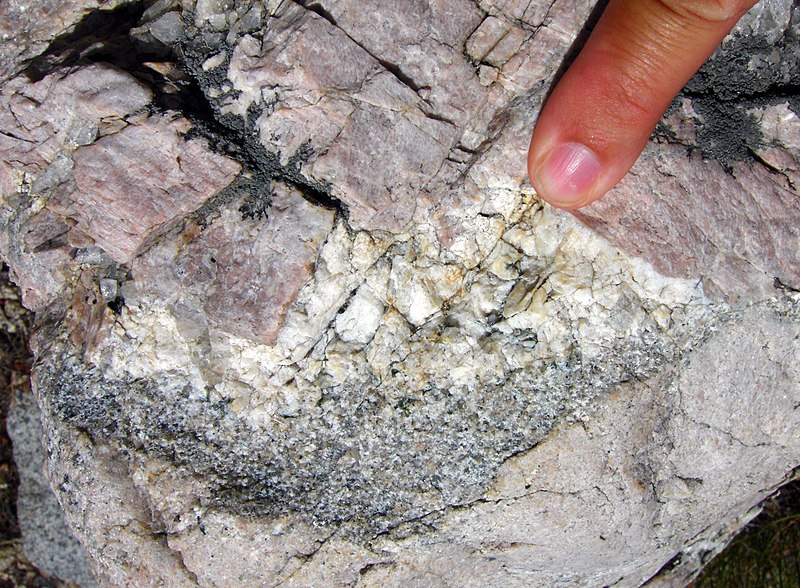
Pegmatite in mica schist.
Photo by Arlette


If we seem to be staying on the subject of pegmatites it is because they are very important in the production of gemstones. There are over 100 different types of gems that are produced from pegmatites. Most of these pegmatites are chemically the same as granite, and the term actually refers to their texture rather than their composition. There are three recognized varieties of granitic pegmatite, and one that is recognized in gabbro. All pegmatites containing crystals that are larger than 2 cm in diameter and can reach truly gigantic proportions. There is a feldspar mine in the Ural Mountains of Russia that has been producing feldspar from any single crystal for many years.

Pegmatites were classified in the mid-20th century by Buddington with a depth zone classification of granitic rocks in 1959. Cerny’s revision of 1991 is the most commonly when used today for the classification of pegmatites. Basically these classifications are based on the depth at which pegmatites were emplaced, metamorphic grade as well as minor element content. Under this classification Abyssal pegmatites are the highest grade that have been in place that either high or low pressure. Muscovite grade pegmatites were emplaced in high-pressure, but a lower temperature. Rare element pegmatites were emplaced at even lower pressures and temperature. In this classification the miarolitic pegmatites having large cavities were emplaced at shallow depths. The most gemstones are found in the miarolitic pegmatites within the enclosed cavities.

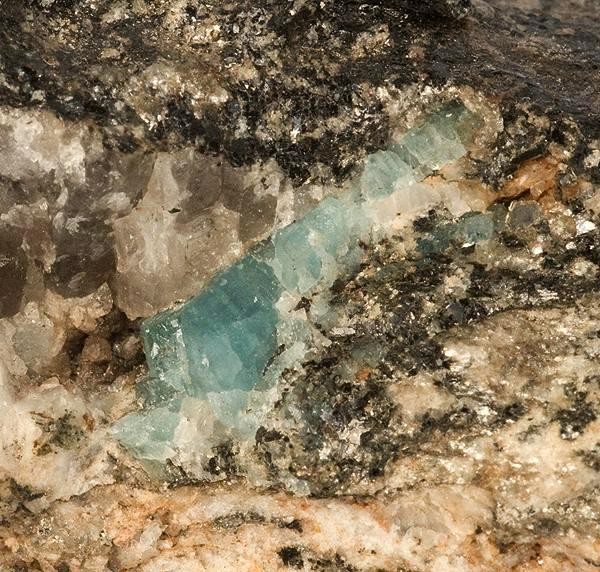
Beryl with microcline found in a pegmatite cavity.
Photo by Rob Lavinsky


The simple pegmatite is composed of feldspar, quartz and lesser amounts of muscovite mica. This is the simplest type of pegmatite that is found that can range from tiny veins a few millimeters wide to great masses of pegmatite that can cover several acres, and be meters wide. For the most part simple pegmatites have a very uniform composition, and little variance in the size of the crystals from one side to the other. Approximately 80% of all pegmatites found in nature are of this type. There are very few gemstones found in the simple pegmatites. Most of them contain white colored feldspar and milky quartz with sometimes bands of muscovite mica parallel to the sides of the vein. Under the above classification this type of pegmatite would fall under the classification of being an abyssal pegmatite.

Red tourmaline on lepidolite and quartz from a pegmatite cavity.
Photo by Rob Lavinsky


The rare element class of pegmatites is further divided into the sub classifications LCT and NYF. LCT pegmatites contain lithium, cesium and tantalum. NYf stands for a niobium, yttrium and fluorine. These are perhaps the rarest types of pegmatite. Most of the gemstones bearing pegmatites are of the LCT variety. The closer they form to the surface the more apt they are to have miarolitic cavities containing gemstones.

Monday, May 9, 2011

How a Pegmatite Works

A pegmatite vein in a roadcut.
Photo by Woodlouper


The next several articles that are going to be published in this blog concern a very special type of rock formation that is called pegmatites. Another name that is sometimes used for this rock is giant granite because the large sized crystals of different minerals that are found in them. The most common minerals in a pegmatite are feldspar, mica and quartz with quartz in many pegmatites making up almost 50% of the total minerals present.

Although they are described as veins of pegmatite most of them are tabular shape masses of rock that are injected as a granitic magma into pre-existing cracks in the country rock, or sometimes they also form large ovals that are more or less deformed by earth movements that occur at the same time they are being deposited deep in the earth.

A pegmatite mine.
Photo by Pfuss


The crystals are found in a pegmatite are the result of very slow cooling that occurs in the depths of the earth's crust several miles beneath the surface. The pegmatites that are now exposed at the surface have all had several miles of rock eroded away so we can now see them at the surface.

Although most pegmatites are at home in gneiss or schist some of them are actually found in granite intrusions that have taken a long time to cool so that the pegmatite grades from granite. That only pertains to some of pegmatites, it is theorized that changes in the chemical composition can cause some pegmatites to be formed in a very short time; sometimes a matter of days and still have large sized crystals.

Closeup of a pegmatite
Photo by Mark A. Wilson


Unless a pegmatite is within a granitic intrusion they are all outliers of such an intrusion. The further a pegmatite is from the parent intrusion the more likely it is to have rare minerals in its composition. There are three main types of pegmatites of granitic composition and the fourth that is found in more mafic rocks such as gabbro. The further they are from the granitic or gabbro like intrusion the more apt they are to contain the proper chemical ingredients to form gemstones.

There are generally three major minerals and under the right conditions can form gemstones, they are beryl, topaz and tourmaline. There are also more than 100 other minerals that under the right conditions can also form gemstones. Sometimes even the body of the pegmatite itself is code is cabochons if it is especially attractive. Graphic granite that is found in some pegmatite makes especially attractive 

The rare mineral "bazzite" found in a pegmatite cavity. This is an analog of beryl containing the rare earth element scandium.
Photo by Rob Lavinsky 


Many pegmatites display different zones that are apt to contain different suites of minerals. The outer portion of a pegmatite displays very fine crystals and is often termed an aplite. There are several different shells that a pegmatite can display numbering up to seven. The inner core of all zoned pegmatites is usually quartz and in the inner core is where you usually find cavities that are filled with flawless crystals of various gemstones. Although it is unusual there are many instances where a single large cavity can produce several million dollars worth of gemstones.