Total Pageviews

Thursday, March 8, 2012

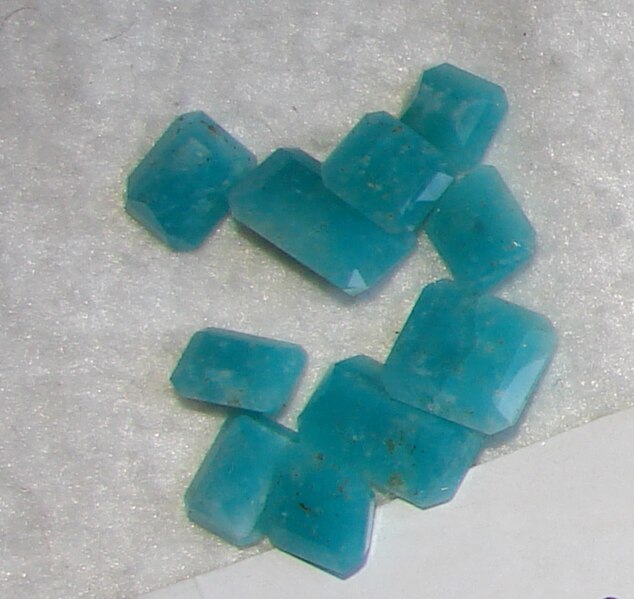
Amblygonite one of the Gemological Garbage Cans


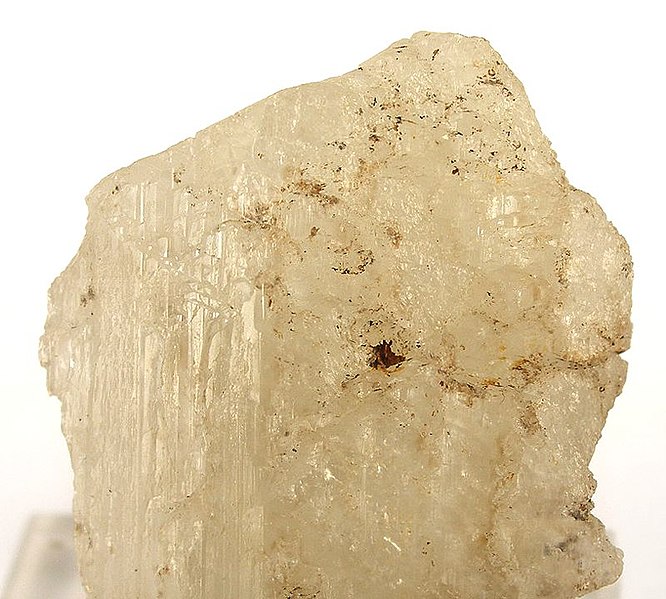
It is easy to see how amblygonite is often mistaken for other minerals this specimen mimics milky quartz
Photo by Ra'ike


As a mineral amblygonite is classified as a fluorophosphate with a chemical formula of (Li, Na)AlPO4(F, OH) that is composed of sodium, lithium, aluminum, phosphate, fluoride and hydroxide. This is a mineral occurs in pegmatite deposits were this easily mistaken for albite or other feldspars. It is readily distinguished by its density, cleavage and flame test for lithium. Amblygonite forms a solid solution series with montebrasite that is the low fluorine member of the series.

Faceted amblygonite from Brazil.
Photo by Ra'ike


This is a mineral found in LCT type pegmatites, high-temperature tin veins and greisens where it is found with spodumene, apatite, lepidolite, tourmaline and other lithium bearing minerals. It is often been used as an ore of lithium The chief commercial sources have been the deposits in California and France where the mineral contains about 10% lithium. 

A single crystal of faceting grade amblygonite.
Photo by Rob Lavinsky


The mineral amblygonite was originally discovered in Saxony, Germany by August Breithaupt in 1817 and named by him from the Greek words amblus (blunt) and gouia (blunt) because there is an obtuse angle between its cleavages.  Later the same mineral was found at Montebras, France and Hebron, Maine. Because there are slight optical differences in amblygonite found at these differing localities they are also called montebrasite and hebronite after the localities where it has been found.  The mineral is also found in large quantities in Pala in San Diego County, California as well in the Black Hills of South Dakota.  To date the largest single crystal of amblygonite measured 7.62 x 2.44 x 1.83 meters that weighed about 102 tons.

Amblygonite variety Montebrasite
Photo by Rob Lavinsky


When its transparent amblygonite is faceted into gemstones where it is set into jewelry, however because it is prone to breakage and abrasion as well as displaying hardness problems as well as toughness it is rarely mounted into jewelry.  This stone when it is cut often finds its way into collections as unmounted stones. The principle sources of this gemstone are Brazil and the United States however other countries have also produced faceting grade amblygonite such as Australia, France, Germany, Namibia, Norway and Spain.  Most of the gem quality amblygonite crystals that have a yellowish caste are found in pegmatite cavities.

Saturday, March 3, 2012

Benitoite the One of a Kind Gemstone


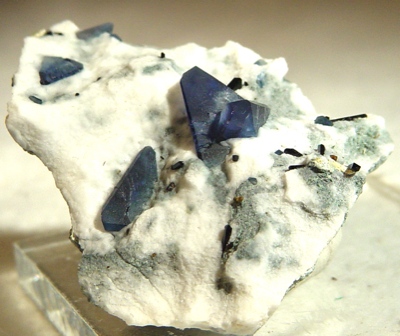
Benitoite in a matrix of neptunite from San Benito County, California.
Photo by Rob Lavinsky


Benitoite is a one-of-a-kind gem since it is only found in one place in California; it is also the state gemstone of California as of 1985.  The stone itself is a rare variety of barium-titanium silicate found in hydrothermally altered serpentine. Benitoite reacts under shortwave ultraviolet light fluorescing light blue in color.

As a mineral benitoite was described in 1907 by George D. Louderback who named it benitoite because it was found near the headwaters of the San Benito River of San Benito County, California. The stone was one of the first if not the first mineral to be studied under x-ray diffraction.

A single crystal of benitoite in matrix.
Photo by Lech Darski


This stone is usually found an unusual set of minerals including the minerals that make up its host rock. The associated minerals usually include naturolite, neptunite, joaquinite, serpentine and albite. Benitoite is very rare mineral that is only found that it few locations among them are places in San Benito County, California. It is also been found in Arkansas and Japan. It is usually found in glaucophane schist as inclusions in veins of naturolite.  Benitoite mining is allowed for a fee in the benitoite mine in the Clearwater management area in central California. Collecting is by appointment only!

This gemstone is typically colored various shades of blue although it can also appear as colorless or even have a yellowish caste.  Its crystals can vary from transparent to translucent with visible inclusions with a vitreous luster.

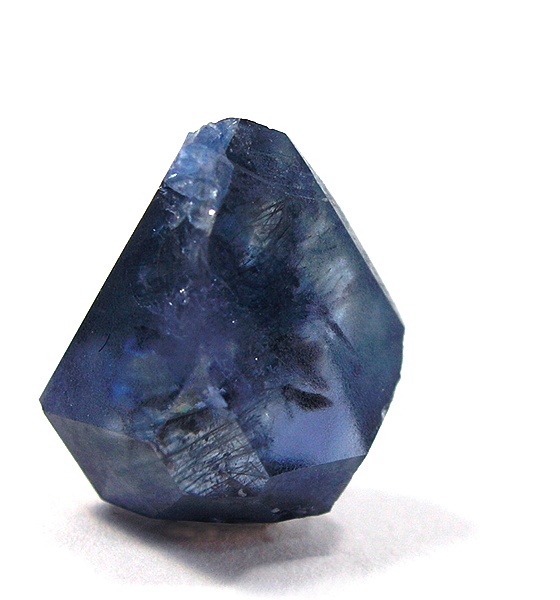
A single crystal of benitoite with no matrix.
Photo by Rob Lavinsky


When found its crystals are hexagonal; bar 6 m 2 that in crystal habits include six place dipyramid flattened shapes having a distinct triangle shape that is often modified by having minor faces.  At times it is also found as small grains.

Benitoite has no cleavage and its fracture is irregular.  Other distinguishing features are its hardness ranging from 6 to 6.5 on the Moh’s scale of hardness.  Its specific gravity is 3.6 making it denser then most other minerals making it capable of being separated by gravity methods such as panning.  The mineral also displays a white streak.

A faceted example of benitoite
Photo by Fastily


This mineral is counted among those that fluoresce under the influence of ultraviolet light displaying a blue light.  Minerals that are associated with benitoite include serpentine, neptunite, natrolite, joaquinite, sanbornite, taramellite, albite and fresonite. 

Benitoite gems are only found in three mines located in San Benito County, California where good to excellent crystals are found.  The only other occurrences are in Eocene aged sands in southwestern Texas along with another few localities in California.  These occurrences are only small grains found in sand.

Benitoite under ultraviolet light.
Photo by Parent Gery 


If you are searching for this mineral the best field indicators its crystal habit, the fact that it displays fluorescence in blue, its distinctive color, the minerals it is associated with and the locality.  The fact it is associated with bodies of serpentine suggests that it might be found in localities that have been identified as suture zones where geologists feel that serpentine is metamorphosed oceanic crust that has been caught up in earth movements associated with the collision of two continental plates,


Friday, March 2, 2012

Azurite Hydrous Copper Carbonate a Blue Gem.


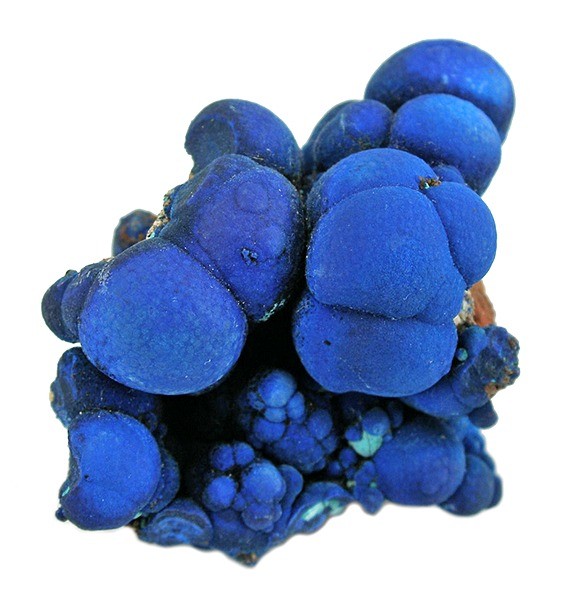
Botrydoil Azurite from the Apex Mine of Utah.
Photo by Rob Lavinsky


Azurite is one of the lesser known copper ores that is produced by the weathering of copper deposits. The mineral is also known as chessylite named after the Chessy-les-Mines near the city of Lyon in France. This mineral has been known to the ancients and is mentioned in Pliny the Elder’s, Natural History.  Because of its deep blue color has also been used as a pigment that is a deep blue color. Azurite is usually found in the desert where the low humidity causes its cousin malachite to lose water.  This is where it is often found in the company of its cousin malachite.  Both minerals are essentially the same copper carbonate except azurite contains more water in its crystals.  Over time this water will evaporate causing the azurite to change to malachite.

Typically azurite crystals are monoclinic that when they are large enough to be seen will appear is dark blue prismatic crystals. In nature azurite crystals are massive to nodular with some of them forming stalactitic masses. Any specimen of azurite over time will lighten in color as its surface retrogrades in the malachite. The mineral is soft with a Mohs hardness of 3.5 to 4. It displays a specific gravity ranging from 3.77 to 3.89. The mineral azurite is destroyed by the application of heat losing both carbon dioxide and water forming a type of black powdery copper oxide. A drop of acid placed on the specimen will cause it to effervesce like any other carbonate.

Azurite and malachite
Photo by Rob Lavinsky


Some of the earliest uses of azurite are a blue pigment in artist’s paints. In this use it was finely ground, and then mulled with linseed oil and turpentine. The mineral is capable of producing many different shades of blue depending upon the fineness to which it is ground. When it is mixed with oil, as in oil paints it turns slightly green. On the other hand if it is mixed with egg yolk it turns a gray green. In older paintings the azurite has turned into malachite displaying a greenish color. Many times what was azurite was mislabeled as lapis lazuli that in times past was a name that was applied to many other blue pigments. True lapis lazuli that was used as another blue pigment came primarily from Afghanistan during the Middle Ages. Azurite was a common mineral found in Europe in the same timeframe.

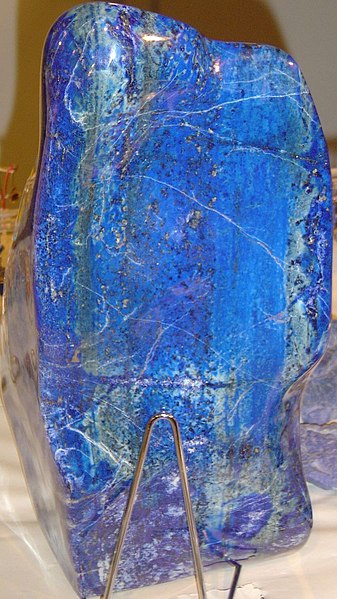
Lapis Lazuli, notice the difference in color from azurite.


There were sizable deposits of azurite that were mined near Lyons, France during the Middle Ages. Azurite was also mined during the 12th century in Saxony and the various silver mines that were located there.

If azurite is heated it turns black whereas the more expensive natural ultramarine remains blue when it is heated. If the mineral is gently heated it produces a deep blue pigment that is often used by the Japanese in some of their painting techniques.

Azurute surrounded by malachite.
Photo by Rob Lavinsky


Occasionally azurite finds uses beads and other types of jewelry; it is also used as a decorative stone. The thing that keeps it from being used more commonly as a gemstone is its softness and the fact that it weathers easily reverting back to malachite.

Tuesday, February 28, 2012

The Emerald Green Garnet Andradite


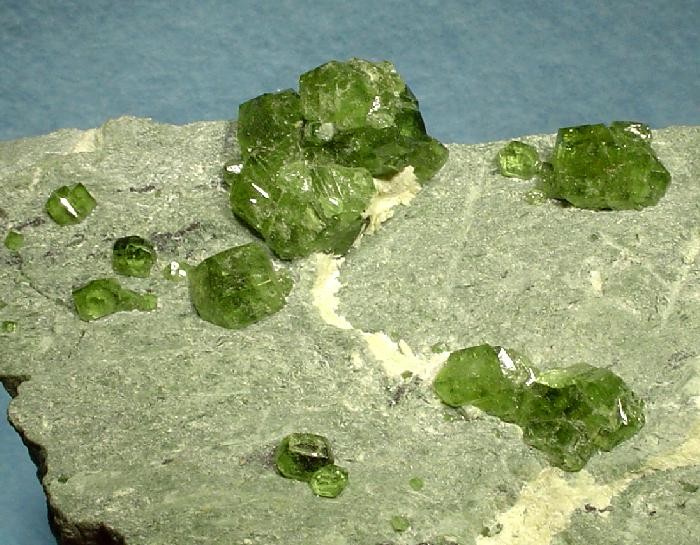
Demantoid an emerald green variety of andradite garnet on a matrix of serpentine,
Photo by Rob Lavinsky


Andradite is another species longing for the garnet family that is classified as a nesonsilicate with a formula approximating Ca3Fe2Si3O12­.  This family of garnets includes three different varieties they come in various colors. There is one variety where titanium ions substitute in the formula producing a black stone that in the gem trade is called melanite, or is sometimes referred to as titanian andradite. The second stone in this group is referred to as the demantoid garnet that is found ophiolite deposits where it is associated with chromium. The stones are often the vivid green in color that occur in small crystals rarely over one carat in size. Because of their rarity they are often worth more than $1000 per carat in the http://www.gia.edu/ world. The third type of stone in this family is called Topazolite that is yellowish green in color and is sometimes found in a high enough quality so they can be cut into faceted gems.

Melanite garnet crystals
Photo by Rob Lavinsky


This garnet occurs in skarns in impure limestone that has been intruded by igneous rock. Sometimes it is also found in calcium rich igneous rocks. Probably the most common place to find andradite is in a rock called serpentine that also produces asbestos. Andradite garnets have been found in the asbestos mines around Thetford Mines, Quebec in small crystals. Serpentine is thought by geologists to be metamorphosed oceanic crust that was caught up in a mountain building event where some of the ocean crust was incorporated into a continental landmass.

Topazolite crystals
Photo by Rob Lavinsky


There are several other minerals that are commonly associated with andradite including this vesuvianite, chlorite, epidote, spinel, calcite, dolomite and magnetite. One of the varieties of andradite is often found near iron mines where the over is magnetite. It is found as braunite on the rock dumps at the old Tillie Foster iron mine in Brewster, New York.

A faceting grade crystal of demantoid.  Sometimes faceted gems cut from this stone can sell for well over $1,000 per carat.  Most of these stones are small rare;y affording faceted gems weighing much more then a carat.
Photo by Rob Lavinsky


Andradite is found in Italy around the area of Mt. Vesuvius and other volcanic areas that are underlain by limestone.  It is also found in Russia in the Urals.  In the United States this stone is found in Arizona and California.  On the East Coast several occurrences are in the Danbury, Connecticut area where andradite occurs in limestone deposits along Rt. 7 where the limestone is in close proximity to intrusions of granite where it is associated with danburite and idocrase.  This is a mineral that should be found in serpentine or contact altered limestone anywhere they are found.

Amber is Fossilized Tree Resin


Amber with a spider inclusion that came from the Baltic Sea area.
Photo by Elizabeth from Holland 


Although not a gemstone in the proper sense Amber in reality is fossilized tree resin that is several million years old. It is one of the oldest gems known to man where it is mentioned in the Bible and also by Pliny the Elder, who lived during the Roman Empire. Pliny was killed by the eruption of Vesuvius on August 24, 79 A.D.

Although amber is found in many parts of the world its earliest occurrence was when Amber was found around the Baltic Sea where it is still mined to this day.  Other places in the world where amber is found include the United States, the Dominican Republic, New Zealand and Indonesia.  In truth amber enjoys a worldwide occurrence.

Blue amber from the Dominican Republic
Photo by Vassil 


Mankind has admired amber for thousands of years where he appreciated its color and natural beauty since Neolithic times.  Amber is still used as an ingredient in perfumes; it has also been used as a healing agent in folk medicine.  Amber however finds its major use in Jewelry.

Amber pendents with inclusions
Photo by Adrian Pingstone


Geologically there are five recognized classes of amber that are defined according to their chemical composition.  Amber comes from a sticky tree resin that over time hardens by the loss of volatile chemicals it can contain various animal and plant remains as inclusions.  Some amber occurs in coal seams that are called resinite.  The term ambrite is specifically applied to amber that found in the coal seams of New Zealand.

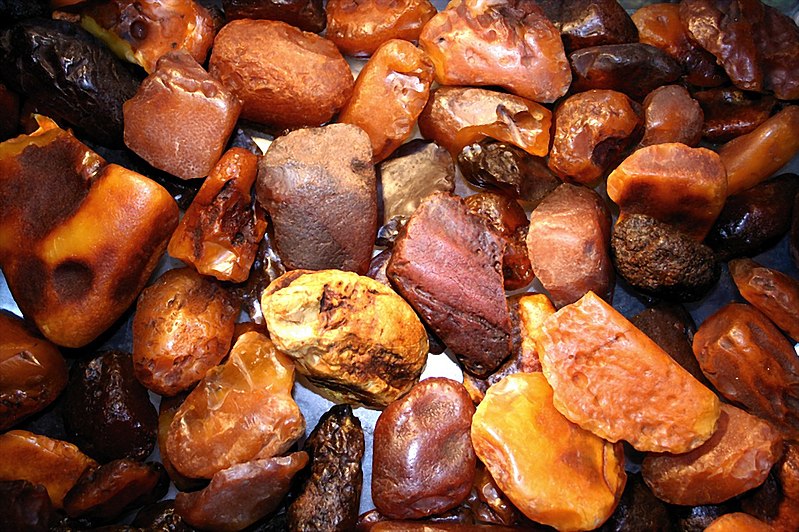
Amber rough from the Baltic Sea where it is washed up after heavy storms.
This amber is waiting to be processed.
Photo by Lanzi


One of the rarest members of the amber family is found in the Dominican Republic that is blue and flouresis under ultraviolet light.  Amber is found in several parts of the eastern United States most notably on Martha’s Vineyard where it is found on Gayhead.  The stone is also found in the marl deposits of New Jersey.  

Monday, February 27, 2012

Ametrine the Astounding Bicolored Stone


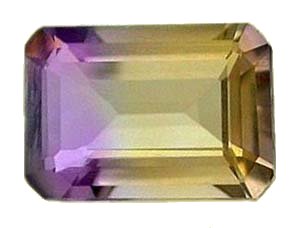
A faceted example of ametrine
Photo by De Wela49


Ametrine is a variety of colored quartz where one end of the crystal is amethyst colored and the other end is citrine colored. Most of these stones are found in Bolivia and are often marketed under the name bolivinite. Because they are fairly abundant they are not considered to be an expensive gem. Many of these stones today are actually synthetics made in Russia.

In 1994 a Russian chemist perfected a method to make multicolored quartz crystals in a pressurized vessel. These stones are later subjected to radiation that brings out the typical Ametrine colors. It is easy to detect these stones because in nature neither yellow-green nor gold-blue exists. In nature but artificial ametrine can also be created by treating an amethyst crystal on one end with heat. Since quartz is a poor conductor of heat only one end of the crystal that has been heated will change color.

An example of ametrine from Bolivia.
Photo by Ra'ike 


The most probable cause of a bi-colored amethyst crystal is by differential heat that is applied to one end of the crystal; in the case of Bolivianite causing a temperature differential across the length of the crystal will create a bi-colored stone.

Most of the Ametrine enters into trade comes from a single mine in Bolivia although there are some other places that produce the same gem notably Brazil and India. There are several legends concerning the Bolivian mine the most prevalent being the one about a Spanish Conquistador who presented them to the Spanish Queen as a present after he had learned about the Anahi mine where they were produced as a dowry present to Mary by an Indian princess named Anahi from the Ayereos tribe.

An ametrine crystal also from Bolivia
Photo by Rob Lavinsky


Typically Ametrine is faceted into a rectangular shape with a 50-50 combination of amethyst and citrine showing its bicolor nature. There are times when there is a checkerboard pattern of facets that is added to the top of the stone to increase the natural light reflection. This stone can also be cut in such a way as to blend the two colors creating a mixture of yellow, purple, and peach tones in the stone. Ametrine is also a popular stone among artistic cutters and carvers that like to play with the various colors creating landscapes from the stone.

When buying one of these stones the buyer has to remember that at a Moh’s hardness of 7 it is not a particularly durable stone that should not be used in rings that are going to be worn steadily. This tone is more suitable for broaches and pendants. You can buy this stone in just about any size or shape but remember the color contrast stands out better in stones over seven carats in size.

Saturday, February 25, 2012

Amazonite the Green Feldspar Gem


Amazonite a green variety of microcline feldspar.
Photo by Rob Lavinsky


Amazonite that is also cold Amazon stone is a green colored variety of microcline a type of feldspar. It got its name from the Amazon River when certain green stones were formerly obtained from the land surrounding the river although it is doubtful that any of this green feldspar occurs anywhere in the Amazon region.

Amazonite with terminated smoky quartz crystals.
Photo by Rob Lavinsky


Although amazonite is a mineral having a limited occurrence it was originally obtained from the Miass district in the Ilman Mountains about 50 miles southwest of Chelyabinsk, Russia. It was found here in granitic rocks in small quantities. It can also be found in the United States as high-quality crystals found in the area of Pike's Peak, Colorado. Some spectacular specimens displaying amazonite along with smoky quartz crystals in a matrix of albite and orthoclase feldspar have been found around Pike’s Peak. Another area where amazonite is found in Colorado is at Crystal Peak in El Paso County. There are other places in the United States were amazonite has been found associated with pegmatites like it is in Colorado.

Amazonite cut in cabochon.
Photo by Eurico Zimbres


For many years many people assumed that the bright green color of amazonite was because of copper compounds that are often similarly colored having bright blue or green colors. Recent studies that have been undertaken suggest that the blue-green colors of amazonite are actually caused by a small amount of lead and water as crystal defects in the feldspar.

A lapis lazuli pectoral made in Ancient Egypt.  A small piece of amazonite can be seen as the round stone at the bottom of the pectoral.
Photo by Henryk Jan Dominiak 

Amazonite has been used for years when it has been cut and polished as a gemstone, but as gem it is not advisable to use this in the rings because it is brittle and fractures is easily.  However, when cut en cabochon is readily finds use in pendants and lockets.  Large masses of this stone are used for carving.