Total Pageviews

Showing posts with label schist. Show all posts

Saturday, March 3, 2012

Benitoite the One of a Kind Gemstone


Benitoite in a matrix of neptunite from San Benito County, California.
Photo by Rob Lavinsky


Benitoite is a one-of-a-kind gem since it is only found in one place in California; it is also the state gemstone of California as of 1985.  The stone itself is a rare variety of barium-titanium silicate found in hydrothermally altered serpentine. Benitoite reacts under shortwave ultraviolet light fluorescing light blue in color.

As a mineral benitoite was described in 1907 by George D. Louderback who named it benitoite because it was found near the headwaters of the San Benito River of San Benito County, California. The stone was one of the first if not the first mineral to be studied under x-ray diffraction.

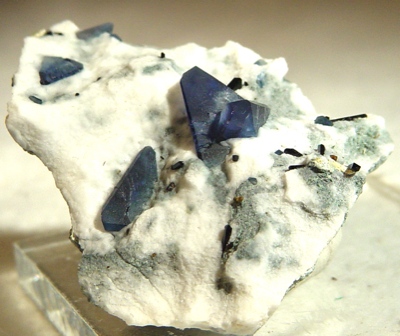
A single crystal of benitoite in matrix.
Photo by Lech Darski


This stone is usually found an unusual set of minerals including the minerals that make up its host rock. The associated minerals usually include naturolite, neptunite, joaquinite, serpentine and albite. Benitoite is very rare mineral that is only found that it few locations among them are places in San Benito County, California. It is also been found in Arkansas and Japan. It is usually found in glaucophane schist as inclusions in veins of naturolite.  Benitoite mining is allowed for a fee in the benitoite mine in the Clearwater management area in central California. Collecting is by appointment only!

This gemstone is typically colored various shades of blue although it can also appear as colorless or even have a yellowish caste.  Its crystals can vary from transparent to translucent with visible inclusions with a vitreous luster.
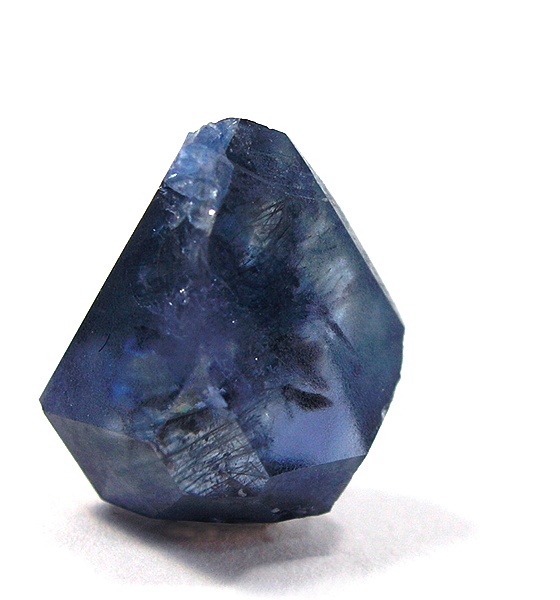
A single crystal of benitoite with no matrix.
Photo by Rob Lavinsky


When found its crystals are hexagonal; bar 6 m 2 that in crystal habits include six place dipyramid flattened shapes having a distinct triangle shape that is often modified by having minor faces.  At times it is also found as small grains.

Benitoite has no cleavage and its fracture is irregular.  Other distinguishing features are its hardness ranging from 6 to 6.5 on the Moh’s scale of hardness.  Its specific gravity is 3.6 making it denser then most other minerals making it capable of being separated by gravity methods such as panning.  The mineral also displays a white streak.

A faceted example of benitoite
Photo by Fastily


This mineral is counted among those that fluoresce under the influence of ultraviolet light displaying a blue light.  Minerals that are associated with benitoite include serpentine, neptunite, natrolite, joaquinite, sanbornite, taramellite, albite and fresonite. 

Benitoite gems are only found in three mines located in San Benito County, California where good to excellent crystals are found.  The only other occurrences are in Eocene aged sands in southwestern Texas along with another few localities in California.  These occurrences are only small grains found in sand.

Benitoite under ultraviolet light.
Photo by Parent Gery 


If you are searching for this mineral the best field indicators its crystal habit, the fact that it displays fluorescence in blue, its distinctive color, the minerals it is associated with and the locality.  The fact it is associated with bodies of serpentine suggests that it might be found in localities that have been identified as suture zones where geologists feel that serpentine is metamorphosed oceanic crust that has been caught up in earth movements associated with the collision of two continental plates,


Thursday, February 23, 2012

Almandine Garnets


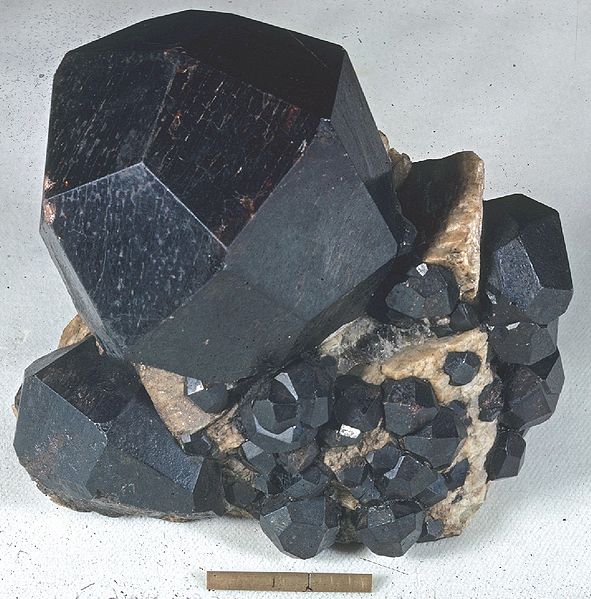
A cluster of almandine garnets in matrix.
Photo by Rock Currier
Almandine is a member of the garnet family that was known to the ancient Romans where it was pronounced “alabandicus” where it was known to Pliny the Elder. This was a stone that was either found near or worked at the town of Alabanda a town in Cariua in Asia Minor. In composition it is an iron aluminum garnet possessing a deep red color that inclines toward purple. Almandine as a stone entering the jewelry trade is either faceted or cut with a convex face en cabochon when it is then called a carbuncle. When the stone was viewed through a spectroscope in a strong light, it generally shows that has three characteristic absorption bands.

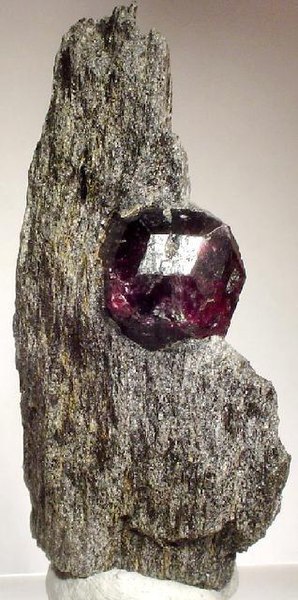
The stone is one end member of a solid solution series the other end up being the pyrope garnet that is magnesium rich rather than iron. The chemical formula for almandine garnets is: Fe3Al2Si3O12. The solid solution occurs when magnesium substitutes for the iron causing an increasingly rich pyrope composition. Almandine is the ferrous iron member of the class of garnet minerals that are important group of rock forming silicates that are the main rock forming minerals in the Earth's crust. Crystals of almandine are often seen in mica schist fillet very much like raisins in a pudding. This type of garnet crystallizes in the cubic space group Ia3d having a that a cell parameter of 11.512 Å at 100° Kelvin.

A gemmy red almandine garnet on a matrix of mica schist
Photo by Rob Lavinsky


Almandine can be found rather abundantly in gem gravels found in Sri_Lanka, but are actually pretty abundant in any stream gravel that is found adjacent to metamorphic or igneous rock. In this case almandine garnets are a constituent of the black sand that are classified as stream heavies. Sometimes almandine garnets are so abundant on beaches that they are mind commercially for their abrasive qualities.

In the gem trade almandine garnets have gone by many names among them are Ceylon ruby. If their color takes a violet tint the stone is sometimes called a Syrian Garnet. Large deposits of some especially fine album being garnets were found in the Northern Territory of Australia that were marketed for years as Australian rubies. An especially interesting variety of the stone that is found in stream gravel's in parts of Idaho show a star when they are cut, and marketed as star garnets.

A collection of jewlery in Kracow, Poland made from pearls, diamonds, almandine garnet and enamel.
Photo by S.F. Burgerer


As a mineral almandine is widely distributed throughout the world with fine rhombic crystals that are called to dodecahedra that are found in the schistose rocks wherever crystalline bedrock is found. In

One of the best localities in the United States is located at Gore Mountain in the Adirondack mountains of New York State at the town of North Creek. Some of the crystals that are found enclosed in gabbro are more than a meter across they are mined by the Gore Mountain mining company that crushes them for abrasives. Many of these garnets from this particular deposit are faceting grade and makes an extremely attractive gems.

Friday, July 29, 2011

Gemstone Occurrences in Rhode Island

This is an amethyst scepter like those found at Diamond Hill
Photo by Rob Lavinsky


There is a greenish mica schist found in Warwick that has embedded in it red almandine garnets. In East Warwick you can find purple almandine garnets embedded in a silvery mica schist. Jamestown has staurolite crystals embedded in phyllite. Garnet-staurolite bearing schist can also be found under the Jamestown Bridge,

A discovery of beryl was recently reported in the magazine Rock and Gem on the western side of Narragansett Bay in the vicinity of the Jamestown Bridge in the pegmatites found in the area. It was also found at the end of the Cliffwalk in Newport.  The largest crystal found in Newport was about 6 cm in length and 1 cm in diameter along with several other smaller specimens.

There have been moonstones reported on the beaches of Rhode Island that continue into eastern Connecticut.  One of the beaches in Rhode Island is actually called Moonstone Beach.

The state stone is bowenite a variety of serpentine of the sub variety antigorite that has often been classified as a semi-precious stone that is cut into polished slabs or cabochons.  The Maoris of New Zealand have also used bowenite to make axes.  This stone is associated with limestone and was originally found in Lincoln.

Amethyst has been from several localities in Rhode Island notably however from Diamond Hill in Ashaway, Hopkinton in Washington County.  This mineral is accompanied by several other varieties of quarts.  At times the amethyst from this locality is found as rare scepter specimens.

A variety of Jasper veined with chalcedony is found in several localities in Cumberland, Providence County.  Chalcedony has also been found at the Conklin Quarry in Lincoln and another locality is Diamond Hill in Ashaway.