Total Pageviews

Showing posts with label California. Show all posts

Monday, July 23, 2012

Finding Diamonds in California


Uncut diamonds


From the earliest days of the California Gold Rush diamonds were found in the tailraces of sluice boxes that were used for gold washing.  Diamonds were found not only in recent stream gravels but much older gravel that was buried under layers of lave and tuff from ancient volcanic activity as fossilized stream channels that ran along the mountains from north to south.  These stream channels indicated an ancient stream flow that was almost at right angles to the present day flow.

The biggest problem with California diamonds is there just are not enough to make going after them profitable. Most of the stones have been found as a result of gold washing operations in both present day streams and in the fossilized beds of earlier streams. Many of the diamonds were destroyed by the use of stamp mills used the breakup the gold ore retrieved from the fossilized streambeds. Their presence was noted as fragments seen in the gold ore. The diamonds that were recovered from ore were for the most part small or industrial grade diamonds.

As early as 1853 diamonds were discovered on top of Table Mtn. about thirteen miles north of Oroville on state Highway 70 close to the ghost town of Cherokee.  It was in the gold diggings surrounding the town that reportedly more then 300 diamonds were found most of them being of industrial grade.  Claims have been made that at the time this was the largest discovery of diamonds made in North America.  This has been exceeded with the discovery of several diamond producing areas in Canada.

Cherokee was the site of the only diamond mine in California, and it was here the first diamonds were found.  Mike Maher discovered a perfect blue diamond when he was cleaning out his sluice box in 1866.  Other diamonds were found here with one of them weighing six carets, but because gold was the primary concern it is unknown how many millions of dollars worth were discarded with the mine tailings produced by the hydraulicing for gold with high pressure jets of water that washed away the gold ore.  

The fact that diamonds do occur in California is well attested to in newspapers and scientific journals.  In some cases however it is readily apparent that many of these so-called diamonds were in fact quartz crystals that had become rounded because of stream action.  One such quartz crystal had been used as a marker in a game of marbles where it show several percussion marks that were the result of being hit by marbles.  A diamond would not show such percussion marks, but would rather cleave into pieces instead waiting to be found in the sluice boxes at work in the area.

Saturday, March 3, 2012

Benitoite the One of a Kind Gemstone


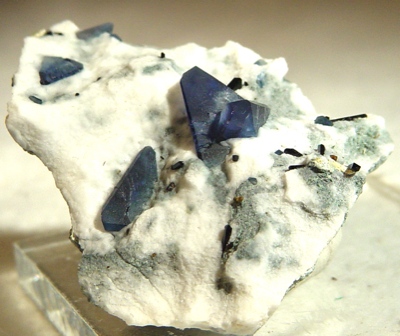
Benitoite in a matrix of neptunite from San Benito County, California.
Photo by Rob Lavinsky


Benitoite is a one-of-a-kind gem since it is only found in one place in California; it is also the state gemstone of California as of 1985.  The stone itself is a rare variety of barium-titanium silicate found in hydrothermally altered serpentine. Benitoite reacts under shortwave ultraviolet light fluorescing light blue in color.

As a mineral benitoite was described in 1907 by George D. Louderback who named it benitoite because it was found near the headwaters of the San Benito River of San Benito County, California. The stone was one of the first if not the first mineral to be studied under x-ray diffraction.

A single crystal of benitoite in matrix.
Photo by Lech Darski


This stone is usually found an unusual set of minerals including the minerals that make up its host rock. The associated minerals usually include naturolite, neptunite, joaquinite, serpentine and albite. Benitoite is very rare mineral that is only found that it few locations among them are places in San Benito County, California. It is also been found in Arkansas and Japan. It is usually found in glaucophane schist as inclusions in veins of naturolite.  Benitoite mining is allowed for a fee in the benitoite mine in the Clearwater management area in central California. Collecting is by appointment only!

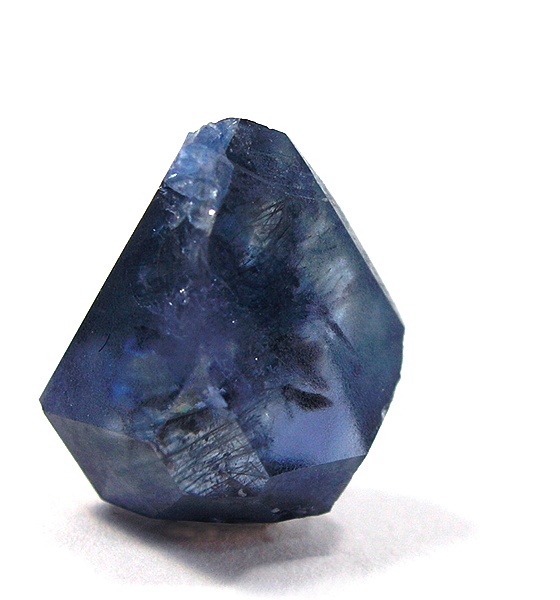
This gemstone is typically colored various shades of blue although it can also appear as colorless or even have a yellowish caste.  Its crystals can vary from transparent to translucent with visible inclusions with a vitreous luster.

A single crystal of benitoite with no matrix.
Photo by Rob Lavinsky


When found its crystals are hexagonal; bar 6 m 2 that in crystal habits include six place dipyramid flattened shapes having a distinct triangle shape that is often modified by having minor faces.  At times it is also found as small grains.

Benitoite has no cleavage and its fracture is irregular.  Other distinguishing features are its hardness ranging from 6 to 6.5 on the Moh’s scale of hardness.  Its specific gravity is 3.6 making it denser then most other minerals making it capable of being separated by gravity methods such as panning.  The mineral also displays a white streak.

A faceted example of benitoite
Photo by Fastily


This mineral is counted among those that fluoresce under the influence of ultraviolet light displaying a blue light.  Minerals that are associated with benitoite include serpentine, neptunite, natrolite, joaquinite, sanbornite, taramellite, albite and fresonite. 

Benitoite gems are only found in three mines located in San Benito County, California where good to excellent crystals are found.  The only other occurrences are in Eocene aged sands in southwestern Texas along with another few localities in California.  These occurrences are only small grains found in sand.

Benitoite under ultraviolet light.
Photo by Parent Gery 


If you are searching for this mineral the best field indicators its crystal habit, the fact that it displays fluorescence in blue, its distinctive color, the minerals it is associated with and the locality.  The fact it is associated with bodies of serpentine suggests that it might be found in localities that have been identified as suture zones where geologists feel that serpentine is metamorphosed oceanic crust that has been caught up in earth movements associated with the collision of two continental plates,