|
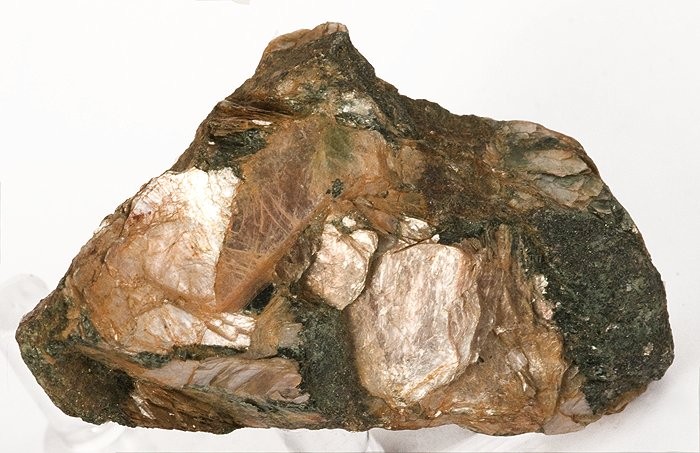
This is rhodonite of the type found in the Betts Mine it is also the state gem of Massachusetts
Photo by Phillipe Giabbanelli |
Massachusetts is another state that is sparsely supplied with gemstones although there are some exceptions one of which is the
Betts Mine in
West Cummington that produced some very fine
rhodonite for years.
The rhodonite accompanied by rhodochrosite is respectively manganese silicate and carbonate both are cut as gems.
Rhodonite is also the state gem of
Massachusetts.
Rhodonite was first discovered as
float from the glacier during the 19
th century where the American Gem Company part of
Tiffany & Co., became aware of the float.
They used the rhodonite for making knife and umbrella handles as well as dinnerware.
There is a place setting on display in the
American Museum of Natural History in
New York City made from rhodonite from
Massachusetts.
The deposit that is at the contact between the Hawley and
Savoy schists was developed by Anson Betts who mined the rhodonite for use as flux on welding rods and later mined it as a gemstone.
The mine was bulldozed shut after the death of Anson Betts and is now closed to collecting.
Rhodonite is still available from the site in the form of mine tailings where it is still collected.
Down the road from the rhodonite deposit to the east is the small
village of Lithia in the town of
Goshen where the mineral called
spodumene was mined in the late 1800s.
This is an area of LCT pegmatites where the first colored tourmaline was discovered in a quarry in the town of
Chesterfield in the early 1800s.
Goshen is the Dana type locality for the variety of beryl termed “Goshenite.” a colorless variety of beryl.
The same pegmatites also produce blue tourmaline, petalite and pollucite a cesium aluminum silicate mineral. Beryl has also been found in a pegmatite at Royalston in
Worcester County.
 |
This is margarite a rare form of mica on emery from the mines at Chester, MA. Emery is the black mineral that the margarite is hosted upon. Margarite is a brittle form of aluminum rich mica associated with emery deposits.
Photo by Rob Lavinsky |
The Chester Abrasives Co. in Chester used to produce emery from the mines west of Chester in about the area where the power lines cross US RT. 20 in a series of mines running north to south for a total of five mines. In the historical society of Chester there are four apothecary jars containing several pounds of ruby and sapphire crystals that were actually mined in the Cowee Valley corundum mines in Franklin NC operated by the Chester Abrasive Co. in the late 1900s. Although not mined in Chester they are at least worth a good look. There is an exposure of gem grade serpentine on the Middlefield Rd. on the right just as you are climbing out of the Westfield River Valley.
The Connecticut Valley offers a completely different suite of gemstones. The first place to look is in the gravels of the lower Deerfield River because it contains agates that have washed from the nearby trap ridges. The trap ridges themselves offer good deposits of amethyst and zeolites. Lanes Quarry in Westfield is the Dana Locality for datolite, however Lanes Quarry is closed to collectors as it is an active quarry.
 |
Datolite from Lanes Quarry in Westfield
Photo by Rob Lavinsky |
Garnets are found throughout the state wherever there are crystalline rocks although many of them are rotated making them useless as gemstones. Most of them are almandine garnets although in the Betts Mine that contains the manganese minerals rhodonite and rhodochrosite there are a rare variety of orange colored garnets called spessartine that are gemmy and suitable for faceting. Many of these garnets tend to be small, but there are some exceptions weighing several carets.
 |
Spessartine garnets of the type found at the Betts Mine in Plainfield MA where they occur with quartz.
Photo by Rob Lavinsky
|
A good source about rocks and gems in the state can be found at the many gem and mineral stores dotting the landscape. Most of these stores stock guidebooks that give specific localities for collection, and many of them are up-to-date,


.jpg/600px-Rhodonite_(Mineral).jpg)