Total Pageviews

Wednesday, June 27, 2012

Finding Gemstone Deposits:

Ruby crystal on calcite
photo by Rob Lavinsky

Gems have been prized for thousands of years, for their color, luster, durability, hardness and their high intrinsic value per volume.  They are found in all kinds of geologic environments of all ages from thousands of million years to recent times.  Gemstones are also found in all kinds of rocks ranging from igneous to metamorphic to sedimentary and are classified according to the environment where they were formed.  The deposits are rare because of the geological conditions needed to form them are exceptional.  For example, in order for the Emerald to form the beryllium from which it is made has to come in contact with chromium or vanadium.  These elements travel in entirely different geochemical circles that are the exception rather than the rule.

It is important to realize that like any other commodity, gems are subject to the laws of supply and demand.  Even though the demand for gems remains about the same the supplies are becoming depleted.  Many of the gems especially the colored variety are mined in Third World countries by artesianal methods, i.e. by hand.  In any of these countries the discovery of the new deposit often leads to a local prosperity, but many of these stones become involved in the illegal trade that is being used to finance terrorism.

Sapphire crystal
Photo by Rob Lavinsky


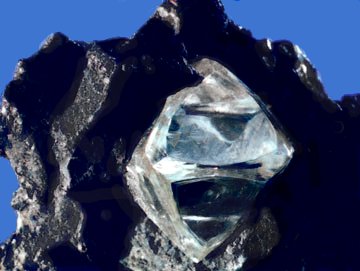
These deposits of gemstones are volcanic in origin and are formed deep within the Earth’s crust.  Gemstones from this origin have formed over 100 Km below the surface and are brought to the surface as the result of magma intrusions or lava flows.  Diamonds are one type of this deposit that has formed from 100 to 150 Km below the surface.  These gemstones are found in potassium rich stone called “kimberlite” that is brought to the surface in an explosive eruption that proceeds at near supersonic speeds.  There seems to be a rule known as Clifford's rule that these eruptions take place in Achaean terranes or come up through younger terranes overlying Achaean terrenes.  Kimberlite is quite rich in peridot and appears to be full of xenoliths that are torn off the walls of the magma channel.  A cross-sectional view of the kimberlite is like looking at a carrot.  The stone itself is quite soft and easily eroded away with the diamonds being carried away with the rest of the erosion products.

Diamonds are not the only product that is found in a magmatic deposit so are others stones such as sapphires and zircons.  Sapphires are also formed under some very specific geological conditions the most important one is a magmatic stone that is low in primary silicates such as basalt.  The sapphires form as crystals in the basalt and they're released as products of erosion.  Although they form in the basalt they are rarely mined directly.  Zircons are another example of a gemstone that is found in a magmatic deposit.  Once again these gemstones are not mined directly from the stone that are found as the products of erosion.  In geology zircons are thought to be forever and the oldest dated minerals in the world are some zircons that were found in Western Australia that were dated at 4.5 billion years old.  Zircons are used by geochemists worldwide for dating formations of different ages, and are highly effective in this use.

Some other gemstone minerals that are found in magmatic deposits include:
Peridot, gem quality olivine usually found in mantle xenoliths.
Labradorite, found as gem quality grains in some basalts.
Zircon, found as crystals in granite, basalt and the rarer carbonatites.
Apatite, found as crystals in carbonatites.
Garnets, found as crystals in basalts as xenocrysts and granite.
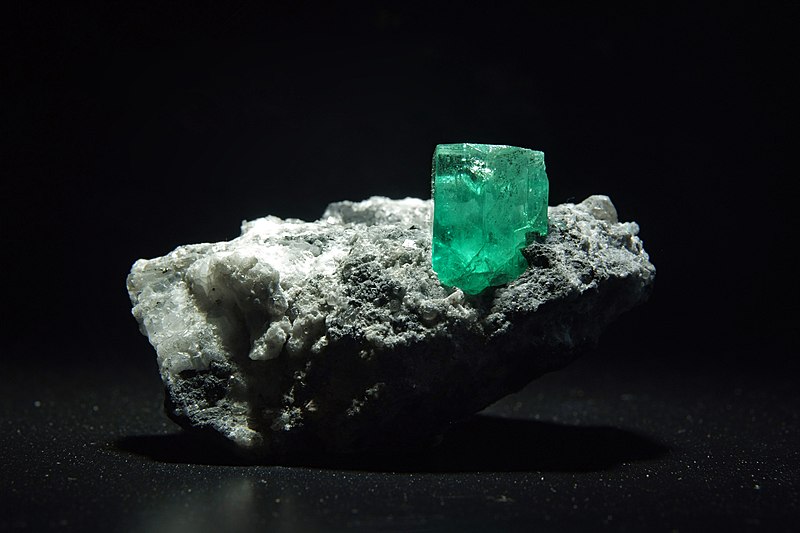
Emerald crystal on calcite
Photo by Eva Krocher


Pegmatites are hydrothermal deposits contain more different types of gemstones in any other rock.  These are formed from the volatile rich fluids that are found in pegmatites when they are formed.  In some geological circles pegmatites are called “Giant granite” because they have the same minerals as granite except the crystals of the individual minerals are much larger.  There are two different kinds of pegmatites simple and complex; most of the valuable minerals are found in complex pegmatites.  Although many of these minerals could be classified as gems other minerals found in pegmatites are the ores for rare metals such as niobium or rare earths. 

Depending on the fluids present when the pegmatite is solidifying different gemstones are deposited.  If the fluid is rich in fluorine topaz will be deposited.  A beryllium rich fluid will produce the mineral beryl in its many forms ranging from aquamarine, emerald, morganite, or heliodor.  Lithium rich fluid is another possibility depositing spodumene or other lithium rich minerals.  Pollucite is deposited from a cesium rich fluid.  In some cases the fluid is rich in several different elements producing “Tourmaline” a gemstone that is actually rarer them diamonds.  A manganese rich fluid will cause spessertine garnet to be deposited.

There are specific zones in a pegmatite where gemstones are found.  Many of them are found in cavities called “Vugs.”  The crystals formed in this environment are usually clear and well formed.  A deposit of this nature containing red and green tourmaline was discovered in the 1970s at Newry, Maine that was worth more then $8 million from a single vug as large as a bedroom.

There are other hydrothermal environments that are also capable of producing gemstones ranging from volcanic rocks to sedimentary rocks.  This is where one is likely to encounter agates, petrified wood, opal, amethyst as well as a whole plethora of gems.  Turquoise is another mineral deposited by hydrothermal waters.  It is copper phosphate and its beautiful sky blue botryoidal masses have been admired for over two thousand years.
Metamorphic deposits:


Diamond crystal in matrix - USGS


The only gem minerals normally found in metamorphic rocks are garnet, zoisite (variety tanzanite), rubies and emeralds.  Rubies are the red variety of the mineral corundum that is aluminum oxide.  These gems are found in cordierite rich gneiss as well as marble.  Sometimes rubies are carried up from the depths of the earth as xenocrysts in basalt.  Most of the world's emeralds are found in low grade carbonaceous schist in Colombia.  Other gemstones that occur in metamorphic rocks are iolite (the gem-quality lilac-purple variety of cordierite), titanite and kyanite.
Jade is another mineral that is found in high-pressure; low-pressure blue schist metamorphic rocks.  There are two entirely different minerals that are recognized as jade in the trade one of these as jadeite a compact variety of the mineral pyroxene, and the other is nephrite a compact variety of the mineral that is derived from tremolite.  Although these minerals are composed of common minerals it takes a very special environment for them to form.


Sedimentary deposits:


By far the most valuable gemstone found in sedimentary rock is precious opal.  The largest deposits of this mineral in the world are found in central Australia.  Other deposits are found in the United States and Mexico.  Most opal is found as a replacement for fossils.  Opal also occurs as replacement beds or blebs in sedimentary rock.  A good piece of opal showing good colors can be as expensive as a diamond.


Placer deposits:


In some placer deposits gemstones are relatively abundant particularly in areas where the local rocks are known to produce gemstones.  This is especially true in areas underlying by cordierite gneiss or marble.  Another area is where gemstone bearing pegmatites are abundant.  Because of their toughness and hardness gemstones that are eroded from their country rock tend to remain intact preserving the best gemstones.  The same rough and tough treatment these stones go under as a result of natural processes particularly running water the weaker and softer stones are broken up leaving behind the highest quality gemstones.  Most of the gemstones in the world are recovered from placer deposits.  In some cases the work of recovery can be quite primitive; in others the most modern technology and machinery is used.


References:


Mineralogical Association of Canada, Editor Lee A. Groat, Geology Of Gem Deposits, Short Course Series, Volume 37, Yukon Geological Survey, © 2007, Yellowknife, Northwest Territories
Gem Deposits, http://amonline.net.au/geoscience/earth/gem.htm
Geology of Gem Deposits, Mineralogical Association of Canada, Editor Lee A. Groat, http://www.mineralogicalassociation.ca/doc/promo_SC37.pdf  Volume 37 © 2007

Saturday, May 19, 2012

Minerals of Litchfield County, Connecticut

Platy ilmenite crystals encrusted on feldspar from Litchfield, Connecticut
Make an offer over $2,500
itchfield County, Connecticut has a very complex geology and a wide variety of minerals that ti date have been largely out of scope to the mineral collector.  It is our aim to make some of these minerals available to the collector.  Our first selection of minerals comes from a long abandoned mine in Litchfield , Connecticut that according to the records produced "soapstone" during the 1700s. Some of the minerals found at this locality include such world class specimens as kyanite, ilmenite, magnetite, quartz and many others.  There are over two-hundred minerals that have been identified in the county that was the home to over two-hundred mines in the past that have been long since abandoned and mainly forgotten.
James Dwight Dana in a painting by Danial Huntington - 1858

It is possible our long abandoned mine site is a Dana Locality because of some mineral specimens that were collected in Litchfield that are now in the collection of the Yale Peabody Museum in New Haven, Connecticut including ilmenite of which our locality still has world class specimens in sizes ranging from mere chips to boulders weighing up to several hundred pounds.  The size range of the specimens range from micro specimens to boulders that can be used in landscape arrangements.

We are making these specimens for sale to the mineral collector.  You can contact us at: geotekllc@gmail.com for prices and additional information.

Below are illustrations of some of the specimens we have for sale:
This is a large specimen of staurolite in feldspar from Litchfield, Connecticut
Make an offer more then $150
Schorl wisps in quartz from the Whodunit Mine in Litchfield, CT
Price $25.00
Goethits pebble from an alluvial deposit in Salisbury, CT
Price $12,00
Stepped layers of ilmenite is feldspar from the Whodunit Mine in Litchfield, CT
Price $25.00
Platy ilmenite crystals in feldspar from the Whodunit Mine in Litchfield, CT
Price $50.00

This is a sample of kyanite from our locality in Litchfield, Connecticut.  This is a large specimen as can be seen by the quarter coin used to illustrate its size.  This specimen is truly spectacular with a mere photograph failing to do it justice.
Price $50

Blue kyanite in smoky quartz from the Whodunit Mine in Litchfield, CT
Price $45.00

About the Whodunit Mine we still don't know what they were mining except it is in a highly mineralised zone that contains many mineral specimens of all sizes and old artifacts.  


We will display more specimens that are for sale as they are prepared and photographed.


For further information about these specimens please contact us at geotekllc@gmail.com


Saturday, March 10, 2012

Alabaster the Non-Gemstone


Church walls and gold leaf decorations made from calcitic alabaster in Poland
Photo by Beemwej


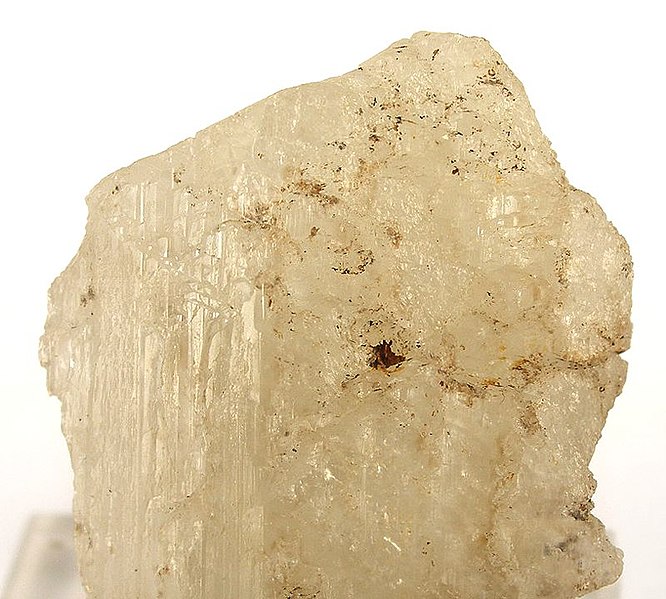
There are two distinct minerals that are called alabaster, one of them is calcium sulfate commonly called gypsum or anhydrite.  The other is a variety of calcium carbonate that is commonly known as limestone or marble.  Of these two the former is the alabaster of today, and the latter is the alabaster of the ancients.  Both of these materials are easy to work with, and have an attractive appearance making them favorites for small carvings and other works of art.

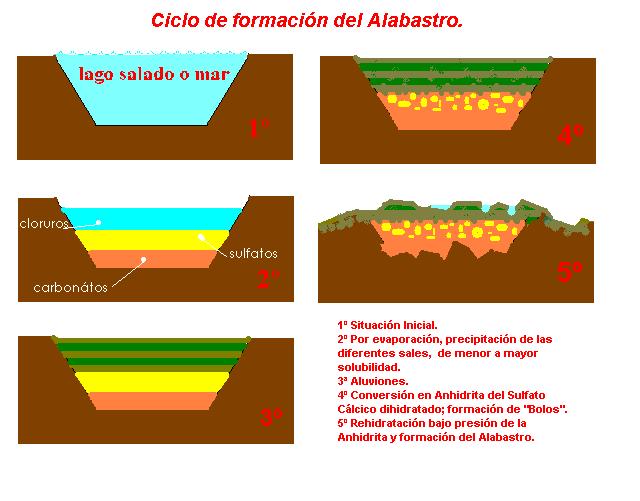
The formation of alabaster explained in Italian
by Miguel


Since we've already established that there are two different types of alabaster the best way to distinguish between them is by their relative hardness. The first type that is composed of gypsum is so soft you can scratch it would your fingernail because I have a Mohs hardness of 1.5 to 2. The calcite variety of alabaster is too hard to be scratched in this way having a Mohs hardness of 3 although you can scratch it with a knife blade. Because it is a carbonate it will effervesce when a drop of hydrochloric acid is placed on its surface. When the gypsum type of alabaster has a drop of mass placed on virtually nothing happens.

An alabaster lamp
Photo by David Dennis


Although alabaster can come in many different colors most people think of it as white, so much so that it has entered the language as a metonym for weight objects. In this sense it is often used to describe “alabaster skin” that means very light and quite transparent that is derived from the use of alabaster in building tombs.

Although alabaster is essentially too soft for use as a gemstone it often finds uses as a decorative stone for making different kinds of statuary and other objects de art. A very common use today is making the basis for electric lamps.

A piece of raw alabaster
Photo by Ra'ike


The word alabaster itself is derived from middle English as well as several other languages including Greek. The word was used to identify a type of vase made of alabaster. There is a certain amount of evidence that the word can be traced all the way back to ancient Egypt where it was named after the town Alabastron where it was commonly found. It was Alabastron where it was originally quarried, however the name of the mineral is still obscure.

The so-called “Oriental” alabaster was highly esteemed by sea ancients for making such items as small perfume bottles small point that basis that were called alabastra. This thing has also been suggested as a possible source of the mineral name. The craftsmen of this stone in ancient Egypt often used alabaster for use in candlestick chart and various other sacred and sepulchral objects. In the Sir John Soane’s Museum in London is a sarcophagus that was carved from a single block of translucent calcite alabaster that was mined Alabastron.

An alabaster carver at work.
Photo by Zyance


Both types of alabaster are essentially evaporative minerals in the case of the gypsum variety it is the mineral that evaporates from seawater before salt,  In the case of the calcitic variety is has its origin from the evaporation of lime water that has reached saturation.  Any further water loss causes the lime to come out of solution where it is deposited. A lot of this type of alabaster is found on the walls and floor of caves where it also forms the formations we call stalactites and stalagmites.

Ancient alabaster vases
Louvre Museum, Paris, France


Although most people think of alabaster as a white mineral it is also found in many other colors particularly when it is stained by mineral salts. Iron is the most common of these although copper and manganese also one of their own suite of colors to the stone. If you cut large blocks of this material into thin sheets they can be used as translucent windows such as those found in the Beineke Library of Rare Manuscripts and Books at Yale University. Throughout the ages how a master has been used to make many beautiful objects and will continue to do so into the future.

Thursday, March 8, 2012

Beryl the Genstone of Many Colors


Beryl crystals from Pakistan var. aquamarine
Photo by Gia Cassa


As a mineral beryl is beryllium aluminum cyclosilicate possessing the chemical formula Be3Al2(SiO3)6­.   As a gem it comes in many colors although pure beryl is colorless of the variety goshenite named after the town of Goshen in the central Berkshires of Massachusetts its type locality.  It is tinted by different colors causing it to be colored blue, green, red, yellow and white.  This is a mineral that is usually found in pegmatites although it is often found in biotite schists and in intruded limestone.  A rare occurrence is found in Utah called bixbite that has been colored red by manganese as an impurity.  Other gems in this family include aquamarine, emerald, green beryl, heliodor and morganite. 

An emerald crystal from Colombia
Photo by Gery Parent


Aquamarine is the color of sea water a bluish green with green beryl as a sub-order of aquamarine.  Emerald of course is bright green that is usually found in heavily intruded limestone although some occurrences are in biotite schist.  Heliodor is the yellow variety of beryl that is sometimes galled “golden beryl.”  Morganite is sometimes found associated with both aquamarine and golden beryl, bit is differentiated by its pink color.  Red beryl is also called bixbite or red emerald because of its red coloration.  Of all the beryl’s bixbite is the rarest, but only occurs in small crystals allowing gems cut from it to be lass then 5 carets in weight,

Golden beryl or heliodor
unknown


Beryl aside from its use as a gem is also the ore of beryllium where it occurs in granitic pegmatites.  One such crystal was a giant that occurred in the Bumpus Quarry in Albany, Maine that was about 5.5 meters long by 1.2 meters in diameter that weighed around 18 metric tons.  The largest crystal of any kind of mineral was found in Madagascar is a beryl crystal that was 18 meters long by 3.5 meters in diameter.  That is the size as the boiler on a steam locomotive.

A crystal of red beryl var. bixbite from Utah
Photo by Rob Lavinsky


Beryl is found on all the continents wherever crystalline igneous or metamorphic rocks are found.  The gems are found in the core of pegmatites where at times terminated crystals are found growing into cavities or vugs in the rock.  Some beryl like the emeralds found in Columbia are found in a peculiar black limestone that has been intruded with granite that contain in addition to the beryl an abundant amount of pyrite that certainly predates the formation of the emerald crystals.. Beryl is also found associated with biotite schist.   Many of the emeralds found in the Ural Mountains of Russia are this type of deposit.  The emeralds found at the Crabtree Corners deposit in North Carolina are also an example of this kind of deposit.

A crystal of morganite on albite and quartz.
Photo by Rob Lavinsky


One of the most important deposits of aquamarine in the United States is found in the Maryall district of New Milford, Connecticut where they occur in a large pegmatite that that was originally mined for feldspar and mica.  This mine has produced some fine specimens of both aquamarine and heliodor beryl including a 44 carat heart on display in the American Museum of Natural History in New York City.  It is also known to produce many other minerals especially large garnets and uranium minerals.  

Amblygonite one of the Gemological Garbage Cans


It is easy to see how amblygonite is often mistaken for other minerals this specimen mimics milky quartz
Photo by Ra'ike


As a mineral amblygonite is classified as a fluorophosphate with a chemical formula of (Li, Na)AlPO4(F, OH) that is composed of sodium, lithium, aluminum, phosphate, fluoride and hydroxide. This is a mineral occurs in pegmatite deposits were this easily mistaken for albite or other feldspars. It is readily distinguished by its density, cleavage and flame test for lithium. Amblygonite forms a solid solution series with montebrasite that is the low fluorine member of the series.

Faceted amblygonite from Brazil.
Photo by Ra'ike


This is a mineral found in LCT type pegmatites, high-temperature tin veins and greisens where it is found with spodumene, apatite, lepidolite, tourmaline and other lithium bearing minerals. It is often been used as an ore of lithium The chief commercial sources have been the deposits in California and France where the mineral contains about 10% lithium. 

A single crystal of faceting grade amblygonite.
Photo by Rob Lavinsky


The mineral amblygonite was originally discovered in Saxony, Germany by August Breithaupt in 1817 and named by him from the Greek words amblus (blunt) and gouia (blunt) because there is an obtuse angle between its cleavages.  Later the same mineral was found at Montebras, France and Hebron, Maine. Because there are slight optical differences in amblygonite found at these differing localities they are also called montebrasite and hebronite after the localities where it has been found.  The mineral is also found in large quantities in Pala in San Diego County, California as well in the Black Hills of South Dakota.  To date the largest single crystal of amblygonite measured 7.62 x 2.44 x 1.83 meters that weighed about 102 tons.

Amblygonite variety Montebrasite
Photo by Rob Lavinsky


When its transparent amblygonite is faceted into gemstones where it is set into jewelry, however because it is prone to breakage and abrasion as well as displaying hardness problems as well as toughness it is rarely mounted into jewelry.  This stone when it is cut often finds its way into collections as unmounted stones. The principle sources of this gemstone are Brazil and the United States however other countries have also produced faceting grade amblygonite such as Australia, France, Germany, Namibia, Norway and Spain.  Most of the gem quality amblygonite crystals that have a yellowish caste are found in pegmatite cavities.

Saturday, March 3, 2012

Benitoite the One of a Kind Gemstone


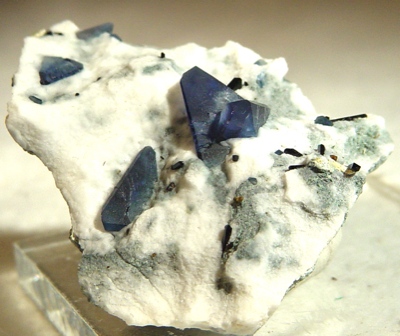
Benitoite in a matrix of neptunite from San Benito County, California.
Photo by Rob Lavinsky


Benitoite is a one-of-a-kind gem since it is only found in one place in California; it is also the state gemstone of California as of 1985.  The stone itself is a rare variety of barium-titanium silicate found in hydrothermally altered serpentine. Benitoite reacts under shortwave ultraviolet light fluorescing light blue in color.

As a mineral benitoite was described in 1907 by George D. Louderback who named it benitoite because it was found near the headwaters of the San Benito River of San Benito County, California. The stone was one of the first if not the first mineral to be studied under x-ray diffraction.

A single crystal of benitoite in matrix.
Photo by Lech Darski


This stone is usually found an unusual set of minerals including the minerals that make up its host rock. The associated minerals usually include naturolite, neptunite, joaquinite, serpentine and albite. Benitoite is very rare mineral that is only found that it few locations among them are places in San Benito County, California. It is also been found in Arkansas and Japan. It is usually found in glaucophane schist as inclusions in veins of naturolite.  Benitoite mining is allowed for a fee in the benitoite mine in the Clearwater management area in central California. Collecting is by appointment only!

This gemstone is typically colored various shades of blue although it can also appear as colorless or even have a yellowish caste.  Its crystals can vary from transparent to translucent with visible inclusions with a vitreous luster.

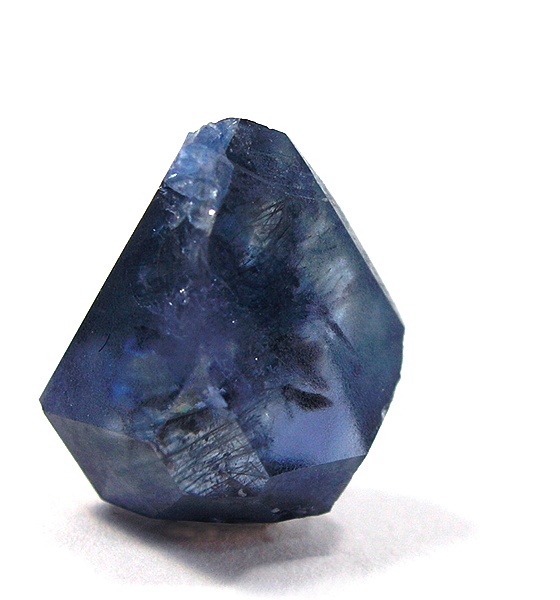
A single crystal of benitoite with no matrix.
Photo by Rob Lavinsky


When found its crystals are hexagonal; bar 6 m 2 that in crystal habits include six place dipyramid flattened shapes having a distinct triangle shape that is often modified by having minor faces.  At times it is also found as small grains.

Benitoite has no cleavage and its fracture is irregular.  Other distinguishing features are its hardness ranging from 6 to 6.5 on the Moh’s scale of hardness.  Its specific gravity is 3.6 making it denser then most other minerals making it capable of being separated by gravity methods such as panning.  The mineral also displays a white streak.

A faceted example of benitoite
Photo by Fastily


This mineral is counted among those that fluoresce under the influence of ultraviolet light displaying a blue light.  Minerals that are associated with benitoite include serpentine, neptunite, natrolite, joaquinite, sanbornite, taramellite, albite and fresonite. 

Benitoite gems are only found in three mines located in San Benito County, California where good to excellent crystals are found.  The only other occurrences are in Eocene aged sands in southwestern Texas along with another few localities in California.  These occurrences are only small grains found in sand.

Benitoite under ultraviolet light.
Photo by Parent Gery 


If you are searching for this mineral the best field indicators its crystal habit, the fact that it displays fluorescence in blue, its distinctive color, the minerals it is associated with and the locality.  The fact it is associated with bodies of serpentine suggests that it might be found in localities that have been identified as suture zones where geologists feel that serpentine is metamorphosed oceanic crust that has been caught up in earth movements associated with the collision of two continental plates,


Friday, March 2, 2012

Azurite Hydrous Copper Carbonate a Blue Gem.


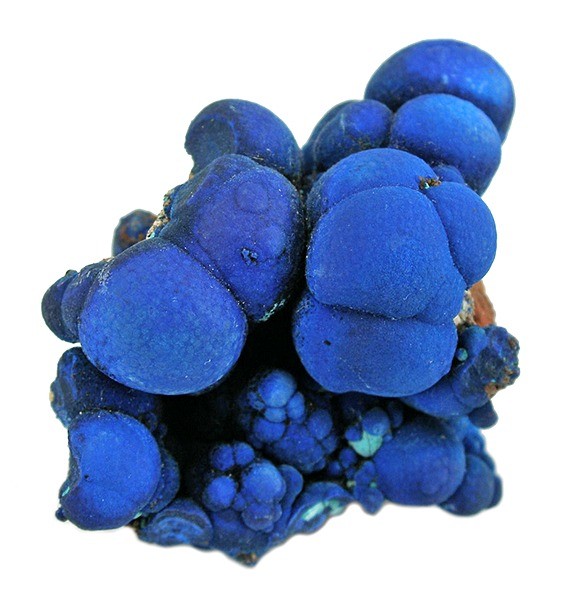
Botrydoil Azurite from the Apex Mine of Utah.
Photo by Rob Lavinsky


Azurite is one of the lesser known copper ores that is produced by the weathering of copper deposits. The mineral is also known as chessylite named after the Chessy-les-Mines near the city of Lyon in France. This mineral has been known to the ancients and is mentioned in Pliny the Elder’s, Natural History.  Because of its deep blue color has also been used as a pigment that is a deep blue color. Azurite is usually found in the desert where the low humidity causes its cousin malachite to lose water.  This is where it is often found in the company of its cousin malachite.  Both minerals are essentially the same copper carbonate except azurite contains more water in its crystals.  Over time this water will evaporate causing the azurite to change to malachite.

Typically azurite crystals are monoclinic that when they are large enough to be seen will appear is dark blue prismatic crystals. In nature azurite crystals are massive to nodular with some of them forming stalactitic masses. Any specimen of azurite over time will lighten in color as its surface retrogrades in the malachite. The mineral is soft with a Mohs hardness of 3.5 to 4. It displays a specific gravity ranging from 3.77 to 3.89. The mineral azurite is destroyed by the application of heat losing both carbon dioxide and water forming a type of black powdery copper oxide. A drop of acid placed on the specimen will cause it to effervesce like any other carbonate.

Azurite and malachite
Photo by Rob Lavinsky


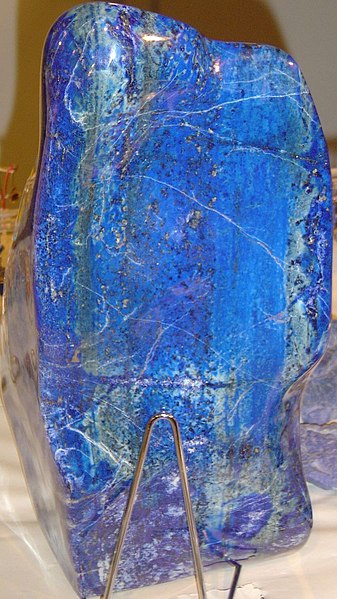
Some of the earliest uses of azurite are a blue pigment in artist’s paints. In this use it was finely ground, and then mulled with linseed oil and turpentine. The mineral is capable of producing many different shades of blue depending upon the fineness to which it is ground. When it is mixed with oil, as in oil paints it turns slightly green. On the other hand if it is mixed with egg yolk it turns a gray green. In older paintings the azurite has turned into malachite displaying a greenish color. Many times what was azurite was mislabeled as lapis lazuli that in times past was a name that was applied to many other blue pigments. True lapis lazuli that was used as another blue pigment came primarily from Afghanistan during the Middle Ages. Azurite was a common mineral found in Europe in the same timeframe.

Lapis Lazuli, notice the difference in color from azurite.


There were sizable deposits of azurite that were mined near Lyons, France during the Middle Ages. Azurite was also mined during the 12th century in Saxony and the various silver mines that were located there.

If azurite is heated it turns black whereas the more expensive natural ultramarine remains blue when it is heated. If the mineral is gently heated it produces a deep blue pigment that is often used by the Japanese in some of their painting techniques.

Azurute surrounded by malachite.
Photo by Rob Lavinsky


Occasionally azurite finds uses beads and other types of jewelry; it is also used as a decorative stone. The thing that keeps it from being used more commonly as a gemstone is its softness and the fact that it weathers easily reverting back to malachite.

.